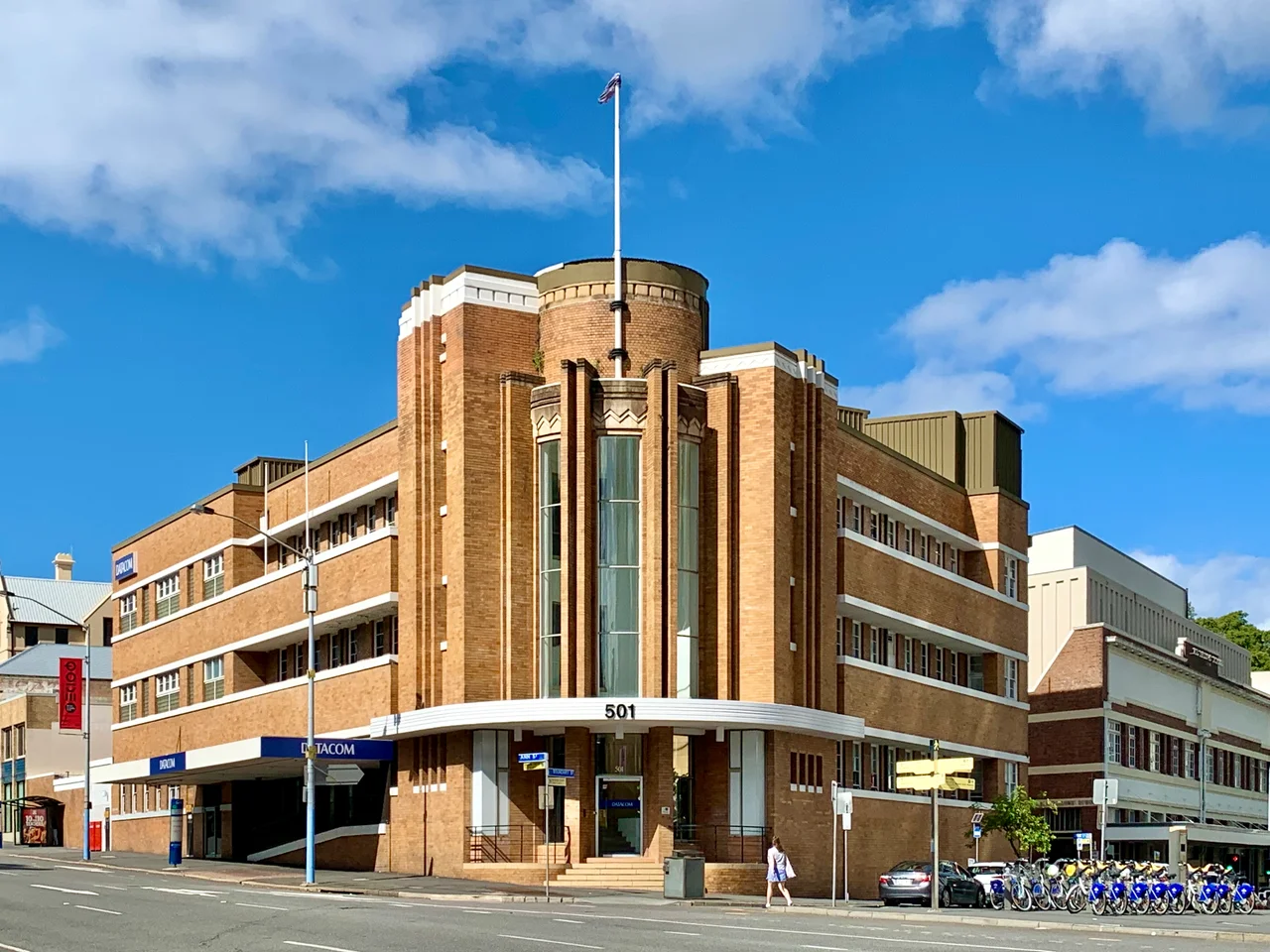

Queensland Brewery Company Building
It went up at the wrong moment and looked like the future anyway. In 1942, with the Pacific War at Australia's doorstep and military convoys rolling through Brisbane, the Queensland Brewery Company finished a headquarters on the corner of Ann and Boundary Streets that broke every rule the city's commercial architecture lived by. A photograph from that July catches a parade of army vehicles passing beneath it. Where the buildings around it stood square and ornamented, this one curved. Its rounded entry tower, then sheathed in glass brick, rose like the prow of a ship, and Brisbane had never seen a commercial building quite so confident about being new.
An Architect Ahead of the Street
The design was the work of Herbert Stanley Macdonald, of the firm Addison and Macdonald, and it was a deliberate departure. Macdonald fused two modern currents that rarely met on a Queensland street: the assertive curves and zigzag energy of Art Deco, and the cool horizontal lines of the Functionalist movement, with its plain geometry, pale surfaces, and broad sheets of glass. Horizontal strip windows band the two street facades and run them flat and fast around the corner, where the vertical tower interrupts them with a chevron motif spaced around its upper portion. Macdonald even reached for materials Brisbane barely knew, glass brick for the tower and synthetic stone for the original signage. Both have since been stripped away, but the gesture marked him as one of the men who carried the European Modern Movement into Queensland.
Beer, Then Insurance, Then Savings
Behind the showpiece front it was a working building, and a busy one. The brewery split it cleanly: administrative offices took half the ground floor and the floor above, while the rest held cellars, a wine and spirits department, a cooperage where barrels were made and mended, and the loading docks that kept the trade moving. It replaced the company's older base at Queen Street, Petrie Bight, and served the brewers until February 1966, when the Royal Automobile Club of Queensland bought it and turned cellars into customer-service counters and board rooms. The RACQ years gave way to others. The building passed to a credit union in 1980, and Credit Union Australia took ownership in 1983, lending the place two of the alternate names it still answers to.
What the Renovations Left Behind
Time and new owners took a toll, and part of the building's story is honest about loss. The glass blocks of the corner piece were swapped for curved plate glass. Most of the original timber-veneer partitioning in the offices is gone. Yet the bones hold. Step into the entry and you find a three-storey void, asymmetrical because a second doorway opens parallel to Ann Street, its ceiling carrying a decorated cornice and a single vertical light fitting hung down the centre. Plaster scored to imitate blockwork climbs the stairwell, where polished timber handrails ride a metal balustrade. The passenger lift survives, largely intact, still doing the job it was installed to do more than eighty years ago.
A Rare Survivor on the Register
Heritage assessors do not hand out the word rare lightly, and they used it here. When the building was added to the Queensland Heritage Register on 21 October 1992, the listing called it a relatively rare example of a landmark building with Art Deco embellishments, and singled out Macdonald's role in introducing the Functionalist style to the state. Its value, the register noted, lies partly in how shrewdly it works its corner, presenting two strong faces to two streets and resolving them in that rounded tower. Across from Centenary Place, in a Fortitude Valley that has changed around it many times over, the old brewery still turns its prow to the intersection, a small monument to the moment Brisbane decided modern could look like this.
From the Air
The Queensland Brewery Company Building stands at 27.462 degrees south, 153.032 degrees east, on the corner of Ann and Boundary Streets in Fortitude Valley, just northeast of the Brisbane CBD and a short way back from the river. It is a low, three-storey landmark rather than a tall one, so from the air it reads less as a tower than as a distinctive rounded corner opposite the open green of Centenary Place. Use the curve of the Brisbane River through the CBD and the grid of the Valley as orientation. Brisbane Airport (ICAO YBBN) is about 11 kilometres to the northeast, and Archerfield (YBAF) roughly 12 kilometres to the southwest. Clear winter days offer the cleanest sightlines over inner Brisbane; summer afternoons bring storm build-up and haze.
Nearby Stories
- Redcliffe Peninsula 2.7 km away
- Tamborine National Park 12 km away
- Cressbrook Homestead 27 km away
- Main Range National Park 31 km away
- 2010-2011 Queensland Floods 38 km away
- Cape Byron 96 km away
- Cape Byron Light 126 km away
- HMS Porpoise (1799) 588 km away