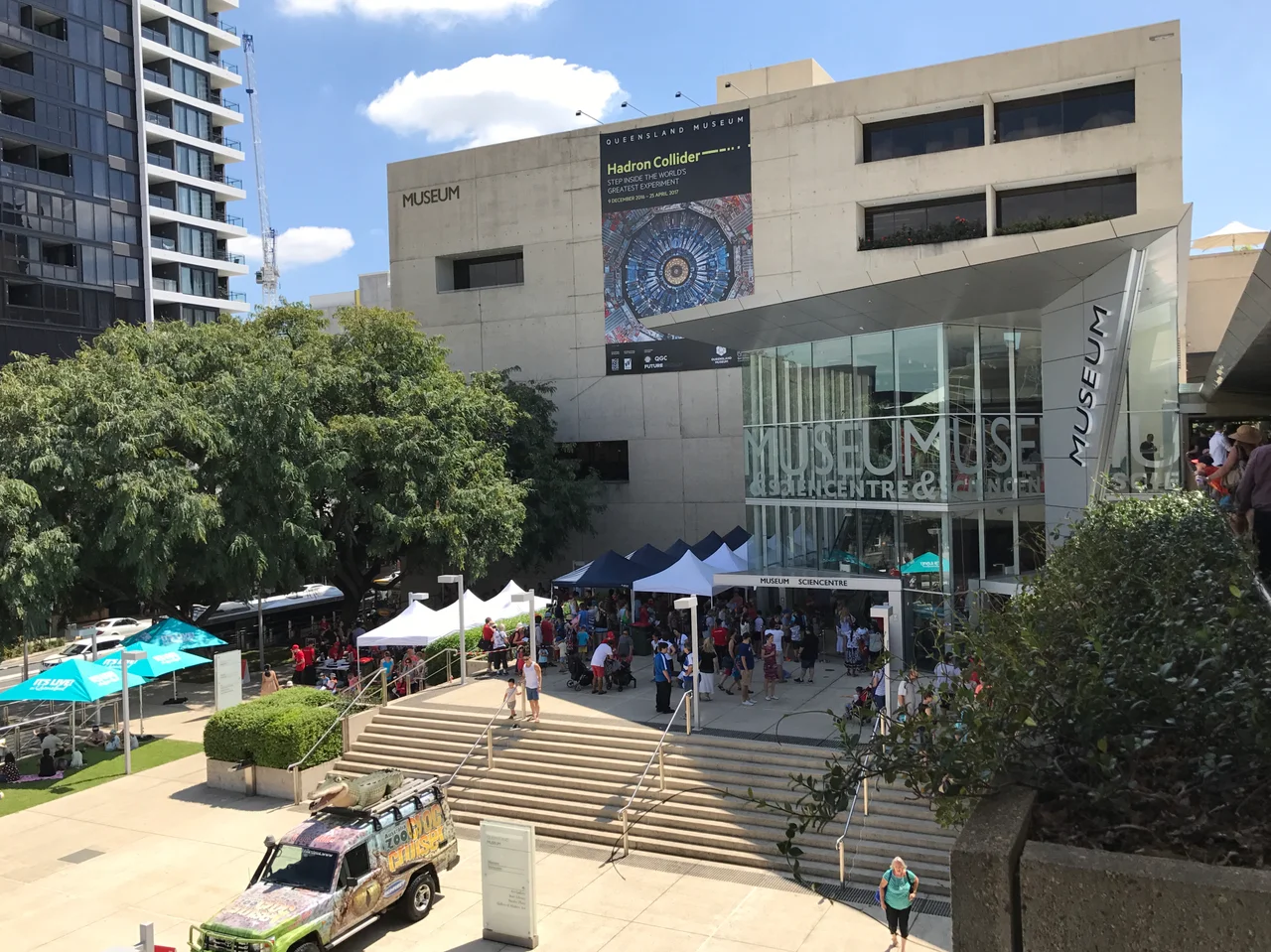

Queensland Museum
Look up, and the whales are flying. Inside the Queensland Museum at South Bank, life-sized models of whales hang from the ceiling of a soaring hall while their recorded calls roll through the space, so that visitors below stand on the floor of an imagined ocean. Look down again and the floor belongs to a dinosaur. A replica of Muttaburrasaurus, more than five metres long, holds the centre of the prehistory gallery, the home-grown giant that Queenslanders simply call Mutt. It is that kind of museum, where you crane your neck and then drop your gaze and somehow both views are full.
The Dinosaur Queenslanders Dug
Mutt has a real backstory. In 1963, a grazier named Doug Langdon found fossil bones in the dry country near the town of Muttaburra, in central Queensland. The museum's palaeontologists studied them and, in 1981, described a new dinosaur: Muttaburrasaurus langdoni, named for the place it was found and the man who found it. It was an ornithopod, a member of the plant-eating, "bird-footed" group, and one of the most complete dinosaur skeletons ever unearthed in Australia at the time. The state took it to heart. In 2023, the Queensland Parliament made Muttaburrasaurus the official state fossil emblem, a piece of deep time formally adopted as a symbol of the modern state, and its cast still anchors the museum's Dinosaurs Unearthed gallery.
The Last of Its Kind
Not every treasure here is millions of years old. In a quieter corner sits Mephisto, a hulking, riveted German tank, the only surviving A7V from the First World War anywhere on Earth. The Germans built fewer than two dozen of these machines, and Australian and Allied troops captured this one near the French village of Villers-Bretonneux in 1918, hauling it home as a trophy of a war that cost the country dearly. To stand beside it is to stand beside the men who took it, and the far greater number who did not come back. Mephisto has become one of the museum's best-known objects precisely because it is singular: a survivor that outlived its own kind, kept and cared for on the far side of the world from the fields where it fought.
Sixteen Decades of Collecting
The museum has been gathering Queensland since 1862, when the Queensland Philosophical Society founded it, with the naturalist Charles Coxen among its principal movers. Its early holdings, just over six thousand objects, lived in borrowed rooms, starting in the windmill on the hill above town and later in a purpose-built home on William Street. It has moved several times since, settling at South Bank in 1986 as part of the Queensland Cultural Centre, and in 2023 it added Kurilpa, a name from the Aboriginal people of this riverbend, to its own. The collection has grown past 15 million items, spanning natural history, science, and the cultural heritage of Aboriginal, Torres Strait Islander, and Pacific peoples. Its medal for scientific achievement has gone to figures from David Attenborough to the conservationist Steve Irwin.
Returning What Was Taken
Part of the museum's modern work is undoing the harm of its own past. Between 1870 and 1970, like museums across the world, it collected the ancestral remains of Indigenous Australians, taking the dead from communities that never gave them up. Since the 1970s the museum has run a program to return and rebury those ancestors, working with the communities they belong to. As of late 2018 the remains of 660 Aboriginal and Torres Strait Islander people still waited in a dedicated, restricted room at the South Bank site, held in trust until they could go home. It is slow, careful work, an institution acknowledging that some things in its keeping were never rightfully objects at all, but people, owed a return.
From the Air
The Queensland Museum sits at 27.473 degrees south, 153.017 degrees east, on the South Bank of the Brisbane River within the Queensland Cultural Centre, immediately beside the Queensland Art Gallery and linked by a pedestrian bridge to the Performing Arts Centre. From the air it is part of the low, flat-roofed Cultural Centre cluster between the river and the green ribbon of South Bank Parklands, just upstream of the Victoria Bridge. Brisbane Airport (ICAO YBBN) lies about 12 kilometres to the northeast, and Archerfield (YBAF) roughly 10 kilometres to the southwest. The river's bend through the CBD and its bridges are the clearest landmarks. Dry winter mornings give the sharpest visibility over the city; in the summer wet season expect afternoon haze and storm cloud.
Nearby Stories
- Redcliffe Peninsula 2.7 km away
- Tamborine National Park 12 km away
- Cressbrook Homestead 27 km away
- Main Range National Park 31 km away
- 2010-2011 Queensland Floods 38 km away
- Cape Byron 96 km away
- Cape Byron Light 126 km away
- HMS Porpoise (1799) 588 km away