
RAF Hell's Mouth
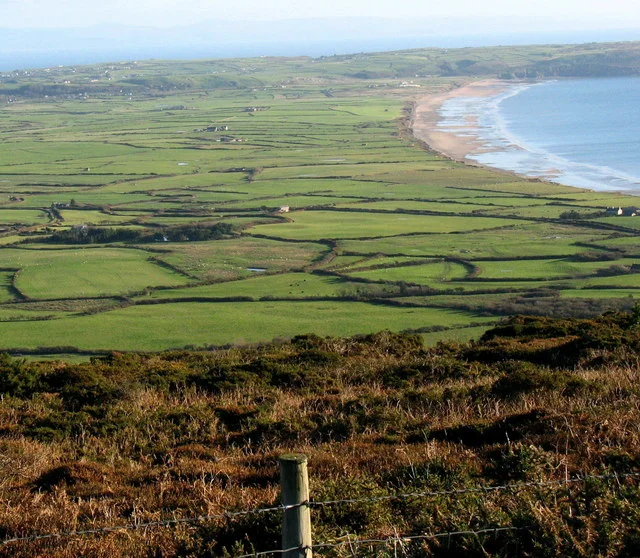
The name was already a warning before the RAF ever arrived. Welsh sailors had long called the south-facing crescent of Porth Neigwl 'Hell's Mouth' for the way it swallowed ships - a great open bay on the underside of the Llŷn Peninsula, exposed to every gale that came howling up out of the Irish Sea. In 1937 the Air Ministry decided that a coast so hostile to mariners was perfect for teaching young airmen how to drop bombs and fire guns at the sea. The trainees and the targets shared the same beach.
Compulsory Purchase
The Air Ministry took seven farms and the entire seven-mile beach by compulsory purchase, sweeping from the slopes of Mynydd Rhiw down to Cilan Head. The grass strip was laid down beside the dunes in 1937 as an outpost for No. 5 Armament Training Camp, headquartered ten miles north-east at RAF Penrhos. The first crews lived under canvas. Workshops went into Nissen huts, and three Bellman hangars eventually rose on the south-east corner of the field. The whole arrangement was deliberately makeshift: a place to come, to fire, to leave. Pilots flew in for month-long detachments, dropped their smoke bombs, and rotated home.
Anchored Rafts and Canvas Sheets
The targets were almost absurdly modest for what the war would soon become. Out in the bay a couple of anchored rafts rode the swell, and trainees aimed eight-and-a-half-pound smoke bombs at them from biplanes - Hawker Harts, Demons, Audaxes - the open-cockpit fighters and light bombers of an earlier age. Live bombs had to be dropped beyond the three-mile limit. For air gunnery, ten-square-foot canvas sheets along the beach gave the gunners something to aim at. A Westland Wallace, and later a Hawker Henley, towed drogues across the sky so air-to-air firing could be practised without endangering any aircraft except, very occasionally, the tow plane itself.
A Railway for Wooden Aircraft
By July 1940 something stranger had appeared between the hangars and the sea: a narrow-gauge railway in an oval loop, built specifically so trainee gunners could shoot at a moving target. A motorised flat truck carried a wooden model of an aircraft along the rails, pulled by a pulley system driven by a JAP V-twin motorcycle engine. From a replica gun turret on the dunes, trainees tracked the model and opened fire. The arrangement worked so well that visiting USAAF officers came to study it. Observers in three towers - one in the south-west corner, one in the middle of the camp, one in the far north-west - watched smoke bombs hit the sea and recorded each splash on a fixed brass ring, calling out the compass bearings.
The Polish Wellington
By 1941 the RAF's operational aircraft had outgrown what Hell's Mouth could teach them. The grass strip was extended and reopened as a relief landing ground for the No. 9 (Observers) Advanced Flying Unit at Penrhos, with Avro Ansons droning across the bay dropping twelve-pound smoke bombs that flared when they touched water. The most dramatic visitor arrived in August 1944, when a Polish pilot put a crippled Vickers Wellington bomber down on the field after engine failure. The Wellington was a twin-engined heavy compared with anything Hell's Mouth was built for. He landed it cleanly, the ground crew patched it up, and the Wellington took off again - over the same beach where the canvas sheets had once hung.
Returned to the Cattle
The airfield closed to flying in early 1947 and the land went back to agriculture. Walk Porth Neigwl today and there is almost nothing to suggest what happened here - the bay is best known now to surfers, who appreciate the same relentless Atlantic swell the Air Ministry chose for its weather. Concrete fragments of the hangar aprons still lie among the dunes. The little railway and the wooden aeroplane are long gone. The beach is back to being what it always was: four miles of sand under enormous skies, with the same wind that scared sailors in the seventeenth century still doing its work in the twenty-first.
From the Air
52.81°N, 4.55°W on the south side of the Llŷn Peninsula. Best viewed at 1,500-2,500 ft to pick out the broad crescent of Porth Neigwl between Mynydd Rhiw and Cilan Head. Nearest active airport is EGCK (Caernarfon), about 20 nm north-east. Sea mist can shroud the bay even when inland Gwynedd is clear - the same problem that hobbled training here in 1940.
Nearby Stories
- Swallow Falls 2.3 km away
- Dinas Dinlle 3.9 km away
- Cardigan Bay 6.7 km away
- Battle of Mynydd Hyddgen 7.5 km away
- Irish Sea Bridge 20 km away
- Ysbyty Ifan 24 km away
- Cantre'r Gwaelod 29 km away
- Irish Sea 46 km away