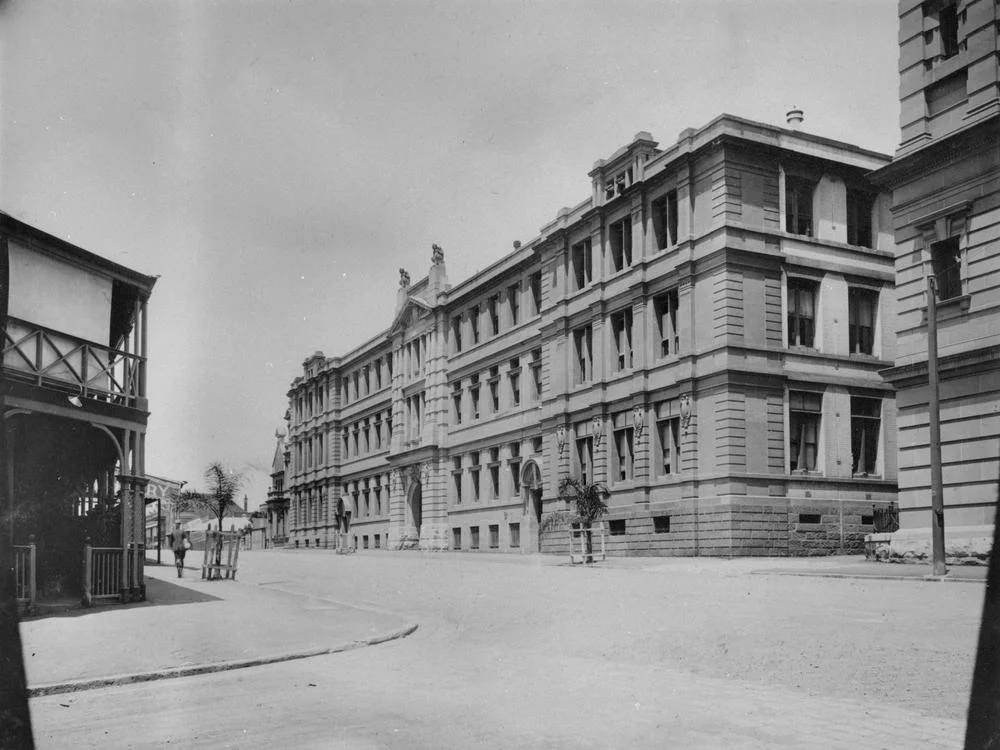

Raid on the Queensland Government Printing Office
On a November night in 1917, soldiers came for the printed word. The Prime Minister of Australia, Billy Hughes, had travelled to Brisbane on the pretext of addressing a public meeting. Instead, late in the evening, he arrived at the Queensland Government Printing Office with the federal censor and a detachment of troops and seized all 3,300 copies of Hansard, the official transcript of the state parliament, along with every piece of the metal type used to print it. The crime recorded in those pages was speech. Queensland politicians had said out loud what the federal government had banned, and Hughes meant to make sure no one else could read it.
A Nation Split Over Conscription
The fight had been building for two years. As the Great War ground on in Europe and the casualty lists lengthened, the early rush of Australian volunteers slowed, and Britain pressed for more men. Hughes wanted to compel them through conscription, but he could not get it through Parliament, so he put the question directly to the people in a 1916 plebiscite. The country said no. He split his own party, allied with former enemies, and called a second vote for 1917. Queensland's Labor premier, T. J. Ryan, became the face of the opposition, the only state leader to defy the federal government openly. Between the two men lay not just conscription but a deeper quarrel over who, in wartime, was allowed to speak.
The Speech That Started It
The federal government had armed itself with the War Precautions Act, which let it censor anything judged harmful to the war effort, and it used the power broadly. More than two hundred publications were banned, from American newspapers to titles as harmless as Good Housekeeping and Cosmopolitan. Ryan and his treasurer, Ted Theodore, found this intolerable. So they devised a loophole. They would read the censored material aloud on the floor of the Queensland Parliament, trusting that parliamentary privilege protected anything spoken there, and then print it in Hansard and send it out by post. It was a clever, deliberate provocation, and Hughes treated it as exactly that. Because the post was federal, he first ordered the mail stopped. Then he went to the printery himself.
Brisbane Prepares for a Fight
What happened next reads less like 1917 Australia than a country on the edge of revolt. Hughes ordered the government printer, A. J. Cummings, to print no more, but Cummings revealed that Ryan had instructed him to ignore federal orders, and that the Queensland Police would help resist any soldiers who tried to force the doors. The state cabinet chose what it called direct confrontation. Armed police were posted inside the printery, and an armed guard placed around the premier himself. Theodore's colleague John Fihelly arranged for hundreds of trade unionists to be sworn in as special constables. There were plans to cut the railways, block the Brisbane River, and seize communications. When the censor tried a second visit, he was turned away at the front door and was reportedly trying to scale a side wall before Cummings let him in the back to confirm the presses had stopped.
How It Ended, and What Remains
It never came to gunfire. Hughes shifted the fight to the courts, charging Ryan and Theodore with making false statements about the supply of volunteers, but a December 1917 hearing found for Ryan and awarded him costs. A second attempt also failed; each man then sued the other, and in April 1918 both quietly walked away. Hughes had badly misjudged his opponent. As one of his own allies observed, the dogged pursuit had only raised Ryan's profile and set him up for a national career. The second plebiscite, like the first, was lost. The printery where it all happened still stands on the riverbank between William and George Streets, its sandstone now folded into the modern Queen's Wharf precinct, a quiet building that once held a printed record worth sending an army to seize.
From the Air
The former Queensland Government Printing Office stands at roughly 27.473 degrees south, 153.025 degrees east, on the western bank of the Brisbane River between William and George Streets in the CBD, now part of the Queen's Wharf precinct. From the air the surrounding landmark is unmistakable: the two curved towers of The Star Brisbane and the Sky Deck slung between them rise directly over this historic government quarter, with the Neville Bonner Bridge reaching across the river to South Bank. Brisbane Airport (ICAO YBBN) is about 12 kilometres to the northeast, and Archerfield (YBAF) roughly 11 kilometres to the southwest. The river's loop through the city centre is the clearest navigation reference. Clear winter mornings give the best visibility; summer afternoons bring haze and storms over the valley.
Nearby Stories
- Redcliffe Peninsula 2.7 km away
- Tamborine National Park 12 km away
- Cressbrook Homestead 27 km away
- Main Range National Park 31 km away
- 2010-2011 Queensland Floods 38 km away
- Cape Byron 96 km away
- Cape Byron Light 126 km away
- HMS Porpoise (1799) 588 km away