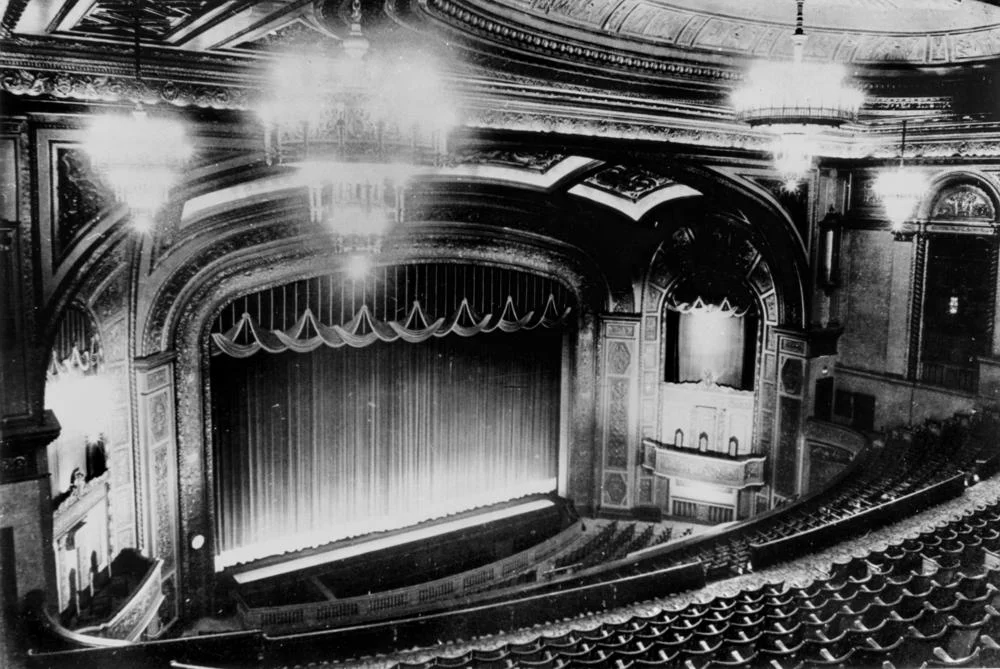

Regent Theatre, Brisbane
Push through the doors off the Queen Street Mall and the city falls away. A marble staircase climbs through a hall painted with knights and lions and twisting vines, lit gold by lanterns the size of barrels. False Gothic windows glow with bronze paint pretending to be glass. This is the surviving heart of the Regent Theatre, the only American-style picture palace Queensland ever built, and for most Brisbane residents it is a small miracle that any of it is still here at all. The auditorium is gone. The foyer remains, fought for twice across forty years, the second time by people who lost.
A Palace for the Pictures
When the Regent opened on 8 November 1929, it cost £300,000, an extraordinary sum at the dawn of the Great Depression. Hoyts built it to imitate Hollywood's golden age, a cinema that was also a stage and, above all, a spectacle in itself. The Melbourne architect Charles Hollinshed designed it with help from Brisbane's Richard Gailey Junior and a young Aaron Bolot. Inside, designers mixed Art Deco, Spanish Gothic, Baroque and Empire styles with cheerful disregard for which century belonged to which. The point was never accuracy. The point was to make a clerk or a shop girl, paying a few pence for a Saturday matinee, feel for a couple of hours like visiting royalty.
The Confection Upstairs
The grand foyer survives as the great set piece, roughly twenty-two metres long and three and a half storeys high. Its vaulted ceiling carries painted figures in medieval costume, shields flanked by lions, and sunbursts ringed by lanterns. Walls drip with pale plaster tracery so dense and creamy that heritage architects reach for the word Rococo. Velvet curtains hang from blind balconies that open onto nothing but mirrors. At the centre, the white marble staircase swells outward at its base, wide enough for the crowds of 1929 to ascend in their hundreds toward a mezzanine promenade. The entrance hall before it is gentler but no less theatrical, its barrel-vaulted ceiling worked in bronze-painted plaster, its end vaults bright with painted scenes.
Two Battles, Forty Years Apart
The Regent has been mourned twice. In 1979 and 1980, the original auditorium was gutted and carved into a four-screen complex, and a campaign rose to defend it. The building, foyer and all, was placed on the Queensland Heritage Register in 1992. Then in 2008, as developers prepared to clear most of the site for a planned office tower, a new Save The Regent group formed, an echo of the first. Members marched on the building's Elizabeth Street facade. They argued it still did the one thing it was built to do, show films. They lost. Between June 2011 and March 2012 the bulk of the Regent came down, and stone grotesques the public had been promised would be saved were destroyed instead, drawing a council fine.
What the City Kept
Demolition stopped at the heritage boundary, and so the threshold, the entrance hall and the grand foyer endured. In November 2014 the Brisbane City Council reopened those rooms as a visitor information centre, returning crowds to a space designed for exactly that. The promised tower stalled for years, its design swelling from one plan to the next while the foyer waited, marooned and magnificent, behind a vacant lot. Walk in today and the contradiction is the whole story: a fragment of fantasy preserved because enough people refused to let all of it disappear, a marble staircase that now leads, in the most literal sense, nowhere, and is loved anyway.
From the Air
The Regent foyer sits at 27.47°S, 153.03°E, mid-block on Queen Street in the heart of Brisbane's CBD, hemmed in by towers and impossible to pick out from altitude. Use the broader cityscape for orientation: the Brisbane River's tight northward loop wraps the CBD, with the Story Bridge to the east and the green wedge of the Botanic Gardens at Gardens Point to the south. Brisbane Airport (YBBN / BNE) lies about 12 km to the north-northeast on the river delta; Archerfield (YBAF), the general-aviation field, is roughly 12 km to the south-southwest. Approaches over the city are tightly controlled; expect clear subtropical visibility most of the year, with humid summer haze and afternoon storms from December to February.
Nearby Stories
- Redcliffe Peninsula 2.7 km away
- Tamborine National Park 12 km away
- Cressbrook Homestead 27 km away
- Main Range National Park 31 km away
- 2010-2011 Queensland Floods 38 km away
- Cape Byron 96 km away
- Cape Byron Light 126 km away
- HMS Porpoise (1799) 588 km away