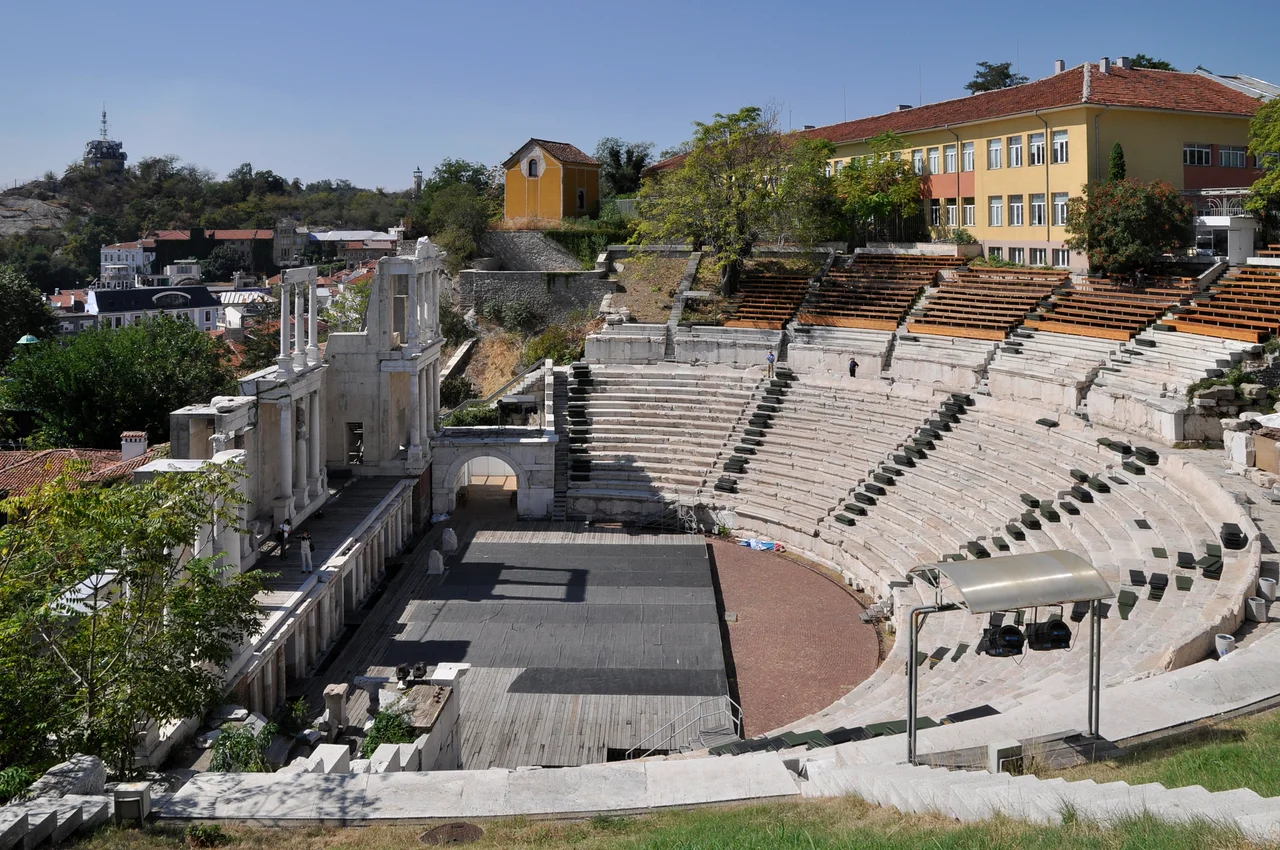

Roman Theatre of Philippopolis
A landslide on the southern slope of one of Plovdiv's three hills in 1972 exposed a piece of cut limestone that did not belong there. The Plovdiv archaeological museum's staff started digging, and what they unearthed over the next twelve years was nothing less than one of the best-preserved Roman theatres in the world. Built in the 1st century AD, probably during the reign of Domitian, the theatre had been swallowed by 4.5 meters of earth after an earthquake or fire collapsed it at the end of the 4th century. For sixteen centuries, the marble seats had waited under the soil, with the names of city quarters still legible on individual benches.
The View from Row Twenty-Eight
The cavea, the curved bowl of marble seating, holds twenty-eight concentric rows divided into two tiers by a horizontal walkway called the diazoma. Narrow radial stairways slice the bowl into wedge-shaped sectors. Built into the natural saddle between two of Plovdiv's three hills, the theatre opens to the south, so the spectators looked over the actors' heads toward the Roman city in the lowland and the Rhodope Mountains beyond. Maximum capacity ran between 5,000 and 7,000 in its imperial heyday. The horseshoe-shaped orchestra below stretches 26.64 meters across, fronted by a three-story scaenae frons that rises like a marble cliff.
Who Sat Where
The marble benches carry inscriptions that read like an ancient seating chart. Honorary places were reserved for the city council, for visiting magistrates, for friends of the emperor. Other inscriptions identified the city quarters by name, so a citizen knew exactly which section to find on a festival day. Some inscriptions document that the theatre served as the seat of the Thracian provincial assembly. Emperor Caracalla visited Trimontium in 214 AD, and to mark his patronage the theatre was reinforced with safety barriers in front of the first row, almost certainly to allow gladiator-versus-animal spectacles. The Romans valued their amphitheatre violence, and a theatre this size could double as an arena.
Attila and Anastylosis
Attila the Hun damaged the theatre in the 5th century during the wave of barbarian incursions that emptied the lower city. The structure was already weakened, and either an earthquake or a major fire finished the job before the century ended. Then came the slow burial, the soil creep down the hillside, the medieval villages that grew on top, the Ottoman streets, the modern Bulgarian city. The 1970s restoration was meticulous. The Bulgarian Conservation School followed the strict anastylosis method, which means rebuilding only with original architectural elements where possible and clearly marking any new material. The result is one of the most rigorous archaeological reconstructions in southeastern Europe.
Live Tonight
The acoustics still work. Every summer the theatre hosts performances, with around 3,500 seats now in active use during concerts and plays. The Opera Open festival fills the cavea with arias. The theatre has hosted, among other modern uses, the prize ceremony for the 21st International Olympiad in Informatics. Heavy metal vocalist Devin Townsend recorded his 2018 live album Ocean Machine here with the Plovdiv Opera's Orchestra and Choir. The progressive metal supergroup Sons of Apollo did the same in 2019 for Live with the Plovdiv Psychotic Symphony. In 2025, King Gizzard and the Lizard Wizard played a three-night residency, releasing the audio as Live in Bulgaria '25 and livestreaming the shows on YouTube.
Two Thousand Years of Audience
Stand in the orchestra and look up at the cavea. The marble benches have been worn smooth by Romans, then Byzantines, then nobody at all for sixteen centuries, then Bulgarians, then a steady international stream of tourists. The Greek inscriptions on the steles around the orchestra are still legible, written in the Byzantine Greek of late antiquity. Beyond the scaenae frons the modern city of Plovdiv spreads across the plain, with the Rhodope Mountains piling up blue on the southern horizon. The theatre is a working stage, not a museum piece. Empires rise and fall. The performances continue.
From the Air
Located at 42.1468 N, 24.7510 E on the southern slope of one of Plovdiv's three hills, in the heart of the Old Town. The theatre opens south toward the Rhodope Mountains; from above, it appears as a clear semicircle cut into the hillside. Plovdiv International Airport (LBPD) lies 5 km southeast at Krumovo. Sofia Airport (LBSF) is 130 km west. The seven syenite hills of Plovdiv are unmistakable from the air.
Nearby Stories
- Batak Massacre 18 km away
- Buzludzha Monument 42 km away
- Museum of Socialist Art 81 km away
- Battle of Kresna Gorge 91 km away
- Battle of Philippi 101 km away
- Complex of Sultan Bayezid II 104 km away
- Trapezitsa Fortress 106 km away
- Bridges of Edirne 113 km away