
Royal Exchange, Manchester
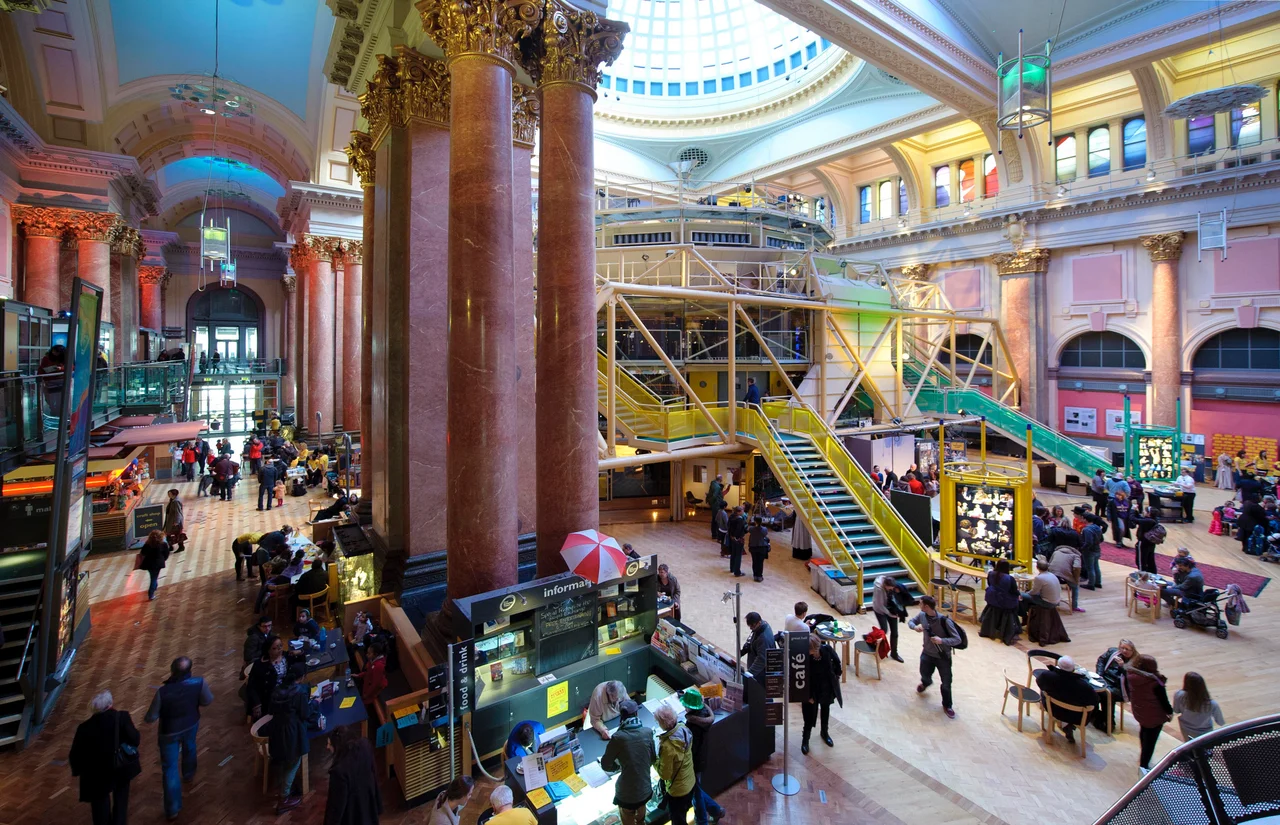
Look up when you walk into the Great Hall. The three glazed domes are still there — the same domes that lit thousands of merchants haggling over cotton prices in the years before the Second World War, when the Manchester Royal Exchange had the largest trading floor in England and a membership in the tens of thousands. Beneath them sits something that is not really architecture and not really furniture: a 150-tonne lattice of steel tubes and glass, four storeys tall, perched on jacks that lift the entire structure clear of the floor. This is the Royal Exchange Theatre — the world's largest theatre-in-the-round, parked like a spacecraft inside a Victorian trading hall, performing Shakespeare and Williams and Chekhov where merchants used to set the price of finished cloth.
The Cotton That Built It
Manchester's wealth came from cotton, and cotton came up the Ship Canal from Liverpool, which got it across the Atlantic from American plantations worked by enslaved people. The honesty of that supply chain has come slowly to the Exchange's own labels: the trade was built, in the eighteenth and nineteenth centuries, on slavery. The first Manchester exchange opened in 1729 and closed by the end of the century. Thomas Harrison's second exchange of 1809 expanded in 1849. The third — the one whose shell still stands — was built by Mills & Murgatroyd between 1867 and 1874, then extended by Bradshaw Gass & Hope between 1914 and 1931 to form the largest trading hall in England, with three domes and double the floor area of what survives today. Then on a single night in December 1940 a German bomb came through the roof, the trading hall burned, and the post-war rebuild reduced the floor to its current footprint.
From Trading Floor to Stage
Trading ceased in 1968 and the building stood empty under demolition threat. Then five theatre directors — Michael Elliott, Caspar Wrede, Richard Negri, James Maxwell and Braham Murray — looked at the cavernous Great Hall and saw not a problem but a stage. Negri, an architect by training, designed a self-contained theatre module that could sit inside the hall without touching the Victorian fabric: a seven-sided lattice of steel and glass, eight metres across at the base and rising to two galleries above the stalls. The whole thing weighs 150 tonnes and is supported on the floor by four 7.5-tonne jacking columns that lift it off the marble surface. Laurence Olivier opened the Royal Exchange Theatre on 15 September 1976. The audience surrounds the actors on every side — 400 at ground level, two galleries of 150 above — so no one is more than nine metres from the stage. It remains the largest in-the-round theatre in the world.
The 1996 Bomb
On 15 June 1996 at 11:17 in the morning the IRA detonated a 1,500-kg lorry bomb on Corporation Street, less than 50 yards from the Exchange. It was the largest bomb to explode on the British mainland since the Second World War. The blast knocked the central dome out of true. St Ann's Church across the street survived almost unscathed, sheltered by the Exchange's stone bulk. The theatre's planned opening that very weekend — of Stanley Houghton's Hindle Wakes — never happened. Repairs took more than two years and £32 million from the National Lottery; the company performed in Castlefield in the meantime. When the building reopened on 30 November 1998, Prince Edward did the honours and the long-delayed Hindle Wakes finally went up. The theatre added a 90-seat Studio space, a bookshop, and a redesigned café and bar. The IRA had tried to bring the city to its knees. Manchester rebuilt and added another stage.
What They Stage
The Royal Exchange's repertoire has always been wider than its single most famous production might suggest. Shakespeare, Ibsen and Chekhov are the bedrock; the British premieres of La Ronde and The Prince of Homburg sat on the same season programmes as Tennessee Williams revivals and August Wilson productions. New writing matters: the world premieres of Ronald Harwood's The Dresser, Edna O'Brien's Triptych, A Wholly Healthy Glasgow and Port all started here. In 2016 The Stage named the theatre Regional Theatre of the Year under Sarah Frankcom's artistic direction. Frankcom left in 2019 to run LAMDA; the theatre then appointed Bryony Shanahan and Roy Alexander Weise as joint artistic directors, a pairing that ran until 2023. The Royal Exchange Young Company, the in-house programme that trains 14-to-21-year-olds in performance and writing, was named The Stage's School of the Year in 2018.
Reckoning
The theatre has been honest in recent years about the work it has done and what that work has cost some of the people who made it. In 2017 the company produced Jubilee, a stage adaptation of Derek Jarman's film directed and adapted by Chris Goode. In 2021, Goode died by suicide shortly after being arrested on suspicion of possessing indecent images of children. Allegations of abuse during his time at the Royal Exchange led the theatre, alongside London's Royal Court, to commission an independent inquiry into safeguarding failures. The resulting report concluded that several individuals had been badly hurt, and called for improved safeguarding across the UK theatre sector. The Exchange has since published its response. It is one of those moments where an institution that prides itself on telling difficult stories has been forced to tell one about itself — without flinching, and without pretending it hadn't happened.
From the Air
Located in Manchester city centre at 53.483°N, 2.244°W, between St Ann's Square and Corporation Street. Manchester Airport (EGCC) is about 14 km south; Manchester Barton (EGCB) is roughly 7 km west. From a low cruise the Royal Exchange is the substantial block south-east of Manchester Cathedral, identifiable by the three glazed domes on its slate roof. Cross Street and St Mary's Gate frame two of its sides.
Nearby Stories
- National Science and Media Museum 0.2 km away
- Jodrell Bank Observatory 3.2 km away
- Siege of Lathom House 5.6 km away
- Chester Zoo 6.2 km away
- Whalley Abbey 8.9 km away
- Haddon Hall 10 km away
- Wentworth Castle 16 km away
- Blackpool 16 km away