.jpg)
Royal Northern College of Music
Walk along Oxford Road on a weekday afternoon and the building gives itself away by sound. A muffled clarinet runs scales behind one glazed bay; a string quartet works through Beethoven behind another. The concrete and glass tell you it is unmistakably a building of the early 1970s, but what is happening inside is much older - the work of training people to play music well, which Manchester has been doing in earnest since Sir Charles Halle opened the Royal Manchester College of Music in 1893 with eighty students and a Royal title from Queen Victoria.
Halle's Idea
Sir Charles Halle was already a Manchester institution by the early 1890s. He had founded the Halle Orchestra in 1858 and, after decades of conducting it, decided the city needed a conservatoire of its own. An appeal raised money. A building on Ducie Street was secured. Queen Victoria granted the Royal title, and Halle himself was installed as Principal. When the doors opened in 1893, eighty students enrolled - by the end of that first year, one hundred and seventeen. For a city that the Industrial Revolution had given factories and railways and very little of the gentler arts, this was something different: a deliberate, civic claim that Manchester was as serious about music as anywhere in Europe.
Two Schools, One College
For most of the twentieth century, Manchester actually had two music colleges. The Northern School of Music was established in 1920, originally as a branch of the Matthay School, and the two institutions coexisted - sometimes cordially, sometimes not - for nearly five decades. In 1955 the NSM principal Hilda Collins approached her counterpart at the RMCM, Frederic Cox, with a quiet but pointed question: should they not be one? Discussions ground on for twelve years. A joint committee was formed in September 1967, and finally, in 1972, the Royal Northern College of Music was born. John Manduell, a former BBC music producer, became its first principal. The Telegraph would later write that under his direction, the RNCM became one of the leading musical academies in Europe, if not the world.
Concrete and Glass on Oxford Road
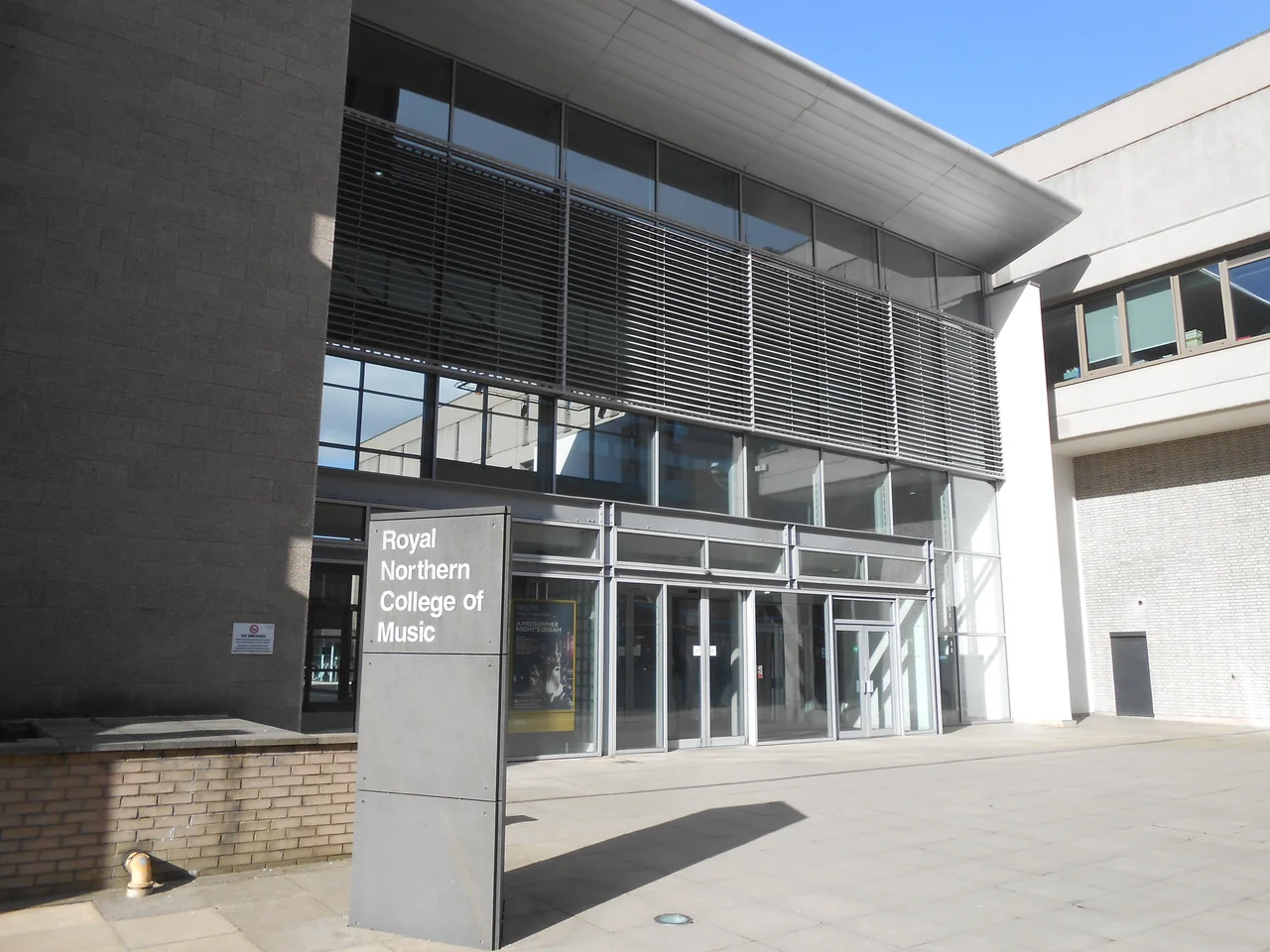
The college moved into its purpose-built home on the corner of Oxford Road and Booth Street West in 1973. The architects - Bickerdike, Allen and Rich - gave it the language of its decade: a two-storey rectangular concrete structure fronted by tall glazed bays recessed behind square concrete pillars. An elevated walkway once ran along the Oxford Road side, part of an unrealised 1960s scheme to lift pedestrians onto concrete stilts and march them all the way to Hulme and Ancoats. Only two bridges of that utopian network were ever built. When the RNCM was extended in 1997-98, the walkway came down with the rest of the dream.
What Goes On Inside
The RNCM today has more than eight hundred students and three hundred teaching staff, organised into six schools: Composition, Keyboard Studies, Strings, Vocal Studies and Opera, Wind, Brass and Percussion, and Popular Music. In 2005 it became the only UK conservatoire selected as a Centre for Excellence in Teaching and Learning, an award worth four and a half million pounds. It also holds a remarkable collection of historic musical instruments, amalgamated from collections built by Dr Henry Watson, Josiah Thomas Chapman and the city of Manchester itself. On a Saturday, the building fills with Junior RNCM students aged eight to eighteen - the next generation, working scales behind the same glazed bays.
From the Air
Royal Northern College of Music sits at 53.4686 degrees north, 2.2364 degrees west, on Oxford Road in central Manchester, two blocks south of the University of Manchester campus. Manchester Airport (EGCC) lies about 12 km south. Manchester Barton aerodrome (EGCB) is about 8 km west. From altitude, look for the long Oxford Road corridor running south-southwest from Manchester city centre.
Nearby Stories
- National Science and Media Museum 0.2 km away
- Jodrell Bank Observatory 3.2 km away
- Siege of Lathom House 5.6 km away
- Chester Zoo 6.2 km away
- Whalley Abbey 8.9 km away
- Haddon Hall 10 km away
- Wentworth Castle 16 km away
- Blackpool 16 km away