_Ruthin.jpg)
Ruthin
On 18 September 1400, Owain Glyndŵr rode into this town and set it on fire. By the time his men withdrew, almost every building inside the walls was ash - everything except the castle, the church, and a few stone houses too stubborn to burn. The cause was a fence-line argument, a strip of common land claimed by Reginald Grey, the English Marcher Lord at the castle, and contested by Glyndŵr the Welsh squire down the valley. Within a generation, that argument had become the last great Welsh war of independence. Ruthin had given the Welsh their grievance and the chronicler his opening line.
Red Fort, Red Stone
The name says it: rhudd din - the red fort - after the iron-stained sandstone bedrock that gives the castle hill its colour. The first castle began rising in 1277 under Dafydd ap Gruffydd, brother to Llywelyn the last Prince of Wales, on land granted by King Edward I in payment for Dafydd's help against his own brother. The original Welsh name for the place was longer and stranger: Castell Coch yng Ngwern-fôr - red castle in the sea swamps - a reminder that the Vale of Clwyd was once a marshier place than the trimmed pasture it has become. Two miles to the south-east stands the older parish church of St Meugan at Llanrhydd, in religious use since the sixth century and probably the original focus of settlement before the castle pulled the town up onto its hill.
St Peter's Square
John Grey, second Baron Grey de Wilton, raised St Peter's Church in 1310 on the north side of the market place. The church has a double nave and two medieval carved roofs, and behind it sits a quadrangle of old college buildings, a school, and Christ's Hospital - the almshouse Gabriel Goodman built in 1590 for twelve poor parishioners while serving forty years as Dean of Westminster. In the square itself lies Maen Huail, a registered ancient monument linked by legend to King Arthur and to Hueil mab Caw, brother of the historian Gildas. The Old Courthouse on the square dates from 1401 and still carries the remains of a gibbet last used in 1679 to execute Charles Meehan, a shipwrecked Franciscan priest hanged in an era when Catholicism counted as treason. Pope John Paul II beatified him in 1987.
Nantclwyd y Dre
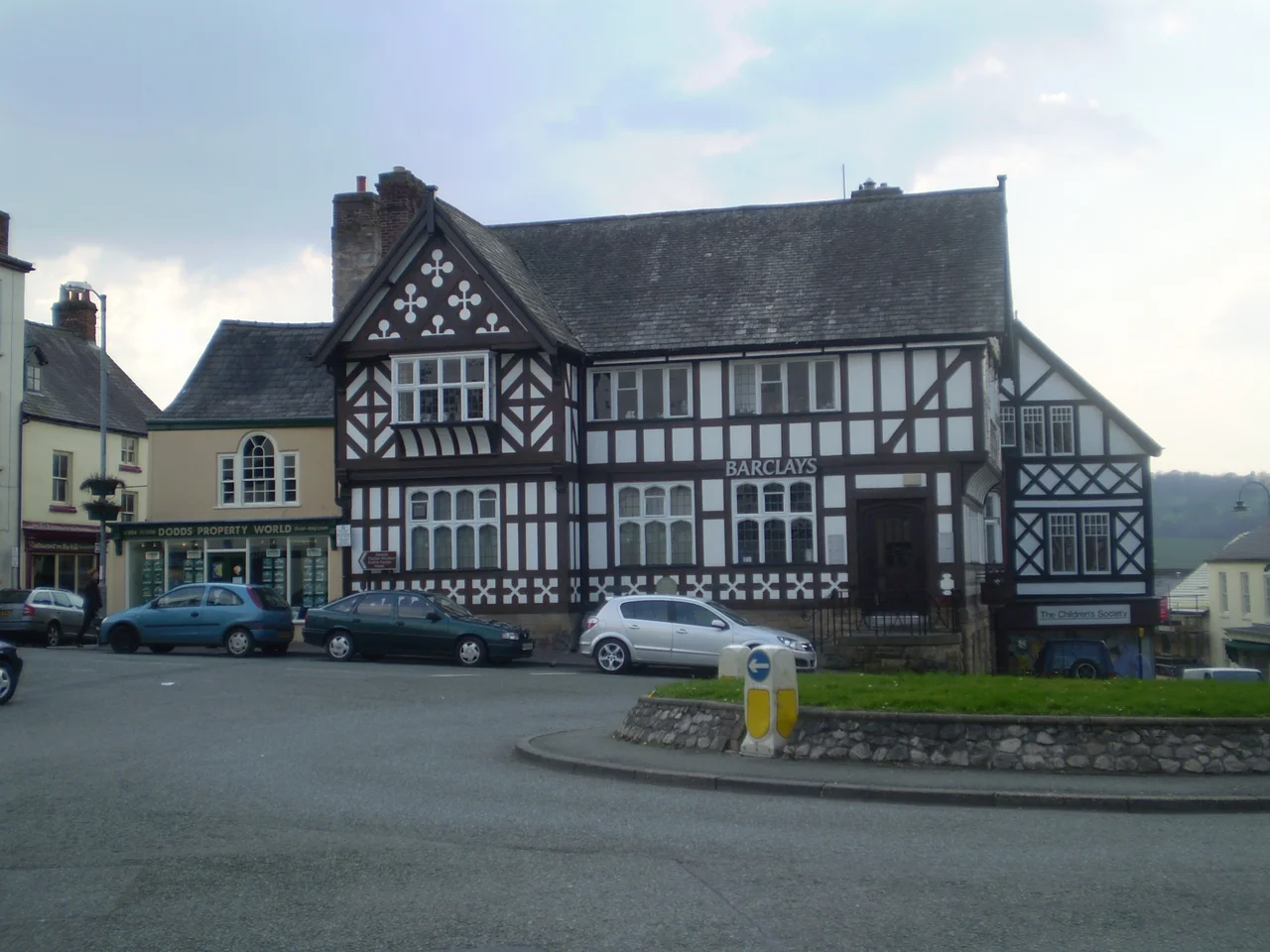
On Castle Street stands Nantclwyd y Dre, built about 1435 by a merchant named Gronw ap Madoc - the oldest dated timber-framed townhouse in Wales. The black-and-white frontage leans gently into the street as five centuries of settling will incline a building. Seven rooms inside have been restored to represent different periods in its long occupation, from medieval merchant's hall to Victorian solicitor's chambers. Up in the attic, a colony of Lesser horseshoe bats roosts undisturbed, their presence carefully accommodated during the restoration. Behind the house lie two gardens: a thirteenth-century inner garden and the larger Lord's Garden beyond, itself believed to have been part of the castle's medieval pleasure grounds. The historian Peter Smith called Ruthin the last surviving example in Wales of a town once full of timber-framed houses - the memory, as he put it, of what Welsh market towns used to look like.
Gaol Street
At the bottom of Clwyd Street, Ruthin Gaol survives as a museum - a four-storey Victorian prison block modelled on Pentonville, finished in 1865 to replace the older bridewell on the same site. Only one execution is recorded here: William Hughes of Denbigh, hanged on 17 February 1903 for the murder of his wife after his plea of insanity failed. The gaol's more famous prisoner was John Jones, known as Coch Bach y Bala - red-haired little Bala - a kleptomaniac and poacher who spent more than half his sixty years in prisons across north Wales and England. He escaped Ruthin twice. The second time, in September 1913, he tunnelled out of his cell, climbed over the chapel roof on a rope of bedding, and lived rough on the Nantclwyd Estate for a week before a nineteen-year-old amateur pursuer shot him in the leg. Jones died of shock and blood loss. The young gunman was charged with manslaughter and then quietly released.
What Wales Sounds Like
The first printed copies of Hen Wlad Fy Nhadau - Wales's national anthem - came off a press on Well Street, in the building that is now Siop Nain, a tea and gift shop. In its eighteenth-century heyday on the drovers' route from Wales into England, Ruthin reportedly had a pub for every week of the year. The 1891 records list thirty-one such establishments serving a population of just over 3,000. The town hosted the National Eisteddfod in 1868 and 1973, and the Urdd National Eisteddfod in 1992 and 2006. The actor Rhys Ifans grew up here. The Ruthin Craft Centre, rebuilt in 2008 for £4.3 million, occupies the site of the old railway station that closed under the Beeching Axe in 1963 - one more layer in a town that keeps finding new uses for old footprints.
From the Air
Ruthin sits at 53.115°N, 3.310°W in the Vale of Clwyd, surrounded by the agricultural landscape of central Denbighshire. The town climbs a low hill in the southern part of the vale, with the castle hotel on its southern flank and St Peter's spire dominating the skyline. Best viewed at 1,500-3,000 feet AGL. Nearest airports are Hawarden (EGNR) 25 nm east, Caernarfon (EGCK) 35 nm west, and Liverpool John Lennon (EGGP) 30 nm northeast. The vale runs roughly north-south between the Clwydian Range and the Denbigh Moors; look for the cluster of stone buildings and the tight grid of streets around the central square.
Nearby Stories
- Carnedd Llewelyn 7 km away
- Tarporley 9.7 km away
- Battle of Winwick 14 km away
- RAF Shawbury 16 km away
- Cymer Abbey 17 km away
- New Brighton Lifeboat Station 19 km away
- Battle of Oswestry 20 km away
- Celtic Array 52 km away