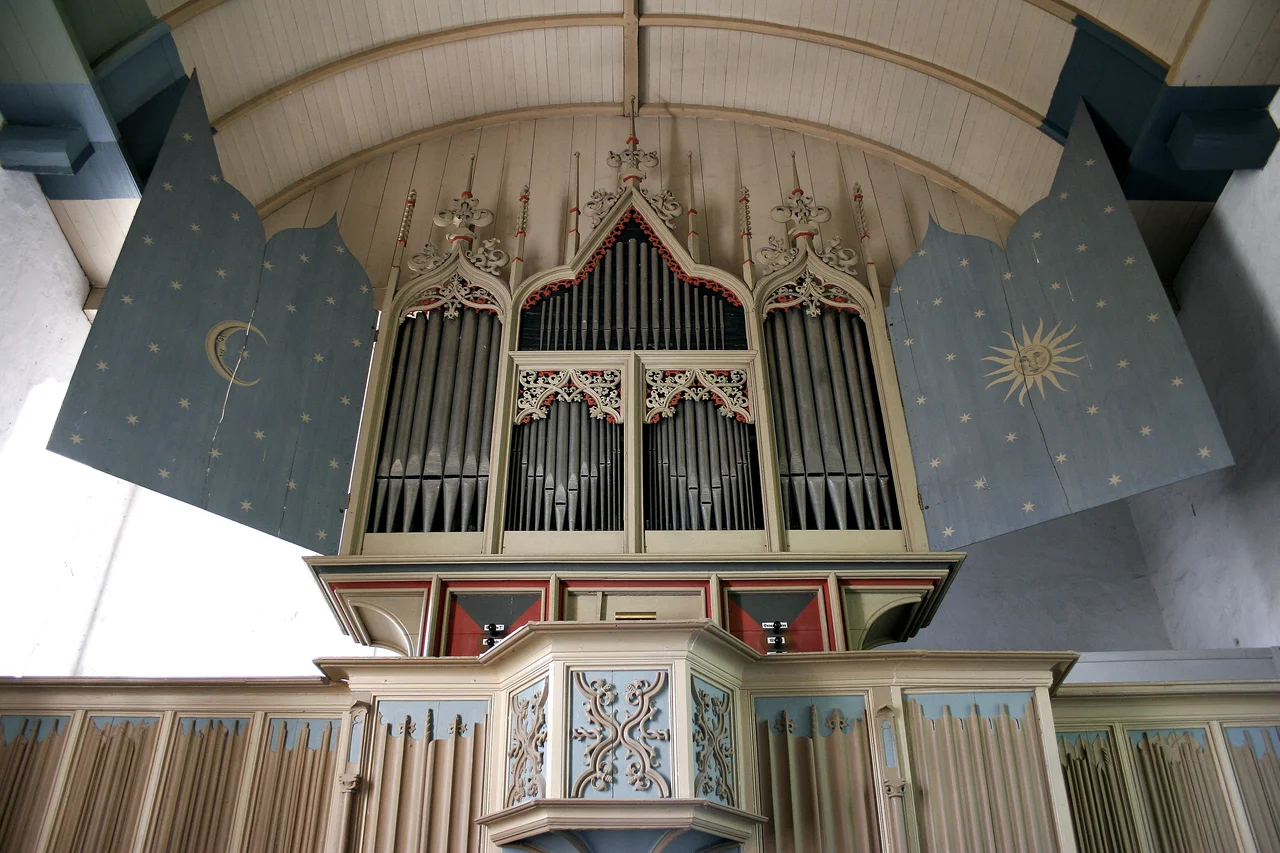

Rysum Organ
Seven stops. One keyboard, with several notes missing from the bottom octave and a compass that runs out early at the top. By the standards of any cathedral instrument built in the four hundred years since, the organ in the village church at Rysum is barely an organ at all - it is a cupboard of pipes with a bellows behind it. And yet when the organist pulls the Praestant and plays a chord, the sound arriving in the room is being made, in large part, by metal that was hammered out of sheet lead in the middle of the fifteenth century. There are perhaps four instruments in the world that can make that claim. This one sits in a farming village of fewer than seven hundred people, fifteen kilometres west of Emden, on ground that people piled up by hand to keep the North Sea out.
Harmannus of Groningen
The organ was built somewhere between about 1440 and 1457 by Harmannus of Groningen, an organ builder from just across what is now the Dutch border. The later date is the one that appears in writing: the chronicler Eggerik Beninga recorded 1457, and for want of anything firmer that is the year usually given. In 1513 the instrument was worked on again and a small balcony was added for the organist to sit on.
What makes Rysum remarkable is not that a fifteenth-century organ exists - cases and carvings survive in a number of places. It is that the pipes survive. Rysum is generally described as the oldest instrument of its kind in northern Europe that still has most of its original pipework, and it is named alongside the organs at Sion in Switzerland, St Valentin in Kiedrich and Ostönnen in Westphalia as one of the oldest playable church organs anywhere.
Seven Stops and a Change of Mind
The specification is short enough to read out in a breath: Praestant at eight foot, Gedackt at eight, two Octaves at four and two, a Sesquialtera of two ranks, a Mixtur of three to four, and a Trompete at eight. Everything not made by the twentieth-century restorers is gothic.
But it did not begin as an instrument you could register. It began as a Blockwerk, in which every rank sounded together whenever a key went down - one enormous, unvarying, unstoppable sound, which is what medieval church music wanted from an organ. By the end of the seventeenth century, and possibly as early as that 1513 rebuild, someone had fitted a slider chest so that individual ranks could be selected. That change was not cosmetic. Congregations had started singing, and an organ that could only roar was no use for accompanying them. The proof is a payment record: a builder named Kayser was paid for seven turned stop-knobs, which means that by his day there were seven things to turn on and off.
Tuned the Old Way
The organ is tuned in meantone, slightly above a1 = 440 hertz. This is the tuning that Europe used before it agreed to compromise, and the compromise it refuses to make is the interesting part. In meantone, the major thirds in the common keys are pure - genuinely pure, without the faint beating that a modern piano's thirds all carry. The price is that a handful of remote keys become unusable, howling badly enough that organists simply avoid them.
The result is that music written for this instrument sounds, in it, the way it was designed to sound. Wind comes from wedge bellows at seventy millimetres of water pressure, gentle by later standards and part of why the tone is what it is. Recordings by players such as Harald Vogel have carried it well beyond East Frisia.
A Century of Well-Meant Damage
Between 1848 and 1910 an organ-building firm held the maintenance contract, and the nineteenth century did to Rysum roughly what it did to a great many old instruments. In 1867 and 1868 the case was cut down to make room for a new ceiling in the church. Around 1880 to 1890 the keyboard and stop-knobs were replaced with modern ones. None of this was vandalism; it was ordinary competent updating, of the kind that has quietly destroyed most of the medieval organs that once existed.
The repair came in 1959 and 1960, when Jürgen Ahrend and Gerhard Brunzema took the instrument apart and put it back the way it had been. They restored the gothic facade, remade three ranks of pipes from hammered lead by the old method, and returned the whole thing to meantone. It is one of the founding jobs of the modern historical-organ movement, and it is why the instrument sounds like itself again.
The Village on the Mound
Rysum was first mentioned in the tenth century and is built on a warft - one of the artificial dwelling mounds people in this coastal country raised, basket by basket, to keep their houses above storm tides. The village holds roughly 689 people across ten square kilometres of the Krummhörn. The Reformed church at the top of the mound dates from the fifteenth century, which is to say it is about the same age as the thing inside it.
East Frisia has an improbable concentration of historic organs for a region this small and this flat, enough that the phrase Orgellandschaft Ostfriesland - the organ landscape of East Frisia - is a real category rather than a tourist-board invention. Rysum is its oldest voice.
From the Air
Rysum lies at 53.380 degrees N, 7.035 degrees E, in the Krummhörn of East Frisia, about 15 km west of Emden and close to the Dollart bay and the Dutch border. From the air the landmark is the landscape rather than the building: a grid of drainage ditches and dead-straight canals across reclaimed polder, with villages sitting as low green humps on their warften above the field pattern. The church tower on the Rysum mound is the local high point. Nearest airport is Emden (EDWE), roughly 15 km east; Groningen Eelde (EHGG) is about 50 km west across the border, and Bremen (EDDW) roughly 150 km east. Best viewing altitude 1,000 to 2,500 feet. Sea fog and low stratus roll in off the Wadden Sea and can shut the area down quickly in spring and autumn.
Nearby Stories
- Tynaarlo 5.3 km away
- Organ in the Jacobikerk at Uithuizen 6.4 km away
- Bourtange 8.9 km away
- Norderney Airport 11 km away
- Razing of Friesoythe 11 km away
- Harle (gat) 19 km away
- Lordship of Gödens 22 km away
- Alpha Ventus Offshore Wind Farm 45 km away