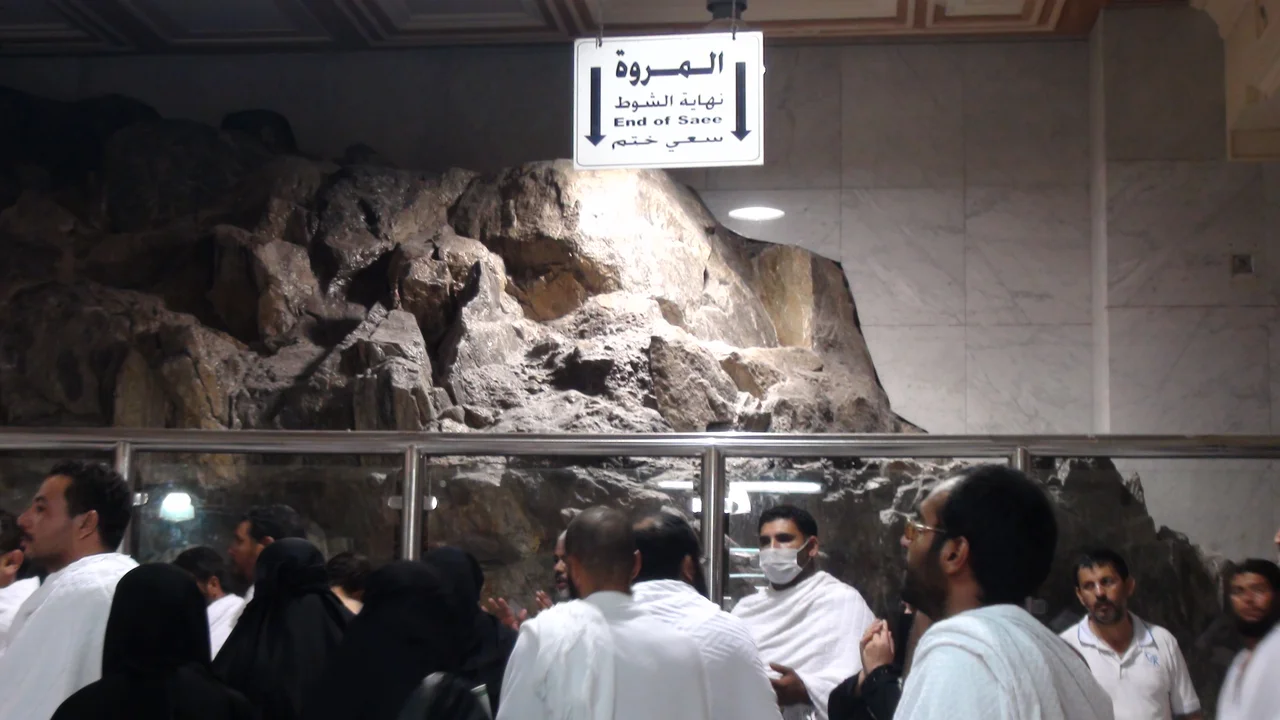

Safa and Marwa
Islamic tradition tells it simply. Ibrahim left Hajar and their infant son Ismail in a dry valley, at what Muslims believe was God's command. Their water ran out. Their food ran out. Hajar, desperate as her nursing son weakened, climbed the nearest hill, Safa, and looked for any sign of a caravan, any glimpse of water. She saw nothing. She climbed the next hill, Marwa, and looked again. Still nothing. She ran back to Safa, then to Marwa, seven times in all, as the mother of a dying child does when there is nothing left to try. On her return, she found water bubbling from the ground where Ismail lay. That spring is the Zamzam Well.
Two Small Hills
Safa is a small outcrop on the flank of Abu Qubais Mountain, southeast of the Kaaba. Marwa is a small white-stone rise to the northeast, attached to Qaiqan Mountain. The distance between them is a few hundred meters. For most of Islamic history these hills stood outside the Masjid al-Haram, though only just. In 1955 and 1956, during one of the first modern expansions of the Grand Mosque, Saudi authorities incorporated both hills and the Mas'aa, the walkway between them, directly into the sanctuary. What had been open ground where pilgrims walked became an enclosed, air-conditioned gallery built right into the mosque complex. The hills are still there, enclosed in marble. Pilgrims still touch them at each turn.
The Sa'i
Sa'i, the ritual of running between the two hills, is an integral part of both the Hajj and the Umrah, a rukn, a required pillar of the pilgrimage. Pilgrims walk from Safa to Marwa and back, seven times in all. Four journeys go outward from Safa, three return, or three go outward and four return depending on how you count. The total distance covered is roughly 3.15 kilometers. The path is divided into two parallel walkways, one going from Safa to Marwa, one returning, with narrower central lanes reserved for elderly or disabled pilgrims. Cool water from the Zamzam Well is available along the route. Performing sa'i commemorates Hajar's search and God's answer. Muslims call it, among other things, an act of memory made with the body.
The Verse That Closed a Debate
Early Muslims had questions about the ritual. Some of the Ansar, the Medinan supporters of Muhammad, told Aisha they felt walking between the hills was sinful, because it had been associated with pre-Islamic pilgrimage customs that visited the idol Manat at Qudaid near Mecca. Anas ibn Malik said he hated walking between the hills for the same reason. Abdullah Yusuf Ali, in his twentieth-century commentary on the Quran, argued that the Quraysh had placed two idols atop Safa and Marwa, which deepened the hesitation. Verse 2:158 of Surah al-Baqarah resolved it, affirming that Safa and Marwa were among the signs of God and that walking between them was not a sin. The ritual has been an unambiguous pillar of the pilgrimage ever since.
Hajar, Without Sanitizing
The sa'i centers one of the most striking figures in the Abrahamic traditions. Hajar is, in the biblical account, Sarah's Egyptian handmaid, the mother of Ishmael, eventually cast out by Abraham at Sarah's insistence. The Quranic and Islamic traditions treat her differently, as the wife of Ibrahim and the mother of Ismail, who becomes the patriarch of the Arab peoples. In both traditions she is a woman left alone in the desert with a small child, expected to survive when survival has been made nearly impossible. What she does in the Islamic narrative is not wait. She runs. Seven times, because her child is dying and there is one more thing she can try. The ritual that millions of Muslims now perform every year is a physical remembrance of a woman refusing to be abandoned, and of a God who answers the mother rather than the patriarch. The tradition says Ismail's heel struck the ground. The water came from there.
A Debate Among Scholars
Not every scholar has agreed about the location. The revisionist historians Tom Holland and Patricia Crone have argued, on the basis of source criticism of early Islamic texts, that Islam may not have originated in Mecca at all, but somewhere further north. Building on that suggestion, Paul Ellis has proposed that Safa and Marwa are actually hills in Jerusalem, Mount Scopus and Mount Moriah. His evidence rests partly on the Jewish historian Josephus, who called Mount Scopus Sapha in Greek, phonetically close to Safa. This is a minority view within academic Islamic studies and is rejected by mainstream Islamic tradition, which has always located Safa and Marwa in Mecca and has been performing sa'i there with continuity that the revisionist scholars themselves acknowledge is ancient. The hills the pilgrims run between, by any reckoning, have been these particular hills for at least thirteen centuries, and the ritual has been these specific steps for just as long.
Still Running
During Hajj, millions of pilgrims perform sa'i in a single week. The Mas'aa is open 24 hours a day, cooled against the heat of Mecca, fed with Zamzam water, staffed to handle medical emergencies. Pilgrims in ihram, the simple white garments that erase distinctions of wealth and nationality, walk beside elderly pilgrims in wheelchairs, families with small children, strangers from every continent. Most of them come once in a lifetime, because the Hajj demands it and the cost and distance are substantial. For those pilgrims, walking the sa'i is the physical enactment of a story older than Islam itself, of a woman in a desert, with a child, refusing to give up. The hills are small. The ritual is not.
From the Air
Safa and Marwa are inside the Masjid al-Haram in Mecca, at 21.42 degrees north, 39.83 degrees east. Nearest airport is King Abdulaziz International in Jeddah (OEJN), approximately 80 km west. Mecca airspace is restricted, and a no-fly zone is in effect directly over the Grand Mosque. Hot desert climate with extreme heat in summer. The entire Mas'aa (the sa'i gallery) is enclosed within the mosque complex and is only accessible to pilgrims in ihram. Non-Muslims are not permitted within the city of Mecca.
Nearby Stories
- Al-Balad, Jeddah 23 km away
- Jeddah Tower 33 km away
- Battle of Turubah 123 km away
- Red Sea Rift 143 km away
- Ghadir Khumm 159 km away
- Al-Baha 162 km away
- Thee Ain 206 km away
- Hejaz 214 km away