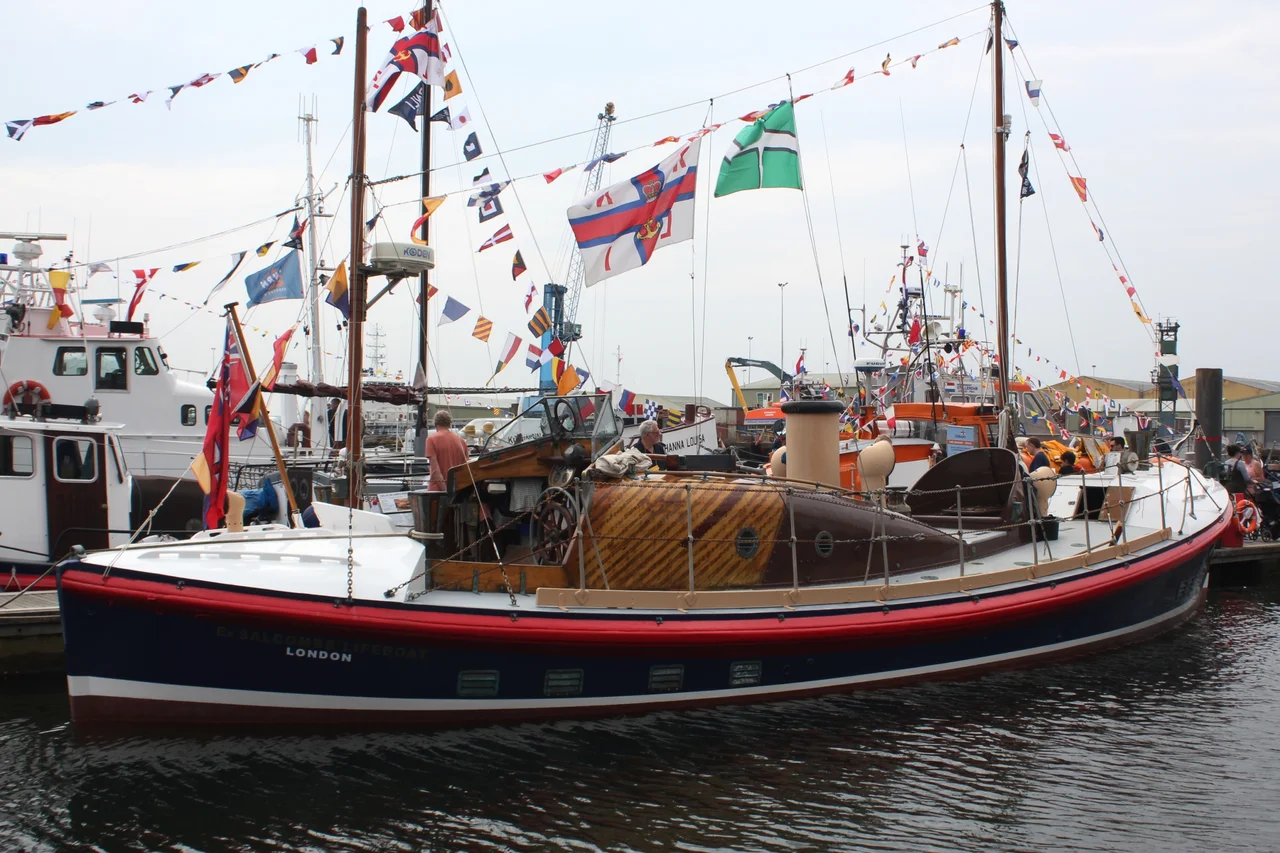
.JPG)
Salcombe Lifeboat Station
On the morning of 27 October 1916, the William and Emma launched from Salcombe to help a wrecked schooner over near Prawle Point. By the time her fifteen volunteer crew were heading home, the sea outside the harbour had risen. At the bar - the shallow sandbank that closes off the mouth of the Kingsbridge Estuary - the lifeboat tried to cross on a falling tide and was rolled bow over stern by a breaking wave. Of fifteen men, two survived. Thirteen lifeboatmen drowned within sight of their own village, watched from the cliffs by wives, mothers and children who could do nothing. The Salcombe RNLI station rebuilt, retrained, and was back on service the following year.
The Bar at Salcombe
The first Salcombe lifeboat was placed at the village in 1869, the year after the schooner Gossamer was wrecked at Prawle Point with thirteen lives lost. The geography of this stretch of Devon coast is brutal. The Kingsbridge Estuary opens to the sea through a narrow gap guarded by The Bar - a shifting underwater sandbank that turns even moderate swell into standing breakers when wind and tide oppose each other. For boats heading out it is dangerous. For boats coming home in deteriorating weather it can be deadly. The original station at South Sands sat south of the town but north of the bar, the slipway pointing out to a coast that has consumed ships for centuries: Prawle Point, Bolt Head, the Skerries Bank. The volunteers came from a village that knew the sea by name.
27 October 1916
The William and Emma had launched that morning to help the Western Lass, a Plymouth schooner driven onto the rocks at Prawle Point. By the time the lifeboat reached her, the Western Lass was empty - her crew already rescued from the cliffs by ropes - and the lifeboat turned for home. The seas had built. Coxswain Sam Distin chose to come in over the bar rather than wait offshore, a decision that was reasonable when he made it. Then a single enormous breaker met the boat. The William and Emma pitched up by the bow, stood almost vertical, and rolled. Of fifteen men aboard, thirteen drowned. The two survivors - Eddie Distin, the coxswain's nephew, and Bill Johnson - washed ashore alive. The village lost husbands, sons, brothers and in some cases all the male earners of a single family on one morning. Salcombe is still, in many ways, the village that lost the William and Emma.
After the Loss
The RNLI did what it always did: replaced the boat and the crew, kept the station open. A new lifeboat arrived. New volunteers came forward. In 1922 the station was moved to moorings nearer the town, the original boathouse turned into a store. A short closure proved a mistake, and Salcombe was reopened in December 1930 with a motor lifeboat - faster, more capable, less dependent on muscle and luck. By 1939 the boat at Salcombe was the Samuel and Marie Parkhouse, and her coxswain was Edwin Distin, who as a young man had survived the 1916 capsize. On 7 December that year - the war just three months old - he took the lifeboat out to help the SS Louis Sheid, which had picked up sixty-two survivors from the torpedoed Tajandoen and then run aground herself near Thurlestone. Distin's crew made two trips to Hope Cove to land the rescued; he received the RNLI Silver Medal for the seamanship he showed that night.
Capsize, the Second Time
On 10 April 1983 the lifeboat Baltic Exchange went out in a force 9 gale to help a capsized dinghy in Bigbury Bay. The dinghy crew got off by helicopter. The lifeboat herself then rolled - the second capsize in Salcombe's history. This time technology meant something different. The Watson class boats had been fitted with automatic righting air bags after a fatal capsize at Fraserburgh in 1970. The Baltic Exchange's air bag inflated as it was meant to. One crew member was washed overboard and picked up again. No one was lost. The lifeboat carried on into Brixham under her own power. Coxswain Graham Griffiths and his crew received framed letters of thanks from the institution. Two of them - Frank Smith and B. Cater - would still be in the boathouse decades later.
Tamar at Union Street
Today the Salcombe station occupies a three-storey building on Union Street at the heart of the town, with a single-storey boathouse next door for the inshore lifeboat. Since 2008 the all-weather boat has been a Tamar class - 250 nautical mile range, twenty-five knots, a long way technologically from the William and Emma but going out to the same coast on the same kind of nights. The RNLI is still entirely volunteer-crewed and entirely funded by public donation. Among the women now on the crew are Esther McLarty and Sam Viles, both honoured by the institution for rescues in the early 2010s. The lifeboatmen of 27 October 1916 are remembered by a stone in the churchyard at Malborough and by a wider memorial in the town. The lifeboat still goes out. That is, in the end, the only memorial the dead would have asked for.
From the Air
Salcombe lies at the mouth of the Kingsbridge Estuary on the south Devon coast at approximately 50.239 degrees N, 3.767 degrees W. The town clusters around a narrow harbour that opens to the Channel between Sharpitor and the spit of Limebury Point; the infamous bar lies just south of the harbour entrance. Bolt Head rises to the west, Prawle Point to the east. The coast all the way from Plymouth Sound to Start Point is dramatic and cliffbound. Nearest airports are the closed Plymouth City Airport (EGHQ) about 18 miles northwest and Exeter (EGTE) about 30 miles northeast; Newquay Cornwall and Bournemouth (EGHH) are alternatives. Cruise altitudes of 1,500-3,000 feet give superb views down into the estuary and along the coast. Channel weather here is changeable - low cloud, sea fog and Atlantic-driven swells year-round.
Nearby Stories
- Dartington Hall 0.3 km away
- Eddystone Lighthouse 3.4 km away
- Cotehele 5.2 km away
- HMS Formidable (1898) 7.8 km away
- Lyme Bay Canoeing Disaster 34 km away
- HMS Affray 48 km away
- Casquets Lighthouses 61 km away
- Battle off Lizard Point 72 km away