.jpg)
Salford Cathedral
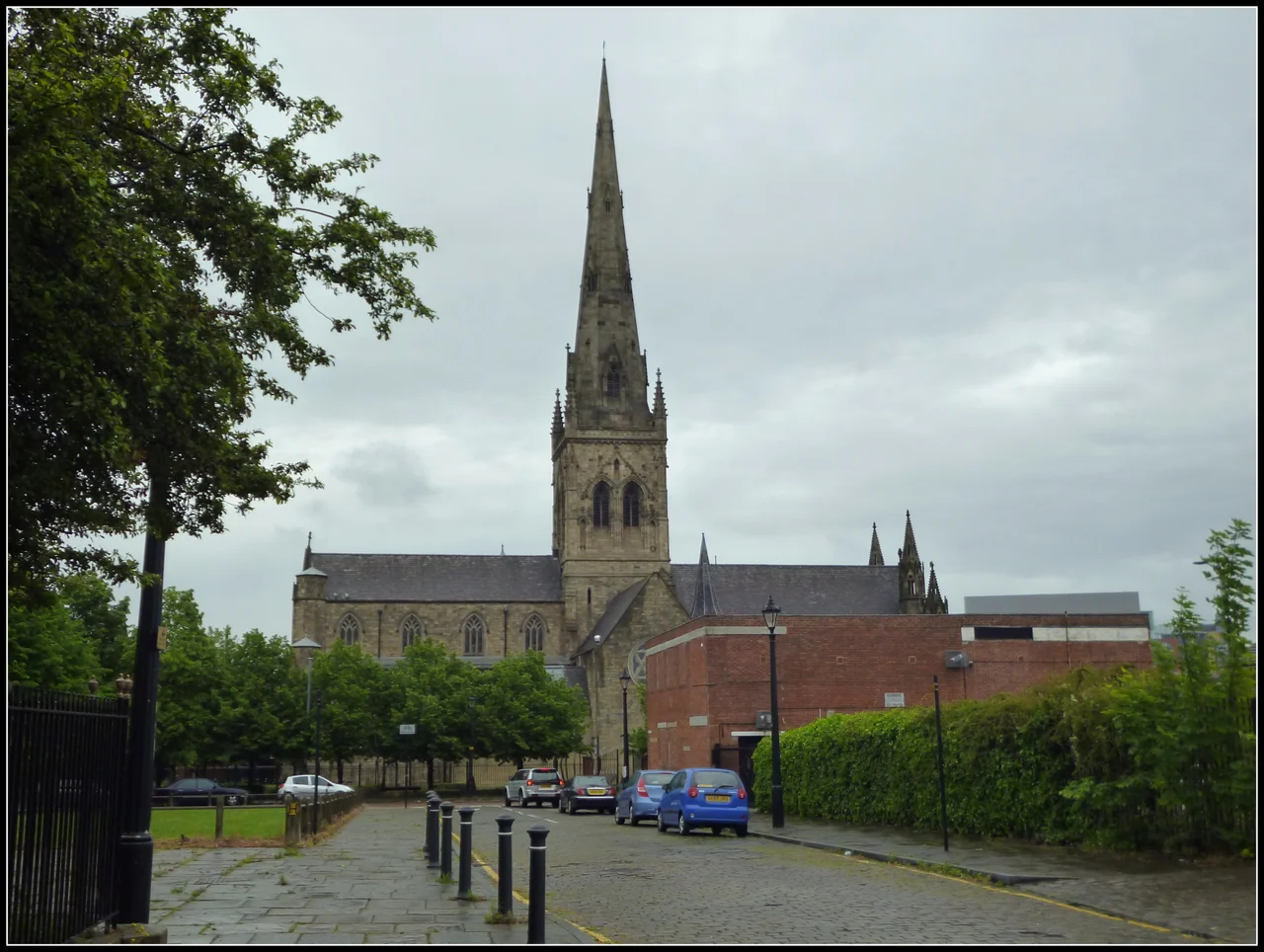
When Matthew Ellison Hadfield drew up plans for a new Catholic church in Salford in the 1840s, he did something audacious. He designed not just a parish church but the first cruciform Catholic church to be built in England since the Reformation - a statement, three centuries after Henry VIII, that English Catholics could once again build great churches in the open. He borrowed the front and nave from Howden Minster in Yorkshire, the choir and sanctuary from Selby Abbey, the vault decorations from St Jacques in Liege, and the spire from the church of St Mary Magdalene at Newark-on-Trent. When it was finished, its 240-foot spire was the tallest in Lancashire.
Foundation and Opening
The foundation stone was laid in 1844 by Bishop James Sharples, coadjutor to Bishop George Brown, then Vicar Apostolic of the Lancashire District. Two local businessmen, Daniel Lee and John Leeming, each donated a thousand pounds, and the total cost came to eighteen thousand. The church opened on 9 August 1848 with a Solemn High Mass attended by the Bishops of all the Vicariates of England and Wales. Four years later, after Pius IX restored the Catholic hierarchy in 1850, St John's was elevated to cathedral status - one of the first four Catholic cathedrals in England and Wales since the English Reformation. On 25 July 1851, William Turner was consecrated here as the first Bishop of Salford.
Storms and Patches
Lancashire weather did not respect Hadfield's spire. In October 1881, a violent storm tore at the stonework, and Canon Beesley spent years raising funds to repair it. The same canon commissioned Peter Paul Pugin - third son of the famous A.W.N. Pugin - to furnish a new Blessed Sacrament chapel in 1884. In 1919-20, the turrets on the west front were found to be in danger of toppling onto Chapel Street; Charles M. Hadfield, grandson of the original architect, oversaw their rebuilding. By 1934 the spire itself had drifted out of plumb and the civic authorities ordered the top sixty feet removed. The repairs were not finished until 1938, just in time for the cathedral to absorb damage in the Second World War.
A Cathedral in Layers
What you see inside Salford Cathedral today is the work of many hands across more than 170 years. The 1856 east window, by William Wailes of Newcastle, traces Catholic Christianity in England from St Augustine's conversion of Ethelbert in 597 to the restoration of the hierarchy in 1850. A 1971 reordering brought in a free-standing altar under the crossing, following the Second Vatican Council. A 1988 reordering removed George Goldie's original stone high altar. A new west window in 1994 marked the 150th anniversary of the foundation stone. In 2021 the cathedral closed for a multi-million-pound restoration that aimed to bring back some of the Victorian heritage stripped out in the 1970s. The work continues in stages.
The Bishop's Seat
Salford Cathedral is the mother church of the Roman Catholic Diocese of Salford, which today covers Manchester and a large part of North West England. It is a Grade II* listed building, and on a quiet weekday it can feel underused - a vast neo-Gothic interior in a city that is otherwise busy reinventing itself. But on a feast day, when the four-manual digital organ installed by Makin in 2002 fills the nave, you understand why those bishops in 1848 thought the city deserved something on this scale.
From the Air
Salford Cathedral sits at 53.4836 degrees north, 2.261 degrees west, on Chapel Street just over the River Irwell from Manchester city centre. Manchester Airport (EGCC) lies about 12 km south-southeast. Manchester Barton (EGCB) is about 7 km west. From altitude the cathedral is identifiable by its tall spire and its position immediately west of the Irwell's tight loop around Manchester centre.
Nearby Stories
- National Science and Media Museum 0.2 km away
- Jodrell Bank Observatory 3.2 km away
- Siege of Lathom House 5.6 km away
- Chester Zoo 6.2 km away
- Whalley Abbey 8.9 km away
- Haddon Hall 10 km away
- Wentworth Castle 16 km away
- Blackpool 16 km away