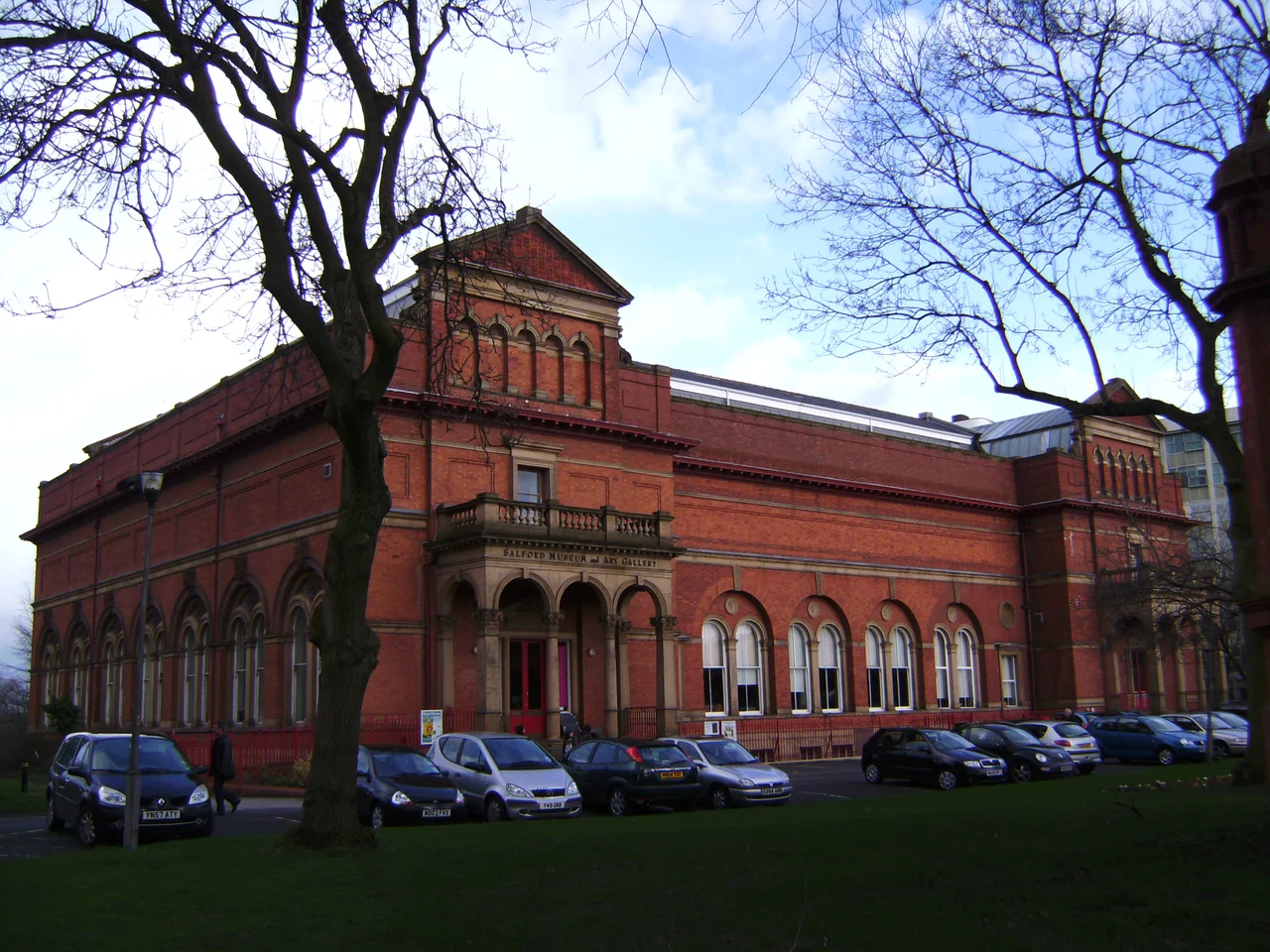

Salford Museum and Art Gallery
There is a Victorian street inside Salford Museum. Not a picture of one, not a wax tableau - an actual street, with shop fronts and lamps and the recorded ambience of a winter's evening, all kept indoors on the ground floor. The shop fronts are real ones, saved in 1957 when slum clearance was about to take them down. It is called Lark Hill Place, and it is the museum's strangest and most enduring exhibit - a piece of preservation done at a time when nobody talked about preservation, in a city that was busy demolishing its own past.
From Mansion to Museum
The site began as Lark Hill, a private estate with a mansion built in the late 18th century. In 1850, along with Queens Park and Phillips Park in Manchester, the estate was purchased by public subscription and converted into Peel Park - the parkland named for Robert Peel, who had contributed to the subscription. The new Royal Museum and Public Library opened in November 1850. The library was, by some accounts, the first unconditionally free public library in the country, opening months before the Public Libraries Act of 1850 even passed. The mansion itself was found in 1936 to be structurally unsound and was demolished, replaced by a new wing finished in 1938. Within five years the museum was drawing 1.6 million visitors.
Italianate Architecture, Top-Lit Galleries
The Grade II listed building has masonry pillars and detailed stonework, but its real architectural interest is upstairs. The top-lit galleries in the north and south wings are among the earliest examples of their type in Britain. The architects Travis and Mangnall were, in the words of one survey, key local exponents of a gracious Italianate style that had become characteristic of commercial architecture in Manchester from the 1840s onwards. In 1874, Edward Langworthy, former mayor of Salford and an early supporter of the museum, left a bequest of ten thousand pounds. It paid for the west wing - now called the Langworthy Wing - that connects the north and south galleries and today serves as the entrance.
Lark Hill Place
By the 1950s, central Salford was being demolished at speed. Victorian terraces and shopfronts that had stood for a century were coming down to make room for tower blocks and new roads. Someone at the museum had the foresight, in 1957, to save not entire buildings but the facades - to bring the shop fronts indoors, reassemble them along a corridor, and furnish their interiors with the objects and signage of the period. The result is Lark Hill Place: a butcher, a chemist, an ironmonger, all under one roof, with the soundscape of a winter's evening playing through hidden speakers. It is, in effect, a small act of conservation done decades before that word became part of British civic vocabulary.
Victorian Salford in Paint
Upstairs in the galleries, the Victorian theme continues in paint. The collection focuses on Victorian art and architecture, with works by Bokelmann, Charles Landseer, Philip Hermogenes Calderon, William Bruce Ellis Ranken and others. There are portraits of local notables like the engineer Joshua Routledge and the 14th Earl of Derby, Lord Stanley. The museum's mission - to preserve and explain the history of Salford and the Victorian world that made it - has stayed remarkably consistent across nearly two centuries. The building has changed; what it does has not.
From the Air
Salford Museum and Art Gallery sits at 53.4852 degrees north, 2.2718 degrees west, within Peel Park beside the University of Salford campus. Manchester Airport (EGCC) lies about 13 km south-southeast. Manchester Barton (EGCB) is about 6 km west-southwest. From altitude look for the green expanse of Peel Park just north of the River Irwell loop, with the university buildings clustered around it.
Nearby Stories
- National Science and Media Museum 0.2 km away
- Jodrell Bank Observatory 3.2 km away
- Siege of Lathom House 5.6 km away
- Chester Zoo 6.2 km away
- Whalley Abbey 8.9 km away
- Haddon Hall 10 km away
- Wentworth Castle 16 km away
- Blackpool 16 km away