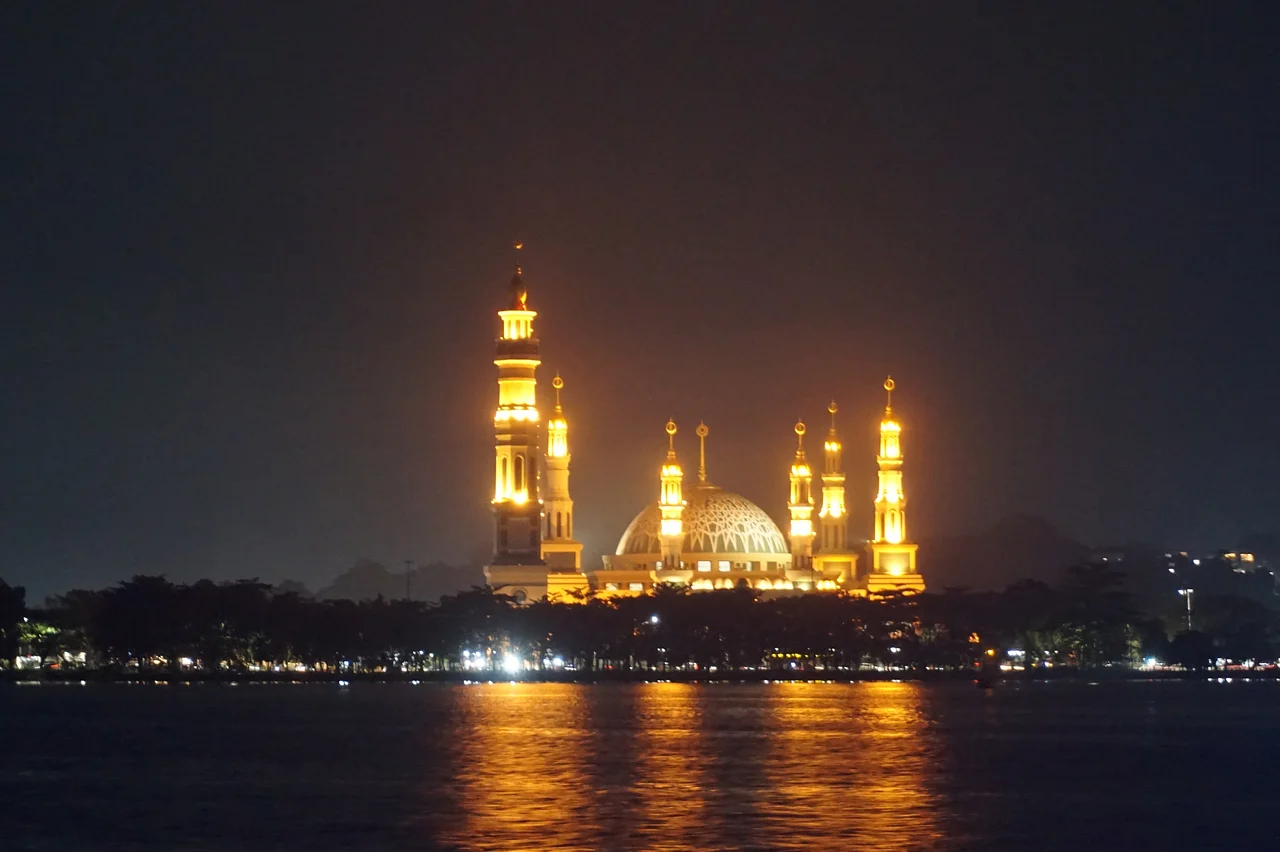

Ninety-Nine Names in the Sky Over Samarinda
Count the steps from the ground floor to the main prayer hall of the Baitul Muttaqien Mosque in Samarinda. There are exactly thirty-three, one-third the number of beads on an Islamic prayer strand. This is not coincidence. Every number in this building carries meaning, and every dimension tells a story of faith translated into concrete and steel. The mosque's main tower stretches 99 meters into the equatorial sky -- one meter for each of the Asmaul Husna, the 99 names of Allah. Its six flanking minarets represent the six pillars of Islam. In a city built on coal and timber money, the Samarinda Islamic Center Mosque is East Kalimantan's most deliberate act of devotion.
From Sawmill to Sanctuary
The land where the mosque now stands was once an industrial sawmill operated by PT Inhutani I, a state-owned forestry company. In 2001, the Provincial Government of East Kalimantan acquired the site and began planning what would become one of the largest mosques in Southeast Asia, second only to Jakarta's Istiqlal Mosque. The location was no accident: it sits along the Mahakam River in the Teluk Lerong Ulu subdistrict of Sungai Kunjang, placing the mosque at the spiritual and geographic heart of Samarinda. Funding came exclusively through the East Kalimantan Provincial Budget, with the total cost reaching approximately 400 billion rupiah allocated across multiple budget years. The project involved formal approvals from provincial officials and religious leaders, including representatives from the Indonesian Ulema Council's East Kalimantan chapter. The mosque was inaugurated in 2008.
A Geometry of Faith
The numbers are everywhere, and none are arbitrary. The main tower rises 99 meters across 15 floors, each averaging 6 meters in height, making it a landmark visible for kilometers along the Mahakam. Four corner minarets reach 70 meters, while two gate minarets stand at 57 meters. Together, the seven towers create a skyline that dominates Samarinda from virtually every approach. The building's footprint is immense: 43,500 square meters of total building area, with a ground floor of 10,270 square meters and a main prayer floor of 8,185 square meters. A mezzanine balcony adds another 5,290 square meters. Beneath it all, a 10,235-square-meter basement and 7,115 square meters of supporting structures complete the complex. The mosque can accommodate over 10,000 worshippers for Friday prayers, and its architectural influences blend Middle Eastern and Turkish design traditions with elements reminiscent of the Blue Mosque in Istanbul and the Masjid Nabawi in Medina.
The River's Congregation
Seen from the Mahakam Bridge, the mosque presents its most dramatic face -- the massive dome and seven minarets reflected in the river that has defined Samarinda for centuries. The Mahakam has been a highway for the Dayak people, the Kutai sultanate, Dutch colonizers, Japanese occupiers, and the coal barges that fuel modern Kalimantan's economy. Along its banks, Islam arrived in the 16th century through Javanese preachers, and it has shaped daily life ever since. The mosque's position on the river connects it to this long spiritual lineage. On Friday afternoons, when the call to prayer echoes across the water and thousands of worshippers fill the prayer hall and overflow onto the grounds, the building fulfills the vision its planners intended: a place where the scale of devotion matches the scale of the landscape. In a province where fortunes rise and fall with commodity prices, the mosque is meant to endure as something coal money built that transcends coal.
Monument and Meeting Place
For visitors approaching Samarinda by air or river, the mosque is the first landmark that registers. Its minarets pierce the canopy of a low-slung tropical city, and the dome catches equatorial light in ways that shift throughout the day. But the building is more than a monument. The complex functions as a community center, educational facility, and gathering place. The basement floors house meeting rooms and administrative offices. The grounds host religious celebrations, community events, and the daily rhythm of five prayer times that structures life across the Islamic world. East Kalimantan's identity has long been defined by extraction -- of timber, coal, oil, and gas. The Samarinda Islamic Center Mosque represents a different kind of investment: not in what lies beneath the ground, but in what a community believes rises above it.
From the Air
The Samarinda Islamic Center Mosque is located at approximately 0.50S, 117.12E, on the banks of the Mahakam River in Samarinda, East Kalimantan. The seven minarets and large dome are visible from cruising altitude and serve as a strong visual reference for identifying Samarinda. The main tower at 99 meters is one of the tallest structures in the city. Nearby airport: APT Pranoto Airport (WALS) at Samarinda, approximately 15 km to the northeast. Sultan Aji Muhammad Sulaiman Airport (WALL) at Balikpapan is roughly 120 km south. Best viewed at 3,000-10,000 ft. Expect tropical humidity and frequent afternoon convective weather.
Nearby Stories
- The Mahakam: Borneo's River of Kingdoms and Dolphins 26 km away
- Building a Capital From Scratch in the Borneo Rainforest 30 km away
- Badak LNG: Borneo's Gas Giant 41 km away
- The Invisible Wall of Makassar Strait 46 km away
- Palu: The City That Knows the Ground Can Move 237 km away
- Cutting the Orchid in Half: The Proposed Sulawesi Canal 248 km away
- Sixty Seconds Over Banjarmasin 266 km away
- Oil, Empire, and the Fight for Borneo 303 km away