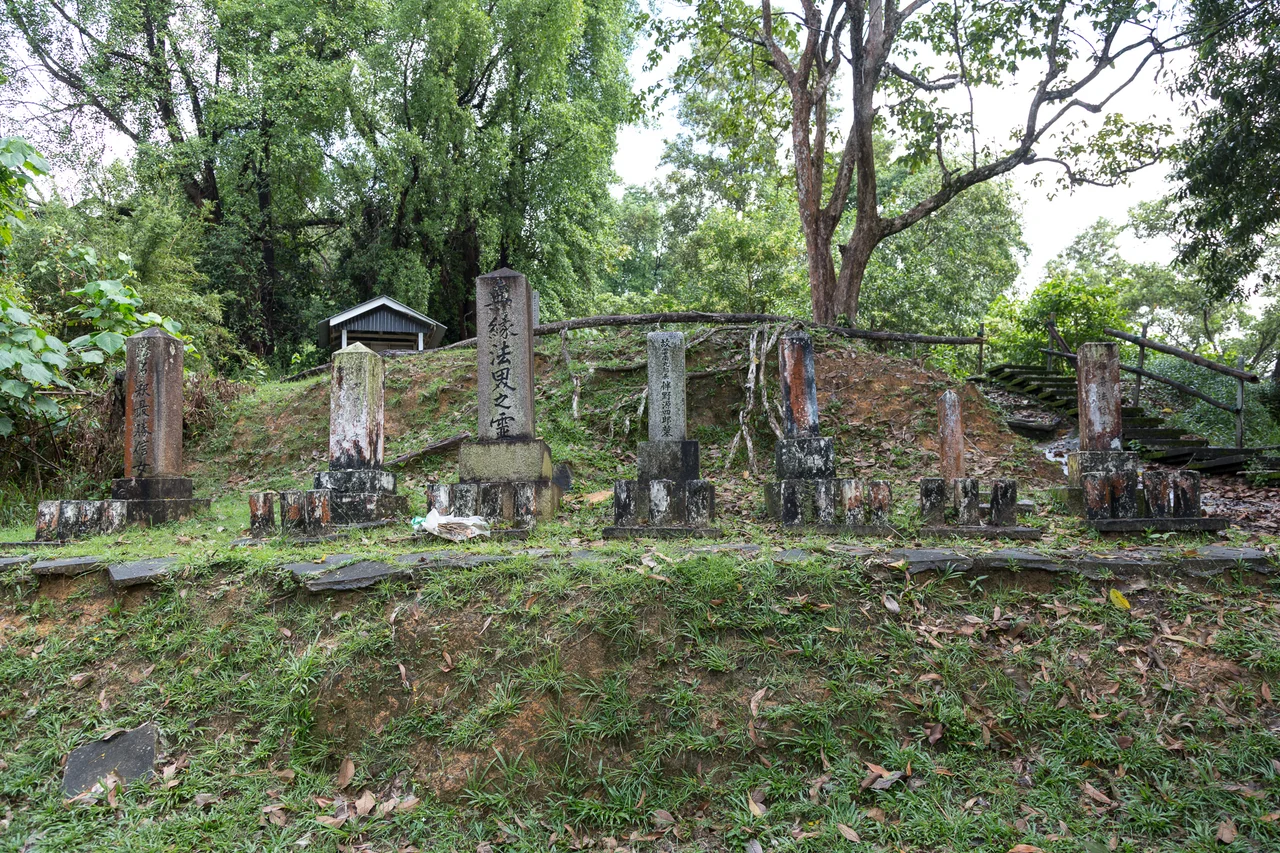

Sandakan Japanese Cemetery
The graves face the wrong way. In Japanese burial tradition, the deceased are typically oriented with their heads pointing north or west. But in the old cemetery on a hill two kilometers from Sandakan's town center, many of the women buried here have their feet pointing toward Japan. Whether this orientation was a deliberate final gesture of condemnation toward a homeland that sold them into exploitation, or simply an accident of geography, depends on whom you ask. What is not in dispute is who these women were: they were Karayuki-san, daughters of impoverished Japanese farming families who were sent overseas as young girls, ostensibly to work as maids, and then forced into prostitution in the brothels of colonial Southeast Asia.
The Okuni of the South Seas
The cemetery was founded in 1890 by Kinoshita Kuni, born on 7 July 1854 in Futae Village, Amakusa County, Kumamoto Prefecture. She managed what was known as Brothel No. 8 in Sandakan, and she was, by all accounts, an unusual figure in that grim industry. Fluent in English, she became influential enough to earn the title "Okuni of the South Seas." The women in her establishment reportedly received better treatment than those in other Japanese brothels in town, and many young women sought her guidance and protection. That she was both a participant in the system that exploited these women and a protector within it is a contradiction the historical record does not resolve. She established the cemetery so that the women who died in Sandakan would at least have a proper burial ground.
Daughters of Poverty
The Karayuki-san came overwhelmingly from poverty-stricken agricultural prefectures in Japan, families of low social status who saw their daughters as economic instruments. The girls were sent overseas under the pretense of domestic service, then channeled into prostitution networks that stretched from Sandakan to Singapore to Vladivostok. They were, in the plainest terms, victims of human trafficking -- though the phrase did not yet exist in the language of their era. Those who survived eventually aged out of the trade, but many had nowhere to go. Their families did not want them back. Japan, modernizing rapidly and cultivating an image of national respectability, preferred to forget they existed. The headstones in the cemetery, many inscribed with Japanese characters now weathered nearly illegible, are among the few physical traces these women left.
Comfort Women and War
The cemetery's population expanded during World War II, when the Japanese military's system of so-called "comfort women" -- women forced into sexual servitude for soldiers -- added another layer of exploitation to Sandakan's already troubled history. The women interred here during the wartime period joined the Karayuki-san of the earlier decades, their graves side by side on the same hillside. Together, they represent nearly six decades of institutionalized sexual exploitation, spanning from the late nineteenth century through the war years. The cemetery, part of the Sandakan Heritage Trail today, stands as one of the few places in Southeast Asia where this history is physically present rather than abstractly acknowledged.
Feet Toward Japan
The detail that draws visitors -- the orientation of the burials, feet toward Japan -- carries an emotional weight that transcends the question of intentionality. Even if the positioning was not a conscious act of defiance by the women or those who buried them, it has become one in retrospect. These were women exported from their own country, exploited abroad, and then forgotten. That their final resting place faces away from Japan has become a powerful symbol, whether or not it was designed as one. The cemetery sits quietly on its hill above Sandakan, shaded by tropical vegetation, its headstones slowly succumbing to the climate. It asks nothing of visitors except that they remember the women buried here were real people with real names, sent far from home to lives they did not choose.
From the Air
Located at 5.844N, 118.125E on a hillside approximately 2 km from Sandakan's central business district. The cemetery is part of the Sandakan Heritage Trail. Nearest airport is Sandakan Airport (WBKS). From the air, the cemetery's hilltop location is distinguishable amid the urban fabric of Sandakan. Best viewed at 1,500-2,500 feet on approach from the north over Sandakan Bay.
Nearby Stories
- Gomantong Caves 18 km away
- Tabin Wildlife Reserve 44 km away
- Jambongan Island 59 km away
- North Borneo 63 km away
- Nunuk Ragang 66 km away
- USS S-36 105 km away
- Banggi Island 150 km away
- Tubbataha Reef 347 km away