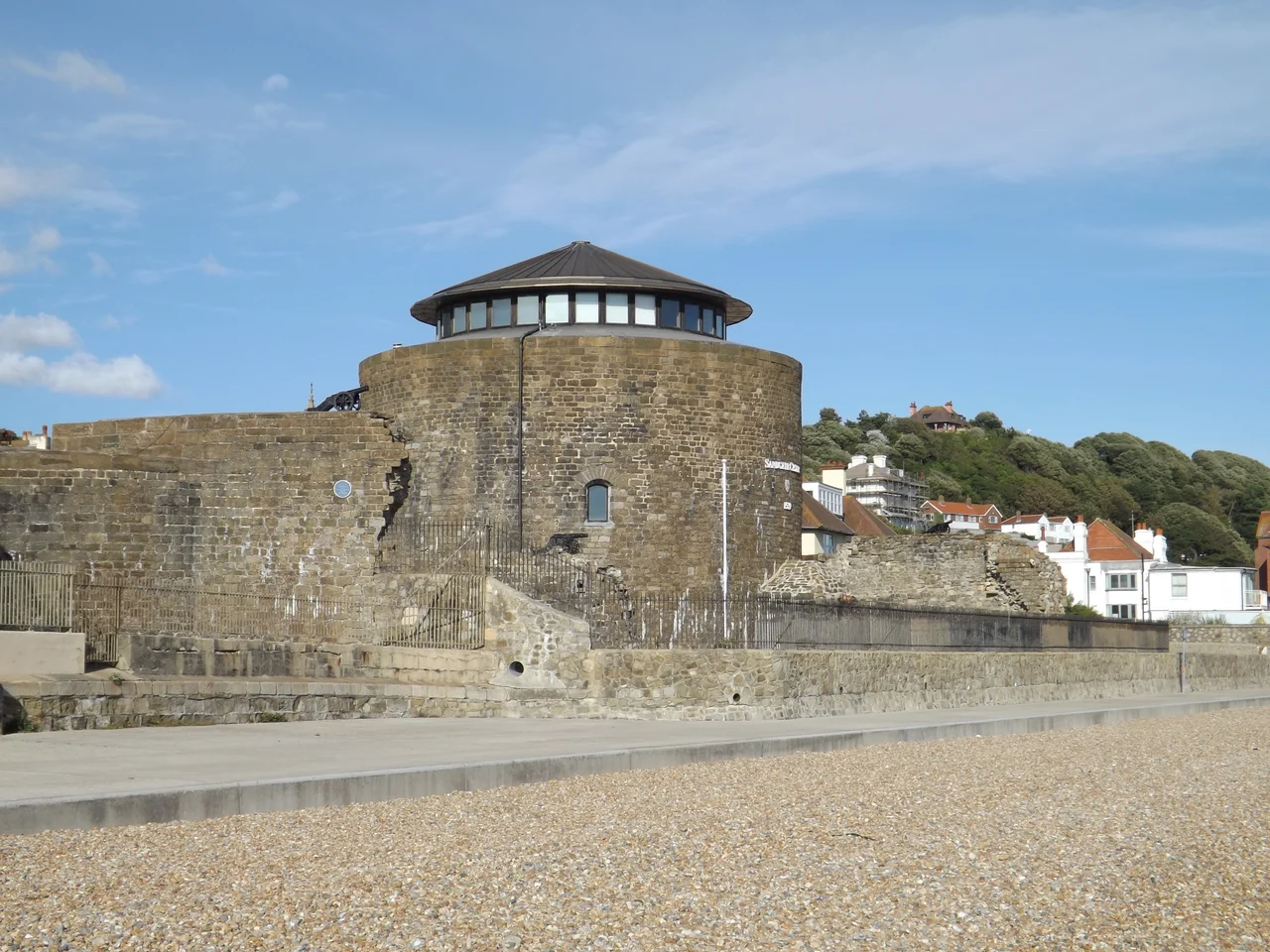

Sandgate Castle
The historian Peter Harrington describes the two leather-bound ledger books in the British Library - 350 pages, written by a sixteenth-century clerk called Thomas Busshe - as the most complete building account of any Tudor fortification anywhere in England. They record every Caen stone hauled down from Somerset and Gloucestershire, every barrel of mortar mixed wrong, every Caen stone recycled from the recently dissolved priories of Christ Church and Horton - 459 tons of it, ripped from monastic walls in Henry VIII's purge and reassembled into the gun ports of Sandgate Castle. Construction ran from 1539 to autumn 1540. Five hundred and thirty men worked on it at peak summer in 1540. Total cost: £5,584. The castle was built to defend a gap in the chalk cliffs west of Folkestone where French ships could land troops. By the early seventeenth century it was already crumbling. By the 1950s, the southern third had been entirely destroyed by the sea.
The King's Device
In 1533, Henry VIII broke with Pope Clement VII to annul his marriage to Catherine of Aragon. Catherine was the aunt of Charles V, Holy Roman Emperor. Charles took the annulment as a personal insult to his family, and in 1538 he and France formed an alliance against Henry. The Pope encouraged them to invade England. England's coastal defences in 1538 were inadequate - the Crown had traditionally left such things to local lords and communities, and most fortifications consisted of modest blockhouses and old towers. Henry responded by issuing in 1539 a 'device' - an instruction giving instructions for the 'defence of the realm in time of invasion' - and ordered a chain of artillery forts built along the south coast. Sandgate was one of them, supervised by a Moravian military engineer named Stefan von Haschenperg. Its design was sophisticated for its date: a circular keep at the centre, three ovoid towers and bastions around it, a gatehouse to the north - all connected by three-storey covered stone passageways and surrounded by two curtain walls. The whole structure could mount four tiers of artillery and had 142 firing points for cannon and handguns. The threatened invasion of 1539 never came. The castle stood ready anyway.
Civil War and Mary Grey
Henry himself may have visited the new castle in May 1542 when he was in Folkestone. Elizabeth I came in 1573, and used the place as a prison: the courtier Thomas Keyes was held at Sandgate after he secretly married Lady Mary Grey - the youngest sister of Lady Jane Grey, the queen of nine days - against Elizabeth's wishes. By 1609 the garrison had shrunk to a captain, his lieutenant, five soldiers, two porters, and ten gunners. By 1616 the mortar was decaying and the proposed repairs cost £260. By 1623 the sea had collapsed a third of the southern wall. By 1627 the captain reported that the castle was 'neither habitable or defensible against any assault'. In 1642, Parliamentary forces took Sandgate at the start of the First English Civil War. In 1648, Royalists briefly seized it during the Second Civil War, along with the other Henrician castles of Walmer, Deal, and Sandown. Parliament won the broader insurrection at the Battle of Maidstone and sent Colonel Rich to retake the Kentish castles. Sandgate fell back into Parliamentary hands later that August.
Becoming a Martello Tower
By the early nineteenth century the sea had eaten further into the cliff and the castle was again in serious decay. Brigadier-General William Twiss surveyed the south coast in 1804 and proposed a chain of fifty-eight new defensive towers. Sandgate was to be converted into what he called a 'secure sea battery'. Work began in 1805 and ran until 1808. The project drastically lowered the castle's height, destroying much of the original Tudor structure in the process. The rubble was used to backfill the outer ward, raising its level and turning the inner ward into a dry moat. The circular keep was rebuilt as a Martello tower - the kind of compact circular artillery fortification the British copied from a Corsican tower at Mortella Point that had given the Royal Navy a hard time in 1794. Sandgate's Martello had an unusual sliding drawbridge that retracted into the floor, a brick magazine on the ground floor, and a single large gun emplacement on the roof. The modified castle held eight 24-pounder guns along the outer wall, plus guns on the southern bastion and the keep itself. Garrison: forty men.
The Sea Wins
Coastal erosion never stopped. Severe flooding in 1875 and 1878 created serious fissures in the stonework. The high costs of maintenance and the castle's dwindling military value drove the government to sell it in 1888 - to the South Eastern Railway company, which planned to turn it into a railway station. That plan never happened. Sandgate passed through private hands instead. Storms in 1927 and 1950 undermined large sections; by the time a new seawall was built in the early 1950s, the entire southern third of the castle had vanished into the Channel. Between 1975 and 1979, the archaeologist Edward Harris excavated what remained, and Peter and Barbara McGregor restored what was left, turning the keep into a private residence. In 2000, Lord Geoffrey Boot acquired the castle. It is still privately owned today, protected under UK law as a Grade I listed building. The two leather ledgers from Thomas Busshe sit in the British Library, recording in three-and-a-half centuries-old handwriting the cost of every stone Henry VIII's masons laid - a complete record of a fortification the sea has been slowly, patiently, taking back.
From the Air
Sandgate Castle sits at 51.073°N, 1.149°E on the Kent coast at Sandgate, between Folkestone and Hythe. From the air, look for the surviving keep and gatehouse beside the seawall, with the modern road and seawall now occupying the line where the southern third of the castle used to stand. The castle is privately owned and not generally open to the public. Folkestone harbour is 2.5 km east; Hythe is 4 km west. The Royal Military Canal terminates near Hythe. Nearest airport is London Ashford (Lydd) (EGMD) about 22 km southwest. Best viewed at low altitude from offshore to see the relationship between the castle, the beach, and the sea wall.
Nearby Stories
- HMS Hermes (1898) 7.3 km away
- Herne Bay Museum and Gallery 8.5 km away
- Benenden School 9.2 km away
- Boulonnais 9.4 km away
- Priestfield Stadium 12 km away
- 1382 Dover Straits Earthquake 17 km away
- Royal Sovereign Lighthouse 21 km away
- Battle of Boulogne 28 km away