
Santiago Metropolitan Cathedral
The cathedral that faces Santiago's Plaza de Armas is the fifth church to stand on this spot, and the four that came before it all met violent ends. Earthquakes cracked them. A fire devoured one in a single night. The Spanish chose the corner in 1541, raising their first chapel of straw and mud on ground where an Inca temple had stood, and the city has been rebuilding its great church here, stubbornly, ever since. The current building took roughly eighty years to complete and survived everything the Andes threw at it.
Built on Older Gods
When the conquistador Pedro de Valdivia refounded Santiago in 1541, he laid the city out on the site of an Inca tambo, a way station on the empire's vast road network. He assigned the northeast side of the Plaza Mayor for a church, planting Catholic worship directly atop the sacred geography it meant to replace. The first services were held in the open air, at the door of the governor's house, until a proper building could rise. By 1544 the records show that mass was no longer being said outdoors, so some kind of permanent structure already stood. A more substantial cathedral of stone went up between 1566 and 1600, modest in scale but richly decorated, and over the centuries its main door shifted to face the square through the so-called Puerta del Perdón, the Door of Pardon. From the start, the church and the square grew together, the spiritual and civic hearts of the colony sharing the same dusty plaza.
The Restless Earth
Central Chile lies on one of the most seismically violent margins on Earth, and the cathedral's history reads like a seismograph. A great earthquake on May 13, 1647, flattened much of Santiago and ruined the church, though its central nave somehow held. A decade later another quake nearly finished the job, forcing a second reconstruction. When the 1730 Valparaíso earthquake cracked the structure yet again, the bishop concluded that patching was pointless. The whole thing would have to be rebuilt. On July 1, 1748, workers laid the first stone of an entirely new cathedral, designed at first by two Bavarian Jesuits and oriented along a new axis, its altar toward Bandera Street and its façade commanding the square.
Fire and the Italian's Hand
On the night of December 22, 1769, fire broke out in the old cathedral, probably from spilled lamp oil near the Blessed Sacrament. Church bells across the city rang the alarm, and crowds rushed to the plaza, but the building was lost. Only an image of the Virgin of Sorrows was saved. The disaster, grim as it was, sped the new construction along. In 1779 the Italian architect Joaquín Toesca arrived to direct the work, and over nearly two decades he reshaped it in the restrained, harmonious lines of Neoclassicism. Toesca became the defining figure of the cathedral, the man whose vision finally gave the long-suffering church a coherent face.
Eighty Years to a Cathedral
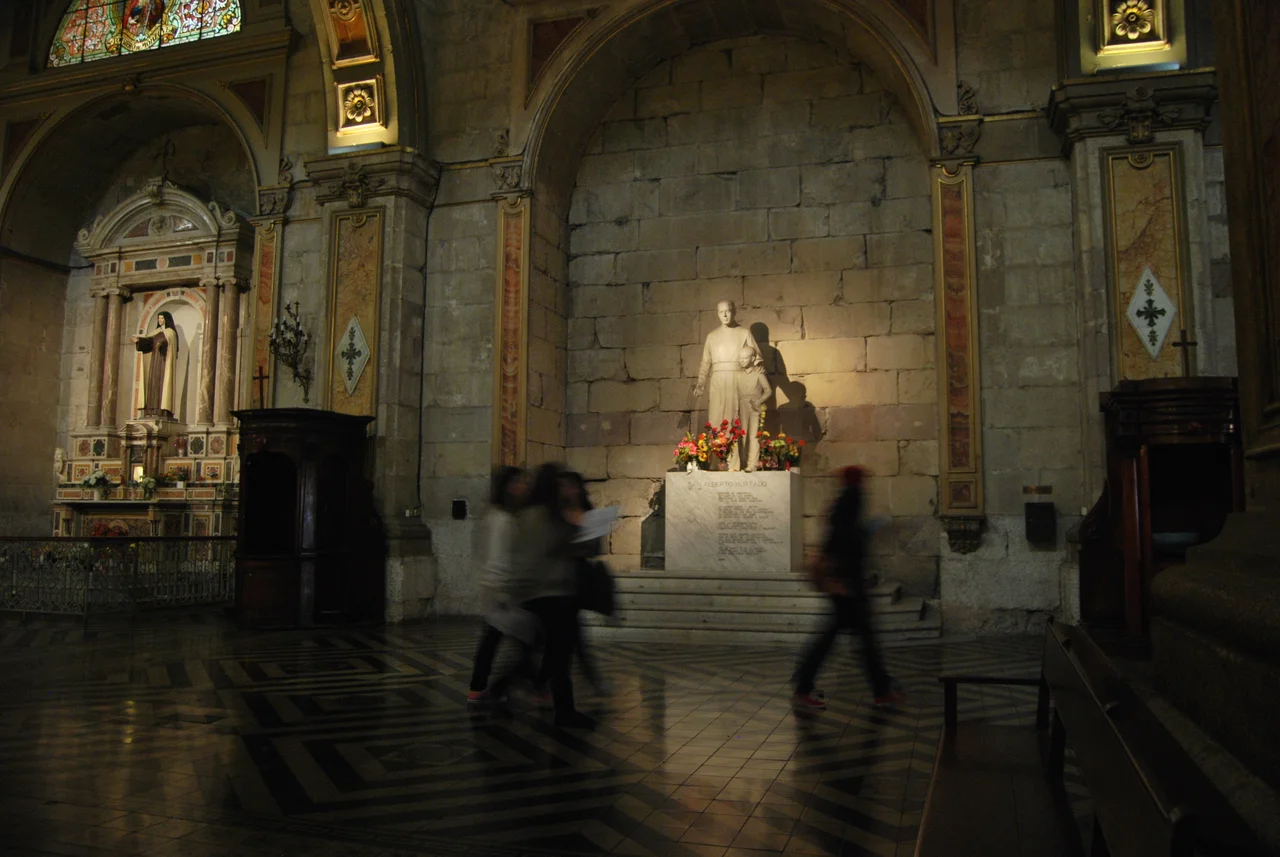
In 1840 Pope Gregory XVI elevated Santiago to an archdiocese, turning the church into a Metropolitan Cathedral. Yet it still was not finished. At the end of the century, Archbishop Mariano Casanova hired Ignacio Cremonesi, who clad the stone in stucco, painted the ceiling, and raised two towers over the façade in a Tuscan-Roman manner. On May 5, 1906, the completed cathedral was finally consecrated, roughly eighty years after work had begun in earnest. Step inside today and the layers of that long labor surround you: three soaring naves spanning some 4,500 square meters, a pipe organ built by German Jesuits in 1754 that still plays, side altars holding relics of Chilean saints, and a crypt where the archbishops of Santiago lie. A marble urn near one door even preserves the hearts of officers killed in the 1882 Battle of La Concepción - a reminder that this church holds the nation's memory as much as its faith.
From the Air
Santiago Metropolitan Cathedral stands at roughly 33.438 degrees south, 70.652 degrees west, on the west side of the Plaza de Armas at the exact center of Santiago's colonial grid. Its twin façade towers and the open rectangle of the plaza make it one of the easiest landmarks to pick out over the dense downtown. The nearest major airport is Arturo Merino Benítez International (ICAO: SCEL), about 15 km to the northwest. Santiago sits in a bowl beneath the Andes; haze often fills the basin by afternoon, so morning approaches give the clearest view of the historic core.
Nearby Stories
- Paine Memorial 21 km away
- 1947 BSAA Avro Lancastrian Star Dust accident 23 km away
- Battle of Chacabuco 31 km away
- La Campana National Park 36 km away
- Puente del Inca 44 km away
- Casa de Isla Negra 62 km away
- Santa Cruz, Chile 103 km away
- Pierre Auger Observatory 172 km away