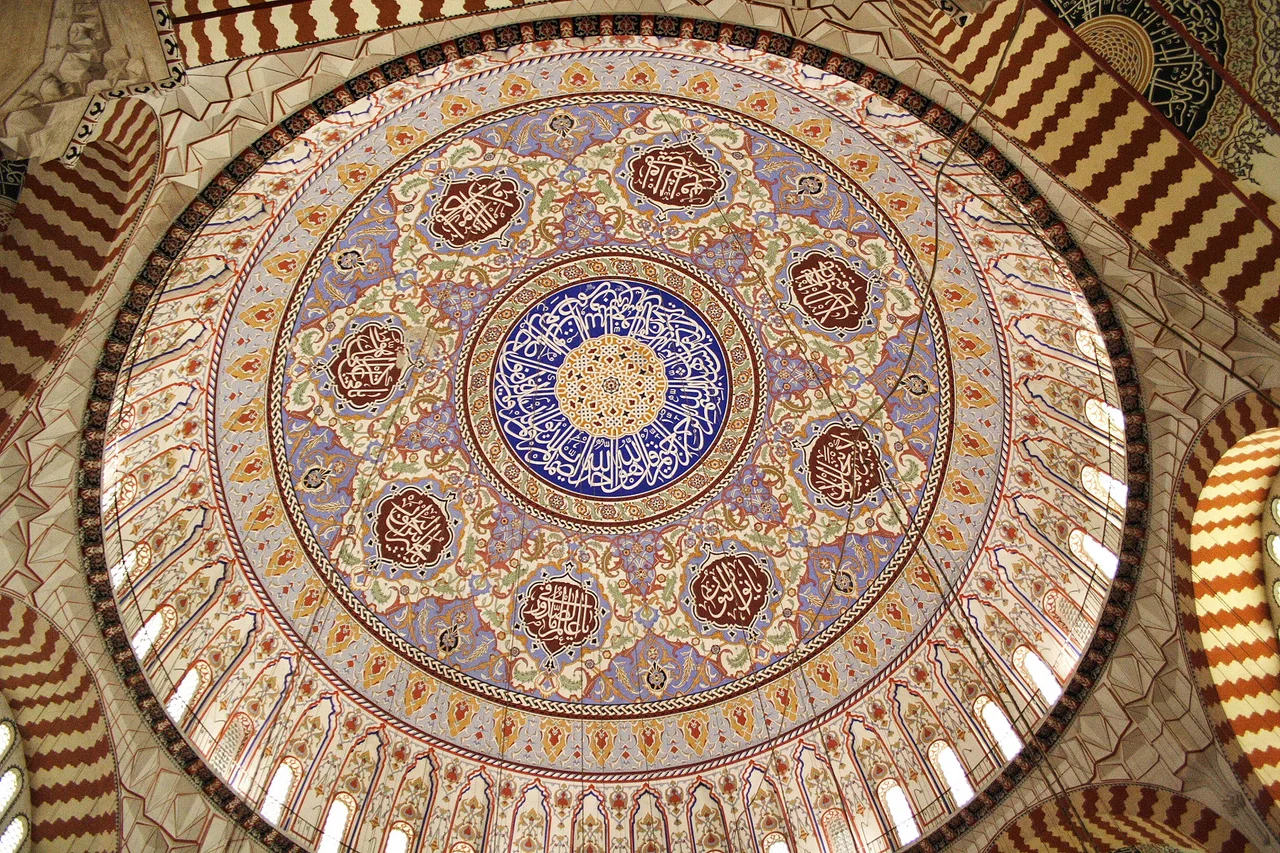

Selimiye Mosque, Edirne
Sinan was eighty years old when he finished it, and he was not modest about what he had done. In his biography, dictated to his friend Sa'i Mustafa Çelebi, the imperial architect declared plainly that at Selimiye he had built a dome six cubits higher and four cubits wider than the dome of Hagia Sophia. Christian architects, he said, had insisted Muslims could never match that thousand-year-old Byzantine wonder. Sinan answered them with a single hemisphere of stone, 31.28 meters across, rising 42 meters above the floor of a hilltop mosque in a Thracian city that had once been the Ottoman capital.
Why Edirne, Not Istanbul
Sultan Selim II commissioned the mosque, and the choice of city is itself part of the story. Selim was the son and successor of Suleiman the Magnificent, and he had inherited an empire at the apex of its power. The natural place for a sultanic mosque was Istanbul. Selim built his somewhere else. Historians still debate exactly why. Selim had served as governor of Edirne between 1548 and 1550, and he kept returning to the city as sultan, suggesting genuine attachment. Edirne had been the Ottoman capital before Constantinople fell, and remained one of the empire's most important cities, a major stop on the imperial road between Istanbul and the Balkan provinces. Some scholars suggest more practical reasons: there were no remaining hilltop sites in Istanbul prominent enough for an imperial complex without massive expropriations of property. There was also a religious convention: an Istanbul sultanic mosque was supposed to be funded from the spoils of a victorious campaign, and Selim had not personally led one. The conquest of Cyprus, completed in 1571 with the surrender of Famagusta, eventually provided the funding. Selim did not live to see the mosque finished. He died in December 1574, just months before its completion.
What Sinan Was Doing
Sinan had spent decades experimenting with how to support a great central dome. The Suleymaniye Mosque in Istanbul, his earlier masterwork for Selim's father, had used a system of two great semi-domes flanking the main dome, an arrangement borrowed from Hagia Sophia. At Selimiye he abandoned this. Instead he used what scholars call the octagonal baldaquin: eight massive pillars, set into the rectangular shell of the building, support the great dome directly. The semi-domes at the corners are small, almost decorative. The eight pillars are partially freestanding but integrated into the outer walls, with additional buttresses concealed in the outer shell so that the walls between them could be opened with windows. Light pours in from every direction. The dome floats. Sinan's other innovation here was the muezzin's platform. Tradition placed it to one side, leaving the view from the entrance to the mihrab unobstructed. At Selimiye, Sinan put the platform directly under the center of the dome, blocking the line of sight to the prayer niche. Visitors entering for the first time look up rather than ahead. He never repeated this anywhere else.
The Four Minarets
From outside, the mosque is framed by four identical minarets, each 70.89 meters tall, among the tallest ever built in the Ottoman tradition. They stand at the four corners of the prayer hall, not the courtyard. Each minaret has three balconies, each accessed by a separate spiral staircase, so that three muezzins could climb at the same time without crossing paths. The traditional Ottoman approach had been to put minarets of varying heights at the corners of the courtyard, with the prayer hall framed by smaller pairs. Sinan's arrangement at Selimiye was about visual logic: the four identical shafts hold the central dome between them like the legs of a tabernacle. The composition is so balanced that decades later, when Hagia Sophia received a second pair of minarets in the same configuration during the reign of Murad III, the design was credited to Sinan as well. The Byzantine cathedral, in effect, was retrofitted to look more like Sinan's mosque.
Inside the Light
The interior reads as a single soaring room. The mihrab sits in an apse-like projection at the far end, set back from the main hall and lit on three sides by windows, so that the Iznik tiles flanking it sparkle in changing daylight throughout the day. The minbar beside it is one of the finest carved stone pulpits in Ottoman architecture, its surfaces patterned with pierced geometric arabesques. The sultan's private balcony, the hunkar mahfili, occupies an elevated position in the eastern corner, walled in tiles whose blues and turquoises remain among the high points of the Iznik tradition. Most of the painted decoration visible today dates from a 19th-century restoration, but fragments of the original Classical-period work survive on the wooden surfaces of the muezzin's platform. Calligraphy by Hasan Karahisari, an apprentice of the great Ahmed Karahisari, was praised by Ottoman writers who saw it new. The windows were probably originally fitted with colored Venetian glass.
What Surrounds It
The mosque stands at the center of a kulliye, the Ottoman charitable complex that bound a great mosque to its supporting institutions. Inside the perimeter wall are two madrasas, schools for Quranic recitation and for hadith, arranged symmetrically around the central axis. Both have small domed cells around an internal courtyard, with a larger domed classroom on one side. Sinan completed both while he was still in Edirne overseeing the mosque itself. A primary school and a covered market street were added later along the southern perimeter, possibly by Davud Agha, his successor as chief court architect. The mosque and its complex were inscribed on the UNESCO World Heritage List in 2011. A multi-year restoration project began in late 2021. Modern Ottoman-style mosques continue to model themselves on Selimiye: the Sabanci Merkez Mosque in Adana, completed in 1998, drew on it directly, as did the Nizamiye Mosque in South Africa, which at 80 percent of Selimiye's size is the largest mosque in the Southern Hemisphere.
From the Air
The Selimiye Mosque crowns a hilltop in central Edirne at 41.68N, 26.56E, in the European part of Turkey near the Greek and Bulgarian borders. From altitude the four matching minarets and the great central dome are unmistakable, the building dominating the skyline of the old city. Recommended viewing altitude is 4,000-6,000 feet for the full hilltop composition. The mosque sits about 230 km northwest of Istanbul. Closest airports are Edirne's small Cakirgozu (LTBU) and Tekirdag Corlu (LTBU is occasionally used differently in databases; Corlu's ICAO is LTBU as well in older charts, modern use LTFC). Practically, traffic typically routes via Istanbul Ataturk-area airspace or Sofia (LBSF) to the north. The Maritsa River loops east of the city. Edirne's location at the Bulgaria-Greece-Turkey tri-border makes for complex airspace transitions; check current NOTAMs.
Nearby Stories
- Didymoteicho Fortress 16 km away
- 1928 Chirpan-Plovdiv Earthquakes 64 km away
- Ganos 85 km away
- Istanbul's Rural Outskirts 113 km away
- Great Basilica of Plovdiv 113 km away
- Samothrace temple complex 117 km away
- Buzludzha Monument 124 km away
- Varna Necropolis 149 km away