
Serra Pelada
They called themselves garimpeiros - prospectors - but Sebastiao Salgado, who photographed them in 1986, saw them for what they were: slaves without chains. Forty thousand men climbed wooden ladders out of a single hand-dug pit, each carrying a sixty-kilogram sack of ore on his back. They descended again, and again, and again - as many as 400 trips a day. The pit deepened. The ladders grew longer. When a man found a lode, he earned the right to wear a striped shirt. When a man slipped, the climb killed him, or the fall did, or the men below him did. This was not mining. This was a human anthill eating a mountain, and the world watched.
How the Gold Rush Began
In December 1979, a cowboy on the Tres Barras Farm in southeastern Para noticed something glinting in the Grota Rica stream. The farm belonged to a man named Genesio Ferreira da Silva. A local child, swimming downstream, pulled up a 6-gram nugget. Word moved fast. By the end of that week a gold rush had already begun, and within five weeks, 10,000 people were digging on Silva's land and another 12,000 were camped nearby. The settlement they built was named Serra Pelada - Bald Ridge - after the treeless hilltop where they mined once the stream was exhausted. Huge nuggets came out of the earth in those early months. The largest weighed nearly 6.8 kilograms, worth $108,000 in 1980 dollars. Silva, the farm owner, took 10 percent of everything until the federal government arrived and took over.
The Machine With No Machines
Until 1989, the entire operation was artisanal, meaning hand-dug. No pickaxes driven by compressed air. No conveyor belts. No excavators. Men with shovels cut the ore loose. Men with sacks carried it up ramps, then - as the pit deepened - up ladders that rose like skeleton spines from the pit floor. At its peak the mine held at least 100,000 people, making it one of the largest in the world. Water cost 3 dollars a liter at the mine, an obscene price for a basic need, paid by men who had sold everything to get here. Around 60 to 80 murders went unsolved in the village each month. In the nearby town of Trinta, thousands of women and underage girls engaged in prostitution for gold - the mine banned women from the pit itself but created, inevitably, a satellite economy of exploitation. This was the price of the dream: a town full of killings, a pit full of men whose bodies the work was quietly destroying.
The Major and the Massacre
The chaos alarmed the military dictatorship of President Joao Figueiredo. In 1980, Major Sebastiao Rodrigues de Moura - known as Sebastiao Curio, a veteran of the Araguaia counterinsurgency - was appointed Interventor Federal, a kind of federal overlord. Curio banned women, alcohol, and gambling at the mine. He organized a paramilitary force called the bate-paus, whose job was to enforce his rule, and he did so ruthlessly. The miners called him the Doctor and the Emperor of the Amazon, words that combined reverence and fear. In December 1987, after the mine had begun its long decline, a delegation of Serra Pelada residents led by Jane Resende blockaded the Maraba Mixed Bridge to demand resumption of mining and better conditions. Governor Helio Gueiros ordered 500 soldiers of the Brazilian Army to clear them. The soldiers cornered the protesters and opened fire for fifteen minutes. Official estimates eventually settled at 9 dead. Seventy-nine miners were reported missing in the aftermath. The event is remembered today as the St. Boniface Massacre or the Bridge Massacre, and its full toll has never been accounted for.
What Salgado Saw
When Sebastiao Salgado arrived at Serra Pelada in 1986, he was not the first photographer to visit. Most of those who came before him had stayed a day, shot in color, and left with a magazine spread. Salgado stayed four weeks and worked in black and white. His photographs - later collected in his Workers series and his book Gold - showed the pit from above as a single living organism, thousands of tiny figures moving up and down the ladders in rhythms that resembled pilgrimage. They showed individual faces streaked with mud and sweat. They forced viewers to do the math: if each sack weighed 60 kilograms, and if a man made 20 trips a day, and if there were 40,000 men in the pit, what were they collectively carrying on their bodies? The answer was a kind of horror. The photographs made Serra Pelada famous the way Salgado's work made so many forgotten places famous - by refusing to look away from the people the economy was grinding up.
The Pit Fills With Water
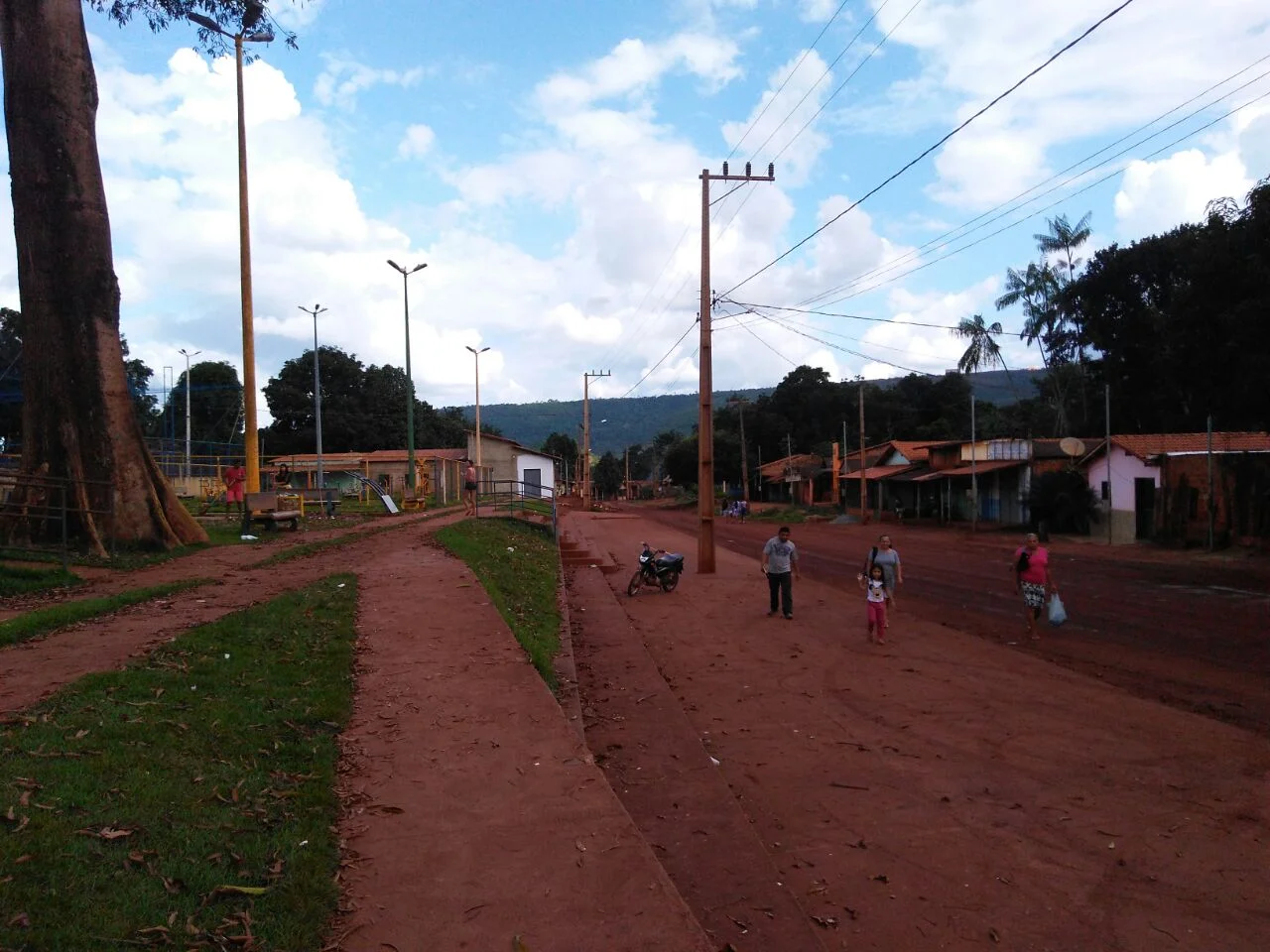
By 1992 the mine was closed, officially because of deadly landslides, though many miners accused President Fernando Collor of yielding to pressure from multinational mining concerns who wanted the site themselves. The pit quickly filled with rainwater and became a polluted lake, dosed with mercury from the years of crude gold extraction. People eating fish downstream showed elevated mercury in their blood. Serra Pelada hill - the bald mountain that gave the place its name - was completely destroyed by the mining, its top inverted into the pit. A parallel hill of mining debris sits beside the hole where the original stood, believed to contain gold tailings that nobody has yet found a way to reprocess safely. The village today has about 6,000 inhabitants. Hopes for reopening the mine have come and gone, each cycle bringing new conflicts, more deaths, and allegations of embezzlement and gold smuggling. Powaqqatsi opened with footage of the pit. Baraka used it. The Salt of the Earth brought Salgado's photographs back to millions of viewers in 2014. The men who climbed those ladders are in late middle age now, if they lived. The pit is a lake. The gold is gone or sealed forever in corporate ledgers. What remains is the record of what 40,000 people endured for the chance to not be poor anymore - and the quiet truth that, for most of them, the chance was a lie.
From the Air
Serra Pelada is located at 5.94 S, 49.66 W in southeastern Para, Brazil, roughly 430 kilometers south of the mouth of the Amazon. The abandoned open-pit mine is now a polluted lake - visible from altitude as an unnaturally circular body of water beside a spoil heap. The village sits nearby with about 6,000 inhabitants. Recommended viewing altitude 2,500 to 4,000 feet AGL to make out the pit geometry. Nearest airfields: Carajas Airport (SBCJ/CKS) to the west serves the Vale iron ore operations, and Maraba Airport (SBMA/MAB) to the northwest provides passenger service. Weather equatorial with strong afternoon convection in wet season (October through April).
Nearby Stories
- Marabá, Pará 31 km away
- Tapirapé-Aquiri National Forest 56 km away
- Serra dos Martírios/Andorinhas State Park 81 km away
- São Geraldo do Araguaia Environmental Protection Area 85 km away
- Xingu-Tocantins-Araguaia Moist Forests 121 km away
- Juscelino Kubitschek de Oliveira Bridge 257 km away
- Pan Am Flight 202 404 km away
- Terra do Meio Ecological Station 464 km away