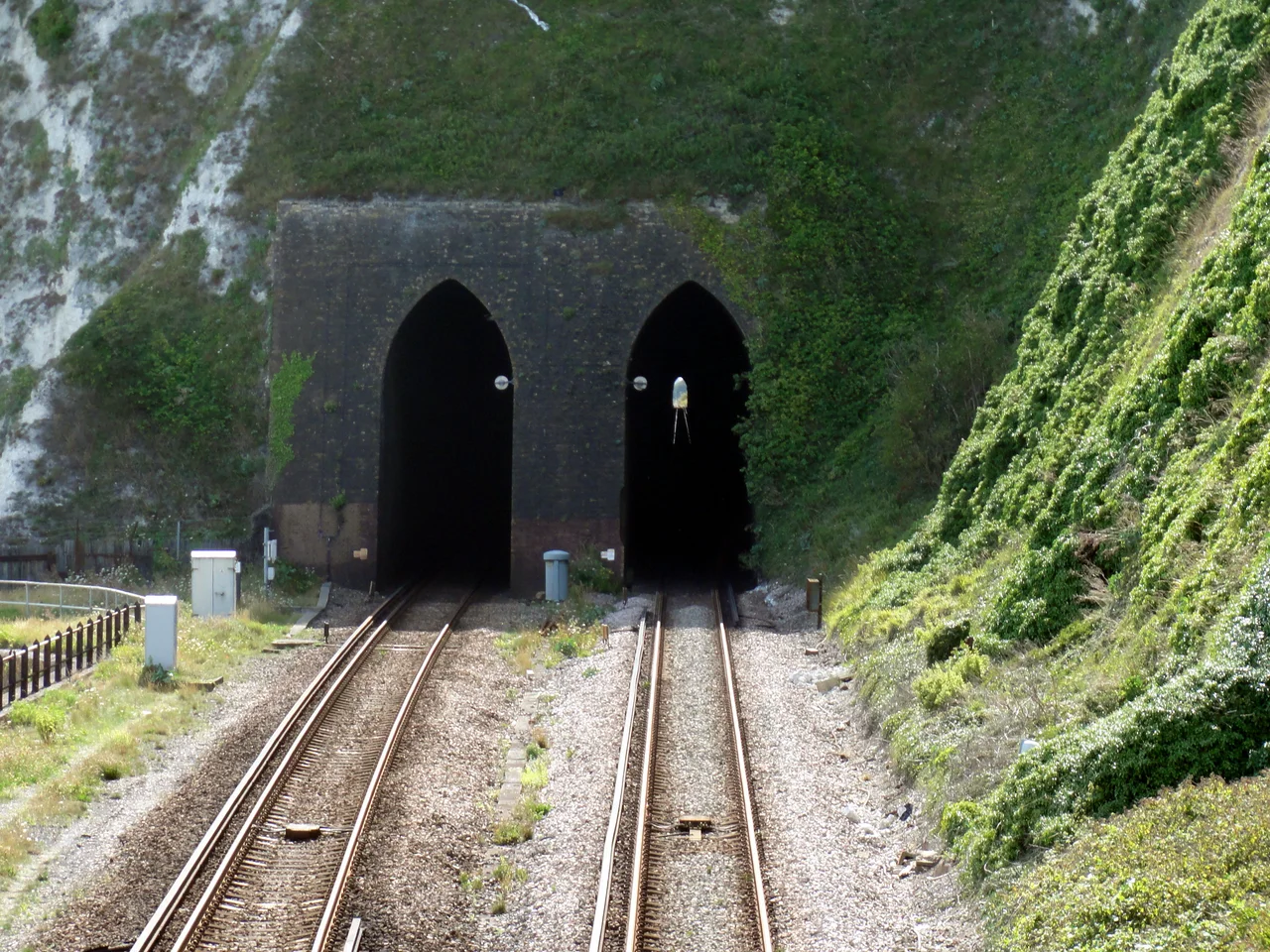

Shakespeare Tunnel
When the railway engineers reached the chalk cliffs between Folkestone and Dover in the 1840s, they had a choice: tunnel through, or stop. Stopping wasn't an option - the South Eastern Railway needed to reach Dover Harbour, where the company had bought the bankrupt port specifically to run trains to the ferry quay for boat-train traffic to the continent. Going around was impossible: the cliffs run straight into the sea. So they tunnelled. The longest of those tunnels was bored beneath a chalk headland that Shakespeare had immortalised in King Lear two and a half centuries earlier - the cliff where Edgar pretends to lead his blind father to the edge, the cliff named for the playwright who described it. They called it Shakespeare Tunnel, and it has carried trains for 180 years.
Cubitt's Tunnel
The Shakespeare Tunnel was designed by Sir William Cubitt, one of the great Victorian railway engineers - the same Cubitt who designed the Foord Viaduct further west and the South Eastern Main Line from London. Construction was part of the line's extension from Folkestone to Dover, completed in 1844 in a recognisably gothic style. The tunnel is bored through chalk - the same Cretaceous limestone, deposited between 100 and 66 million years ago from the skeletons of microscopic algae called coccoliths, that gives the White Cliffs their colour. Working through chalk is comparatively easy by railway-engineering standards, but the cliff's instability above the line - landslips have repeatedly fallen onto the railway at Folkestone Warren, the strip of coast immediately west - has kept engineers nervous for the entire life of the tunnel. The major Folkestone Warren landslip of 1915 buried the line in 1.5 million cubic metres of chalk and clay. A train was nearly buried with it; the driver and fireman saw the cliff giving way and brought the train to a halt just in time.
Shakespeare's Cliff
The cliff above the tunnel takes its name from a single passage in King Lear, written between 1603 and 1606. In Act IV, the blinded Earl of Gloucester asks his disguised son Edgar to lead him to the edge of a Dover cliff so he can jump. Edgar describes the scene from the imagined edge: 'Half-way down hangs one that gathers samphire; dreadful trade!' Rock samphire grows on the chalk slopes - an edible succulent that pickle-makers used to gather by hanging on ropes over the cliffs, a trade dangerous enough to be memorable. Shakespeare named no cliff. But the locals knew the passage well enough to attach his name to this one, and it stuck. The patch of land at the foot of the cliff, created in the 1990s from rock excavated during the construction of the Channel Tunnel, is called Samphire Hoe - thirty hectares of new coastline named for Shakespeare's line about a dreadful trade.
Class 395 and the High-Speed Upgrade
For the first 165 years of its life, Shakespeare Tunnel carried slow trains - steam, then diesel, then the electric local services that began under British Rail's 1955 Modernisation Plan when the South Eastern Main Line through Folkestone was electrified in 1961. Then in 2009, significant works were completed to allow the new Hitachi Class 395 'Javelin' high-speed trains to operate through the tunnel. The Javelins run from Dover to London St Pancras via High Speed 1, the line built for the Eurostar, reaching speeds of 140 mph on the dedicated high-speed section and bringing London within fifty-five minutes of Dover Priory. The tunnel itself - with its Victorian gothic portals - had to be cleared and re-equipped to take the new trains' overhead electrification and modern signalling. Today it is a piece of Victorian railway engineering modified to twenty-first-century standards, carrying commuters and tourists through the same chalk Shakespeare wrote about. Trains enter the gothic mouth on one side of the cliff and emerge less than a minute later on the other, the tunnel doing exactly what Cubitt designed it to do - turning an impassable coastline into a railway.
From the Air
Shakespeare Tunnel sits at 51.110°N, 1.289°E beneath Shakespeare Cliff on the Kent coast between Folkestone and Dover. From the air, look for the gothic portals at the eastern and western ends of the tunnel where the South Eastern Main Line emerges from the chalk cliff. Samphire Hoe Country Park - the thirty-hectare reserve built from Channel Tunnel spoil - sits at the foot of the cliff just south of the tunnel's western portal. The Channel Tunnel itself (the cross-Channel rail tunnel to Calais) runs further inland, with its UK portal at Cheriton 3 km northwest. Nearest airport is London Ashford (Lydd) (EGMD) about 30 km west. Best viewed at low altitude tracking along the coast between Folkestone and Dover.
Nearby Stories
- HMS Hermes (1898) 7.3 km away
- Herne Bay Museum and Gallery 8.5 km away
- Benenden School 9.2 km away
- Boulonnais 9.4 km away
- Priestfield Stadium 12 km away
- 1382 Dover Straits Earthquake 17 km away
- Royal Sovereign Lighthouse 21 km away
- Battle of Boulogne 28 km away