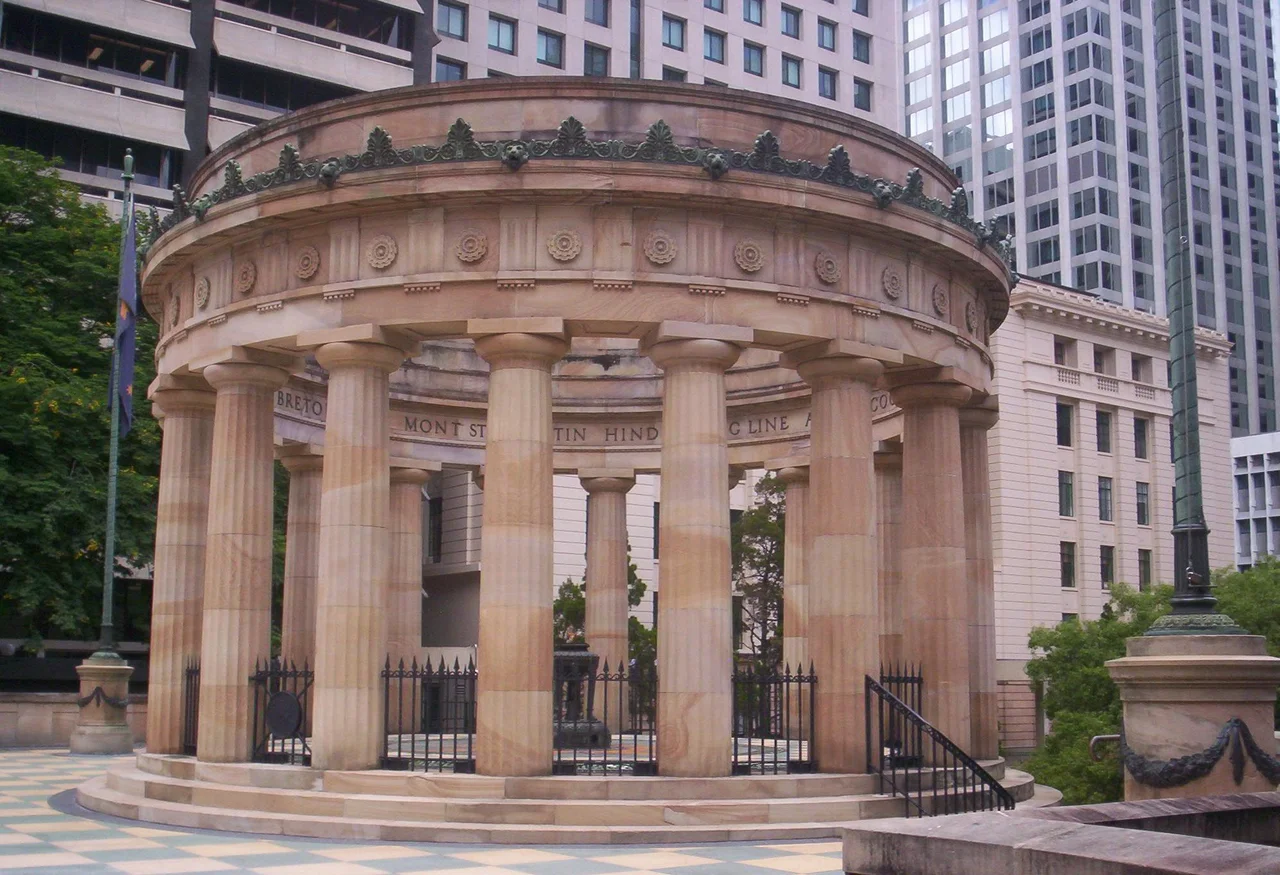

Shrine of Remembrance, Brisbane
Count the columns. There are eighteen of them, pale Helidon sandstone rising in a Greek-Doric ring above Anzac Square, and the number is not an accident of design. Eighteen stands for 1918, the year the First World War ended and the killing stopped. Within the circle they enclose, a flame burns in a brass urn and has been kept alight for the men who did not come home. Brisbane built this shrine with money given a coin at a time, by a city that had sent its sons across the world and counted, afterward, who was missing.
Raised by Subscription
There was no government cheque behind the Shrine of Remembrance. The funds came by public subscription, ordinary Queenslanders giving what they could toward a memorial for the soldiers killed in the First World War. In 1928 a design competition was held, and the Sydney firm of Buchanan and Cowper won it with a Greek Classic Revival temple. The Shrine took two years to build. On Armistice Day, 11 November 1930, at eleven in the morning, Governor John Goodwin dedicated it. The hour and the date were chosen with care: it was at the eleventh hour of the eleventh day of the eleventh month, in 1918, that the war had at last ended.
Sandstone, Granite, Flame
The eighteen columns are cut from Helidon sandstone, quarried west of Brisbane, warm and honey-toned in the Queensland sun. The steps climbing from Anzac Square are Queensland granite, harder and cooler underfoot. At the centre of the temple, the Eternal Flame rests in its brass urn, a small constant fire in the open air. The form is deliberately classical, a Doric temple of the kind raised over the dead in the ancient Mediterranean, borrowed here to give shape to a grief that had no precedent in the young state's history. Restraint is the point. There is no triumph in the design, only a circle, a flame, and a number that means the day the dying ended.
The Crypt Below
Beneath the temple lies a crypt, the Memorial Galleries, long known as the Shrine of Memories. Here the names and badges of Australian regiments are set into the walls, units that fought through the campaigns of two world wars. A large mosaic mural by the artist Don Ross spreads across the space, and on the external wall stands a sculpture raised in memory of the First World War dead, given by the women of Queensland. The lower galleries were built to hold not spectacle but record, a place to find a particular regiment, a particular war, and to stand with it for a while in the cool and the quiet.
The Days Remembered
Each year before dawn on 25 April, Anzac Day, people gather at the Shrine while it is still dark, and wreaths are laid around the Eternal Flame. They return on 11 November, Remembrance Day, the anniversary of the dedication and of the Armistice itself. A third service is held near 15 February, marking the Fall of Singapore in 1942 and the men of the 8th Division lost or taken prisoner there. The Anzacs were the Australian and New Zealand Army Corps, and the name has come to carry an entire national idea of endurance and mateship. At this flame, though, the meaning stays close to the ground: these were sons and brothers, and the city has not stopped keeping the light for them.
From the Air
The Shrine of Remembrance stands at 27.466°S, 153.026°E, on the northern edge of Anzac Square between Ann and Adelaide Streets in central Brisbane, framed by the green rectangle of the square amid the CBD's towers. From the air, look for the open civic space cut into the dense city grid, just north of the Brisbane River's tight loop and a short distance west of the Story Bridge. Brisbane Airport (YBBN / BNE) lies about 12 km to the north-northeast across the river flats; Archerfield (YBAF) is roughly 12 km to the south-southwest. The square is best appreciated from low and slow under controlled approaches; Brisbane's subtropical air is usually clear, with summer haze and storms most likely from December through February.
Nearby Stories
- Redcliffe Peninsula 2.7 km away
- Tamborine National Park 12 km away
- Cressbrook Homestead 27 km away
- Main Range National Park 31 km away
- 2010-2011 Queensland Floods 38 km away
- Cape Byron 96 km away
- Cape Byron Light 126 km away
- HMS Porpoise (1799) 588 km away