
Siege of Carlisle (1315)
Robert the Bruce had broken an English army at Bannockburn the year before, and the kingdom of Scotland was finally his. Carlisle should have been the next prize. It was the western anchor of the English border, a stone fortress on a hill where a Roman fort had stood since 72 CE, the keystone of an entire defensive line. On 22 July 1315 Bruce arrived outside its walls with his army, his confidence, and an assortment of siege equipment he barely knew how to use. Eleven days later he left, beaten not by the garrison but by Cumbrian weather and his own lack of siegecraft.
A King Without a Siege Train
Bruce was a master of ambush and night raid. His preferred method of taking a castle was sending a small party over the wall in the dark with daggers. Bannockburn had been a set-piece victory of brutal, disciplined infantry, but neither his men nor his engineers had much experience hurling stones at masonry. The defender was Andrew Harclay, an experienced veteran who had probably faced Bruce's army at Bannockburn the year before and had spent the six months since strengthening Carlisle's defenses. Harclay commanded a few hundred regulars, swollen by Cumbrian villagers fleeing into the castle for shelter. Springalds and catapults were mounted on the parapets, ready to hurl bolts and rocks down on anyone who came close enough to the walls.
Eleven Days in the Rain
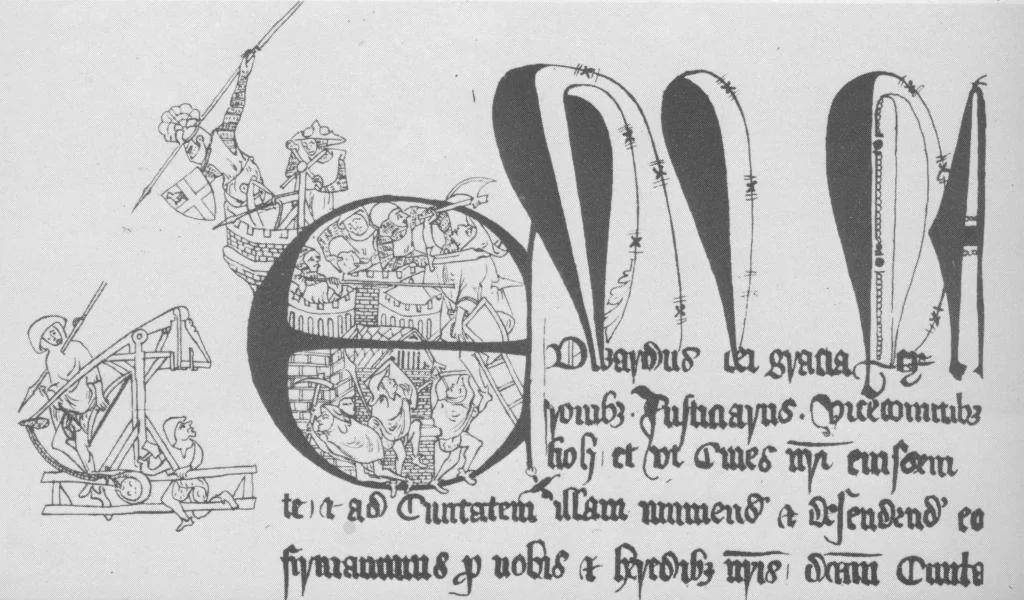
Bruce began by burning Carlisle's suburbs and trampling its crops, a standard medieval prologue. Then he tried the gates. The first assault was thrown back with heavy Scottish losses. So he built a catapult, which proved unable to do much damage to the thick stone walls. He built a siege tower; it stuck in the soft ground before reaching the walls. His men tried to fill the moat with hay and timber to wheel attackers across, but the rain kept washing the filling away. Long ladders were tried. Bridges across the moat were tried. A sow, a wheeled shelter under which sappers could pick at the foundations of the wall, was tried. Carlisle stood. By the eleventh day Bruce had spent every device in his improvised arsenal.
James Douglas Goes Over the Wall
For his final attempt Bruce borrowed the playbook that had taken Edinburgh Castle the previous year, when Thomas Randolph had scaled the rock at night with a handful of men. He launched diversionary attacks on the front of the city while James Douglas, his most feared lieutenant, scaled the walls on an unwatched side with a small picked force. That stealth approach had worked at Edinburgh, in Randolph's hands. Here it failed. The garrison had not let its guard down, the walls were too well watched, and Douglas was driven off. On 1 August 1315 the Scottish army withdrew, either because a relief column was rumoured to be approaching or because news had arrived that Edward Bruce, Robert's brother, had just suffered a defeat far away in Ireland. Carlisle had held.
The Rise and Fall of Andrew Harclay
King Edward II showered the victorious commander with rewards. Harclay received a thousand marks, the town received a royal charter, his post as Sheriff of Cumberland was confirmed, and in 1322 he was created the first Earl of Carlisle. At the Battle of Boroughbridge that same year he commanded the royalist army that crushed Thomas of Lancaster's rebellion, deploying his infantry in the Scottish schiltron formation he had presumably watched the Scots use to such effect. It made him many enemies. In 1323 he was executed for treason, allegedly for trying to negotiate peace with the very man whose siege he had broken. The cynicism of the timing was difficult to miss. Bruce kept raiding England until 1328, when the Treaty of Edinburgh-Northampton finally acknowledged Scottish independence.
From the Air
Coordinates 54.90N, 2.93W, at Carlisle in northern Cumbria where the River Eden meets the River Caldew. Cruise at 3,000 to 5,000 feet for a clear view of Carlisle Castle's red sandstone keep on the high ground north of the city center. The M6 and the West Coast Main Line both pass close by. Nearest airport is Carlisle Lake District (EGNC), 5 nautical miles east. Newcastle (EGNT) is 50 nm east, Prestwick (EGPK) 80 nm northwest, and Glasgow (EGPF) 95 nm north. Variable Cumbrian weather is the historical antagonist; Atlantic fronts roll in from the Solway Firth.
Nearby Stories
- Workington Lifeboat Station 3.8 km away
- Caerlaverock Castle 4.9 km away
- Once Brewed 9.1 km away
- Castlerigg Stone Circle 10 km away
- Morton Castle 17 km away
- Battle of Otterburn 18 km away
- Brough, Cumbria 18 km away
- Kielder Observatory 24 km away