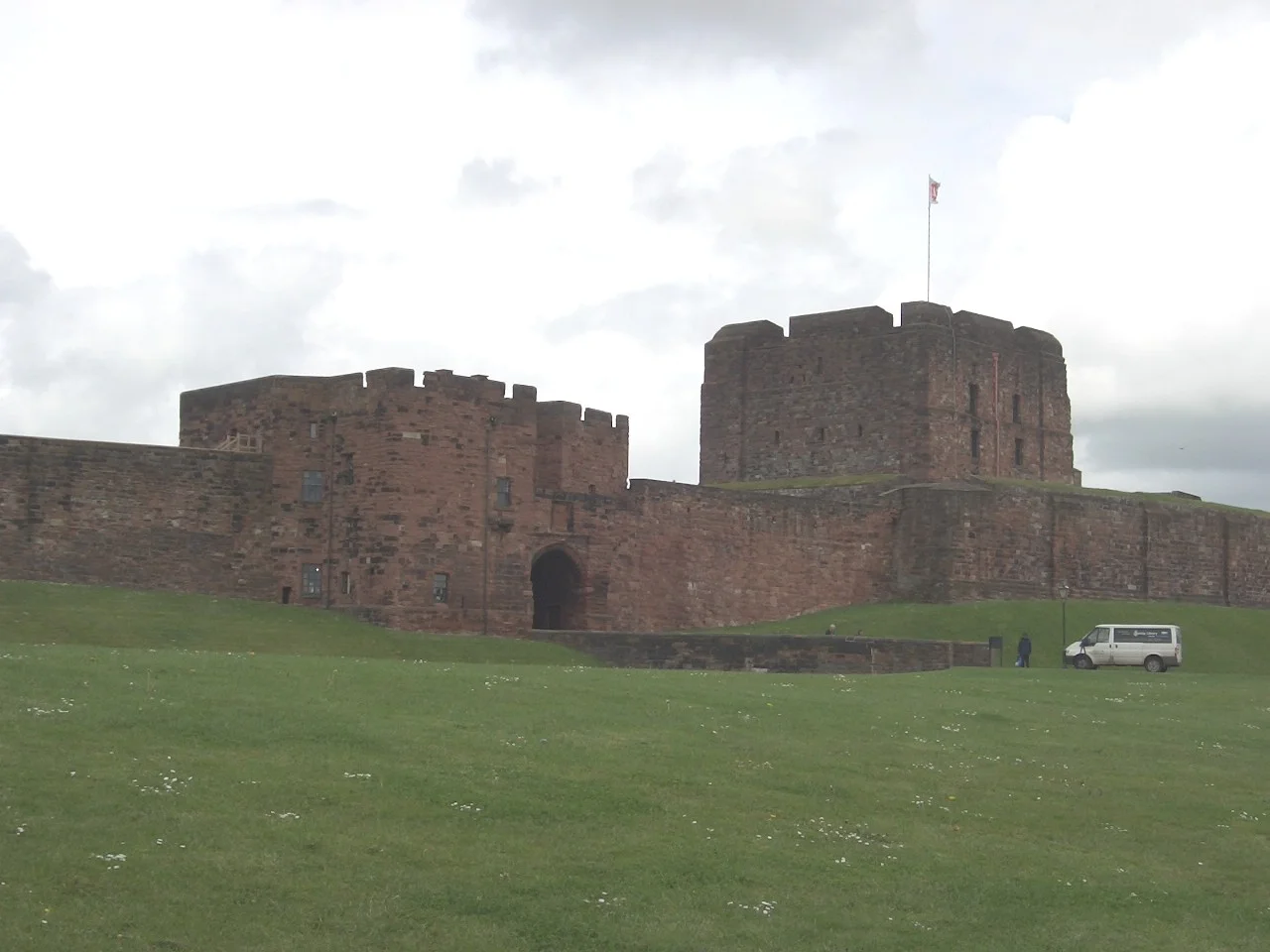

Siege of Carlisle (November 1745)
The defenders on Carlisle's walls fired their muskets all morning into the swirling smoke. The Jacobite besiegers, instead of shooting back, lifted their bonnets onto the ends of their spades and waved them above the trench lines in mockery. It was 14 November 1745, the second day of the first siege of Carlisle, and the absurd theater of it captured the whole campaign in a single image: Bonnie Prince Charlie's invasion of England would be won and lost less by gunpowder than by nerve, opinion, and the deep, demoralizing question of whether anyone was actually going to fight for the Hanoverian crown.
Was Wade Really Coming?
Charles Edward Stuart had crossed into England on 8 November with around 5,000 men, mostly Highlanders, and reached Carlisle two days later. The city's defenses had been neglected since the 1707 Act of Union, but they still looked formidable to a Jacobite army with no proper siege equipment. Charles demanded surrender and threatened to burn the city if refused. His officer O'Sullivan later admitted this was pure bluff. The city's defenders, hoping to be relieved by General George Wade marching from Newcastle, sent word that they would hold out. Then Charles received intelligence that Wade was on his way and had reached Hexham. He left a force to maintain the blockade and rode east with the rest of his army to fight Wade in open ground.
The Council at Brampton
Charles reached Brampton on the 11th and waited. A scouting party returned with confusing news: the report of Wade's march was false. He waited two more days. Nothing. A council of war was convened, and the Jacobite high command split. Some argued for marching on to attack Wade at Newcastle. Others noted that even if they beat Wade, his army would simply retreat into Newcastle, which they had no hope of taking. A third faction suggested returning to Scotland to gather more clansmen. Lord George Murray cut through all of it. He proposed that half the army should remain at Brampton while the other half resumed the siege of Carlisle. James Drummond, Duke of Perth, agreed and volunteered to command the attack. Murray took the blockade. The siege resumed.
Bonnets on Spades
On 13 November the Jacobites moved into position around Carlisle. Lord George Murray quartered at Harbery and posted men in the surrounding villages to cut off the town. The besieging party broke ground after dark, within musket range of the walls, and the garrison fired blindly into the gloom without doing any damage. On the 14th the Jacobites brought up their thirteen cannon. The garrison's musketry continued; the Jacobites' bonnets-on-spades continued. Inside the town, panic was spreading. The militia had thinned by desertion. Many inhabitants pleaded illness rather than mount the walls. People were slipping over the parapets at night to escape. A white flag finally rose above the gate, and a messenger was sent to ask for terms.
The Keys at Brampton
Charles refused any terms until the castle, separately commanded by Colonel Durand, also surrendered. Durand agreed. The terms were generous: townspeople's rights and property would be respected, the garrisons would take an oath not to serve against the House of Stuart for a year and could then go free, and all the arms and ammunition in town and castle would be handed over. The Duke of Perth marched into Carlisle at the head of his regiment on 15 November, shook hands with the men of the garrison, called them brave fellows, and offered them bounty money to join the prince. The mayor and aldermen carried the keys of the city out to Brampton to deliver to Charles personally. The Jacobites found 1,000 stand of arms in the castle and 200 good horses in the town, much of it the property of local gentry who had stored their valuables in the castle for safekeeping. The next day Charles rode in under a general salute of artillery, his pretender father proclaimed king in the marketplace, the mayor and corporation made to attend with the civic sword and mace. The first siege of Carlisle had lasted barely two days, and the campaign that would end in catastrophe at Culloden had begun.
From the Air
Coordinates 54.90N, 2.93W. Cruise at 3,000 to 5,000 feet. Carlisle Castle's red sandstone keep is unmistakable from the air, with the medieval city walls still partially traceable below. Brampton lies 9 nautical miles east, where Charles waited for Wade. Nearest airport is Carlisle Lake District (EGNC), 5 nm east. Newcastle (EGNT) is 50 nm east, Prestwick (EGPK) 80 nm northwest. The Jacobite army approached from the north along what is now the A7.
Nearby Stories
- Workington Lifeboat Station 3.8 km away
- Caerlaverock Castle 4.9 km away
- Once Brewed 9.1 km away
- Castlerigg Stone Circle 10 km away
- Morton Castle 17 km away
- Battle of Otterburn 18 km away
- Brough, Cumbria 18 km away
- Kielder Observatory 24 km away