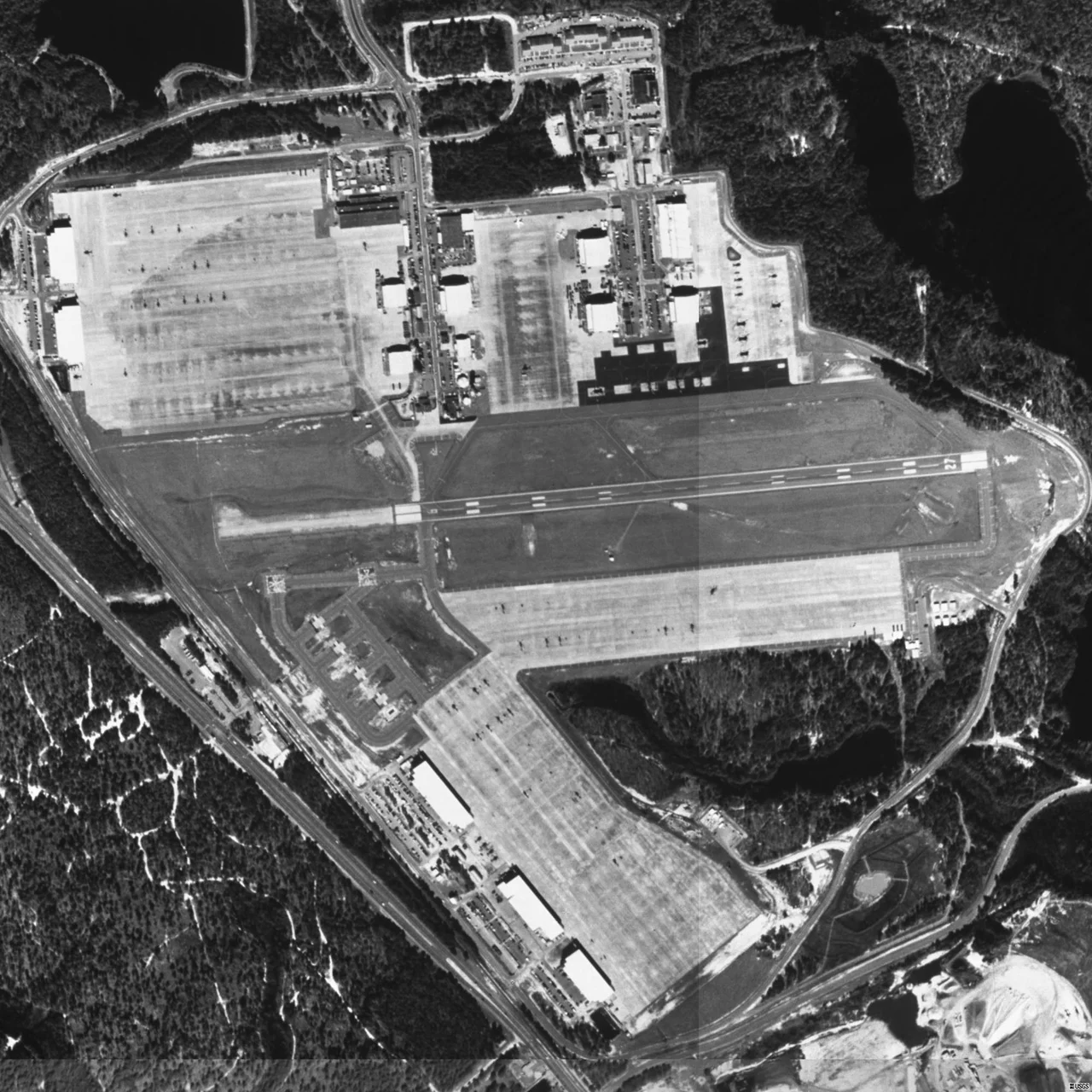

Simmons Army Airfield
A Sikorsky H-19C Chickasaw rotor first beat against the air over Smith Lake in June 1952, three months before the field had a proper name. The 6th Transportation Company brought twenty-one of them in, along with two Bell H-13 Sioux, and by December they were headed to Korea as the first combat helicopter company the United States Army had ever fielded. The airfield they left behind would grow into the busiest Army aviation facility on the East Coast. It would also receive its current name two years later, after a man who died flying out of it.
Warrant Officer Simmons
On November 3, 1953, two H-29B helicopters collided in the air near the field. Among the dead was Warrant Officer Herbert W. Simmons Jr. The Army renamed the airfield in his honor on June 21, 1955, swapping out the prosaic Smith Lake Airfield designation for the name of a pilot who had taken off and not landed. Helicopter aviation in 1953 was still early-stage experimental work. The risks were not theoretical. The naming was an Army tradition with a quiet pull on it: this is who paid for this place.
The Helicopter Pioneers
In December 1961, the 8th Transportation Company departed Simmons with their Piasecki H-21 helicopters and flew off into history. Along with the 57th Transportation Company, they were the first American helicopter units to serve in Southeast Asia. Vietnam would become a helicopter war, the first of its kind, and the doctrine, the training, the basic question of what rotary-wing combat aviation looked like would be worked out partly by men who had spent years at this North Carolina field. The 116th Assault Helicopter Company formed at Simmons in July 1965 and was in Vietnam by October. The 269th Aviation Battalion left in January 1967. Each deployment took aviators from a pine-shaded Sandhills airfield to a war ten thousand miles away.
The Permanent Garrison
By 1965, Simmons had grown to twenty-three permanent buildings, structures still in use sixty years later. Fixed-wing aircraft worked alongside the helicopters: liaison planes for the XVIII Airborne Corps and the 82nd Airborne Division, Grumman OV-1 Mohawk observation aircraft, the 4th Aerial Surveillance Target Acquisition unit. By 1976, the field housed 176 aircraft and logged 375 flight operations a day. By 1983, that number had climbed to 298 aircraft. The early 1980s personnel roster ran to 2,134. Simmons was no longer experimental. It was the Army's daily aviation home.
From Grenada Through the Gulf
On October 25, 1983, the 82nd Combat Aviation Battalion deployed to Grenada as part of Operation Urgent Fury. The campaign was short, but it announced the unit's operational reach. In August 1987, the headquarters reorganized and became the 18th Aviation Brigade. The brigade would deploy to the Persian Gulf, Panama, and the first Gulf War. On the opening day of Desert Storm, February 24, 1991, it airlifted troops and equipment into Iraq. When Hurricane Andrew flattened parts of South Florida in 1992, the same brigade flew relief missions. The pattern repeats: combat, contingency, disaster response, back to Bragg.
Today's Tenants
Simmons is now home to the 82nd Aviation Regiment in all three of its battalions: 1st Battalion attack with AH-64E Apaches, 2nd Battalion assault with UH-60M Black Hawks, and 3rd Battalion general support with Black Hawks for medevac and CH-47F Chinooks for heavy lift. The 122nd Aviation Support Battalion handles maintenance. The U.S. Army Special Operations Aviation Command runs its flight detachment here. The 164th Theater Airfield Operations Group oversees airspace, and the 3rd Airfield Operations Battalion of the 58th Aviation Regiment keeps the field running. Two hundred-plus aircraft. One 4,650-foot asphalt runway, 9/27. A daily operational tempo that has barely paused in seventy years.
From the Air
Simmons Army Airfield (KFBG) sits at 35.13 N, 78.94 W on Fort Bragg, a few miles west of Fayetteville and immediately south of Pope Field. The single asphalt runway 9/27 is 4,650 by 110 feet, oriented roughly east-west. The field is restricted military airspace, embedded inside Fort Bragg's training area; transient civilian aircraft do not land here without prior coordination. The R-5311 restricted area covers the Fort Bragg training complex with surface-to-unlimited altitudes for live-fire and airborne operations. Nearby civil alternates: Fayetteville Regional (KFAY) 10 nm southeast for diversion, Curtis L. Brown Jr. Field (KEYF) at Elizabethtown 30 nm south. Expect heavy rotary-wing traffic in surrounding airspace at low and medium altitudes.
Nearby Stories
- Laurinburg, North Carolina 4.7 km away
- Sampson County, North Carolina 9.1 km away
- Rockingham Speedway 18 km away
- Campbell University 19 km away
- The Robesonian Takeover 20 km away
- Johnston County, North Carolina 21 km away
- North Carolina Aviation Museum 53 km away
- Pender County, North Carolina 57 km away