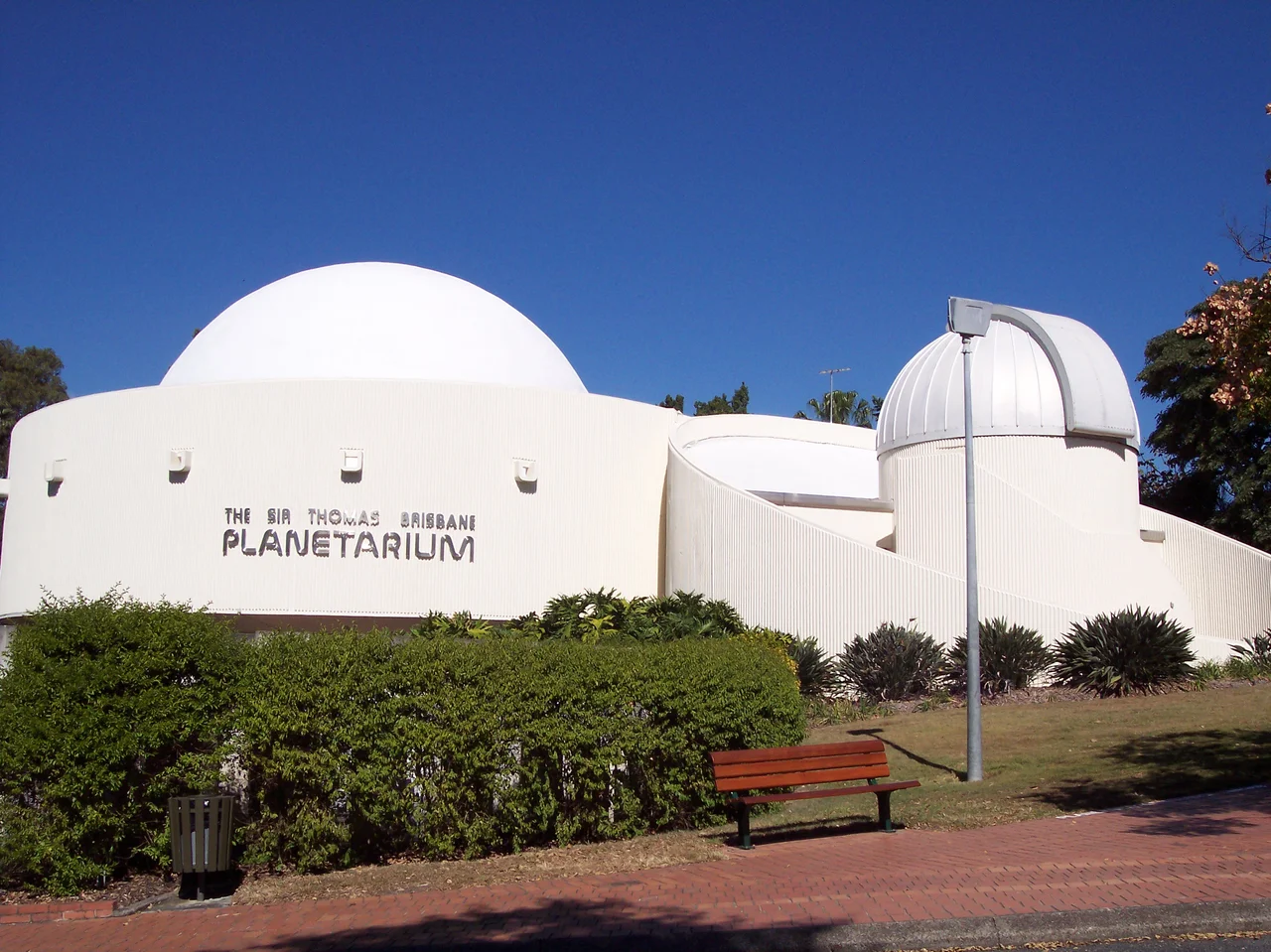

Sir Thomas Brisbane Planetarium
The man Brisbane is named for did not much want the job. Sir Thomas Brisbane took the governorship of New South Wales in 1821, but his real passion lay overhead. Within a year of arriving he had built an observatory at Parramatta and set about charting the southern sky, the half of the heavens that European astronomers, stuck in the wrong hemisphere, had barely catalogued. Two centuries later, in the forested hills of Mount Coot-tha, a planetarium carries his name and finishes the work he loved, projecting the southern stars onto a dome for anyone who walks in.
The Governor Who Watched the Sky
Thomas Brisbane was a Scottish soldier and a serious astronomer, and the colonists never quite forgave him for caring more about the second than the first. His observatory at Parramatta, raised in 1822, produced a catalogue of more than seven thousand southern stars, real scientific work done at the far edge of the British world. The river, the city and eventually this planetarium all took his name. It is a fitting inheritance. A man remembered by his contemporaries as a distracted administrator is honoured now for exactly the distraction, the long nights spent measuring a sky most people never bothered to look at.
Under the Cosmic Skydome
The planetarium opened on 24 May 1978 in the Brisbane Botanic Gardens at Mount Coot-tha, about five kilometres from the city centre. Its heart is the Cosmic Skydome, a hemispherical theatre twelve and a half metres across, seating up to 130 beneath a dome that becomes, when the lights die, the entire night sky. The projection technology has been replaced more than once. The original German-made Zeiss star projector gave way to a Japanese instrument in 2013, and a digital system arrived in 2019. The machinery changes; the experience holds. Lean back, the dome darkens, and the southern constellations bloom overhead with a clarity the light-soaked real city can no longer offer.
Moon Suits and Meteorites
Beyond the dome, the foyer and gallery double as a small museum of the space age. A replica of Neil Armstrong's spacesuit stands near a Saturn V rocket built to one forty-eighth scale, and cases hold meteorites and models of the spacecraft that carried people off the planet. Outside, a statue honours Konstantin Tsiolkovsky, the self-taught Russian schoolteacher whose equations laid the theoretical groundwork for spaceflight decades before any rocket flew. A second statue celebrates Abigail Allwood, the Australian geologist who searches other worlds for signs of ancient life. A sundial keeps the oldest kind of astronomical time in its own courtyard, tracking the same sun the visitors inside have come to leave behind.
Older Star Stories
In 2018 the gallery added Skylore, the first permanent Australian exhibit dedicated to Aboriginal and Torres Strait Islander astronomy. Curated with the astronomer Duane Hamacher and developed in close partnership with Indigenous communities, it gathered leading Elders to share star knowledge, much of it set down publicly for the first time. This is sky-watching far older than any telescope, the accumulated observation of peoples who read the seasons, the tides and the right time to travel in the movements of stars and the dark spaces between them. Beneath a dome named for a nineteenth-century governor, the planetarium makes room for the astronomers who were charting these same southern heavens for tens of thousands of years before he arrived.
From the Air
The Sir Thomas Brisbane Planetarium sits at 27.476°S, 152.977°E, on the eastern slopes of Mount Coot-tha within the Brisbane Botanic Gardens, about 5 km west of the CBD. From the air the landmark is the mountain itself, a forested ridge topped by a cluster of broadcast towers that dominate Brisbane's western skyline and are visible for miles; the planetarium and gardens lie on its lower flanks toward the city. Brisbane Airport (YBBN / BNE) is roughly 16 km to the northeast; Archerfield (YBAF) lies about 12 km to the south-southeast. The elevated, partly wooded terrain rewards a daylight approach in clear air. Subtropical visibility is generally good, with humid haze and afternoon storms most common from December to February.
Nearby Stories
- Redcliffe Peninsula 2.7 km away
- Tamborine National Park 12 km away
- Cressbrook Homestead 27 km away
- Main Range National Park 31 km away
- 2010-2011 Queensland Floods 38 km away
- Cape Byron 96 km away
- Cape Byron Light 126 km away
- HMS Porpoise (1799) 588 km away