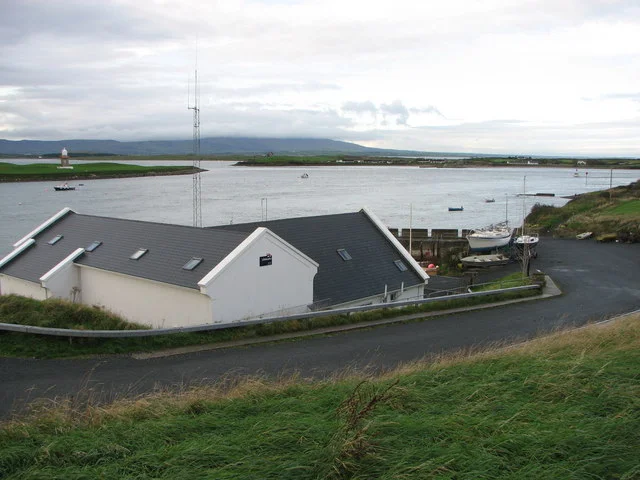

Sligo Bay Lifeboat Station
In April 1829, a fishing smack called the Peggy capsized in Sligo Bay as it tried to come ashore. A man named James Mulligan and two companions waded into the surf and pulled two crewmen out of the water. One later died. Three years on, in February 1832, the pleasure boat Caroline sank near Sligo with two aboard; a Mullaghmore boatman called Michael Duffy launched a yawl with five other men and saved one of them. Both Mulligan and Duffy were awarded the silver medal of the Royal National Institution for the Preservation of Life from Shipwreck - the body that twenty-two years later became the RNLI. They had no lifeboats, no training, no station. They had the sea and the willingness to enter it.
The Station That Came 170 Years Late
Despite Sligo Bay's long record of rescue and disaster, the RNLI did not formally establish a station at Rosses Point until 30 May 1998. The bay had been served by neighbouring stations, by individual boatmen, by sheer luck. The 1998 founding finally placed an institutional lifeboat where one had clearly been needed all along - at the entrance to a bay where Atlantic swell meets a shallow estuary with a narrow safe channel, where the Metal Man has been pointing the way since 1821 for the simple reason that without him, ships kept hitting the bottom. The first boats were inshore D-class inflatables. The station grew quickly.
Spix's Macaw, and What That Name Means
The lifeboat that arrived in 1992, re-hulled and pressed into service, carried the name Spix's Macaw - after a small blue parrot native to a single Brazilian river system, then on the edge of extinction. The bird was declared extinct in the wild in 1999. RNLI lifeboats often carry the names of the people who funded them, but they also carry the names of causes their funders wanted to honour. A captive breeding programme has since put a small number of Spix's Macaws back into the Brazilian skies. The boat that bore the name retired from Sligo years ago. The connection stands as a reminder that the people who pay for sea-rescue often think about other kinds of rescue too.
Elsinore, the Boathouse, the Boat
The permanent boathouse at Rosses Point went up in the shadow of Elsinore House - the ivy-covered ruin where the Yeats family had spent their childhood summers. It holds the lifeboat and launch tractor, with crew facilities, a workshop, and a small RNLI shop. On 26 February 2002 the station received a new, slightly larger Atlantic 75 inshore lifeboat, named Elsinore (B-781) for the house above it. The boat served thirteen years before being transferred elsewhere in November 2015 and replaced by a newer Atlantic 85.
Sheila and Dennis
The replacement, B-888, was named Sheila & Dennis Tongue. Sheila and Dennis Tongue had been born in Birmingham and later moved to Exmouth on the Devon coast, where they grew to appreciate the work of the RNLI watching the lifeboat go out from their adopted hometown. They left their estate to fund lifeboats - four of them, in total, scattered to stations along the coasts they had loved. At a naming ceremony in Rosses Point on 16 April 2016, Raymond Tongue - the couple's nephew - formally handed the boat over. She has served here since. When she launches into Sligo Bay on a winter night, she carries the memory of a Birmingham-born couple who never lived in Sligo, who chose to spend their savings on the chance that strangers far from Devon might come home.
From the Air
Sligo Bay Lifeboat Station sits at 54.305°N, 8.568°W on the north shore of Sligo Bay at the seaward end of the Rosses Point peninsula, 7.5 km northwest of Sligo town. From the air, the modern boathouse is visible near the ruin of Elsinore House on the seaward side, with the Metal Man's navigation tower on Perch Rock just offshore. Sligo Airport (EISG) is 6 km southwest across Sligo Bay; Donegal Airport (EIDL) is 50 km north. Best viewed at 1,500-2,000 ft AGL; coastal winds and sea-state are highly variable here.
Nearby Stories
- Killala 5.5 km away
- Ballaghaderreen 7.4 km away
- Townlands of Kilcommon 10 km away
- River Shannon 11 km away
- Monastery of Mohill-Manchan 15 km away
- Pettigo 18 km away
- Killybegs 19 km away
- RMS Empress of Britain (1930) 97 km away