.jpg)
Sligo Mac Diarmada Railway Station
On 11 January 1923, in the middle of the Irish Civil War, the railway station at Sligo went up in flames. Anti-Treaty forces set the building alight and then, in a final flourish of sabotage, sent seven engines flying down the branch line toward the quay. Six of them stopped somewhere along the way. The seventh punched through the concrete wall at the end of the line and tumbled into Sligo harbour. It would be three years before the new station building opened on the same elevated site, dominating the streets below as the old one had. Today the terminal carries the name of an Irish patriot who was executed seven years before that fire was lit.
How the Lines Reached Sligo
Sligo's railway story begins on 3 December 1862, when the Midland Great Western Railway extended its main line from Dublin and made the seaport a terminal. Within twenty years it became a small hub: the Sligo, Leitrim and Northern Counties Railway pushed north to Enniskillen in 1881, and in 1895 the Waterford and Limerick Railway - later the Great Southern and Western - linked Sligo to Limerick and the south. For a few decades you could board a train in Sligo and reach almost anywhere in Ireland that mattered. The Enniskillen line closed in 1957. The Limerick passenger service ended in 1963. Today only the Dublin line survives, and it survives well - regular intercity services connect the northwest to the capital in just over three hours.
Naming for a Patriot
In 1966, on the fiftieth anniversary of the Easter Rising, the station was renamed Mac Diarmada Station after Seán Mac Diarmada from County Leitrim. Mac Diarmada was one of the seven signatories of the 1916 Proclamation of the Irish Republic, executed by firing squad at Kilmainham Gaol on 12 May 1916. He was thirty-three. He walked with a limp from polio. He helped organise the Rising knowing that defeat was likely, and that defeat would likely cost him his life. The renaming - one of many across Ireland that year - was a deliberate act of public memory. The locals largely just call it Sligo Station, which is fine. Mac Diarmada's name is still on the signs.
The Freight Line That Was
When the Midland Great Western Railway came to Sligo in 1862, it also built a short branch curving off north and downward before reaching the station, dropping to the freight terminal at Sligo Quay. A large crane built by CIÉ in the mid-1970s handled containers there. The last freight train left Sligo Quay in December 2008, ending more than 140 years of rail freight in the town. The track is still there. The crane is still there. On 1 December 2021, Iarnród Éireann's Rail Freight 2040 strategy named Sligo as one of three future Tactical Rail Freight Terminals, alongside Galway and Cork - a hopeful sign that the dormant freight line might one day wake again, moving regional goods back onto rails for the first time in nearly two decades.
Elevated Above the Streets
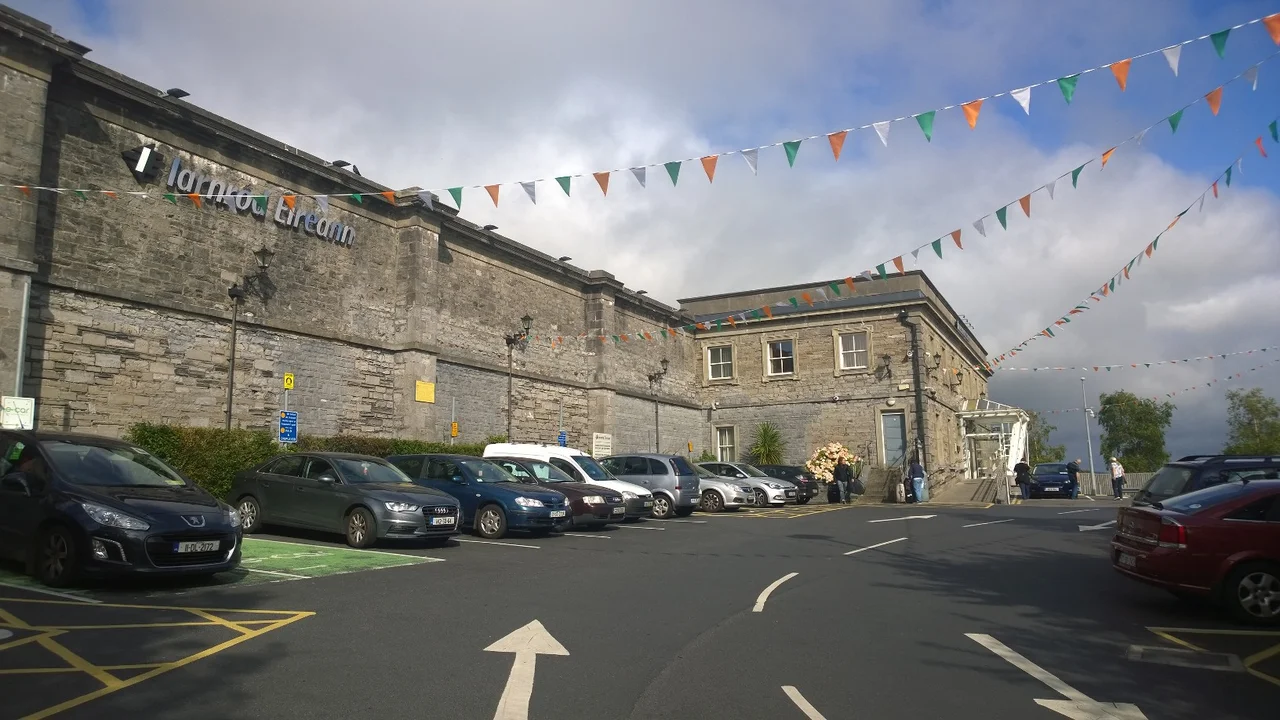
The current station building, opened after the 1923 fire, sits raised above the surrounding streets, its frontage dominating the approach from Lord Edward Street. Two platforms, one intermediate carriage siding, and a passing loop on the approach handle the modest but steady traffic of the modern line. There used to be a turntable here for steam locomotives, later useful for turning the CIÉ 121 Class single-cabbed diesels that worked the route in the latter half of the twentieth century. The locomotive shed to the south of the line is long gone, demolished. The bus station sits at street level adjacent to the south side - the two services share a small interchange that handles most onward connections in the northwest. Sligo Mac Diarmada is the end of the line, in the literal sense. Further west, there is only the bay.
From the Air
Sligo Mac Diarmada Railway Station sits at 54.272°N, 8.481°W in central Sligo, with the railway elevated above the surrounding street grid west of the town centre and just south of the Garavogue river. From the air, the station building, platforms, and approach tracks running northeast toward Dublin are visible, with the disused quay branch curving north toward Sligo harbour. Sligo Airport (EISG) is 8 km west; Donegal Airport (EIDL) is 50 km north. Best viewed at 1,500-2,500 ft AGL over the town centre.
Nearby Stories
- Killala 5.5 km away
- Ballaghaderreen 7.4 km away
- Townlands of Kilcommon 10 km away
- River Shannon 11 km away
- Monastery of Mohill-Manchan 15 km away
- Pettigo 18 km away
- Killybegs 19 km away
- RMS Empress of Britain (1930) 97 km away