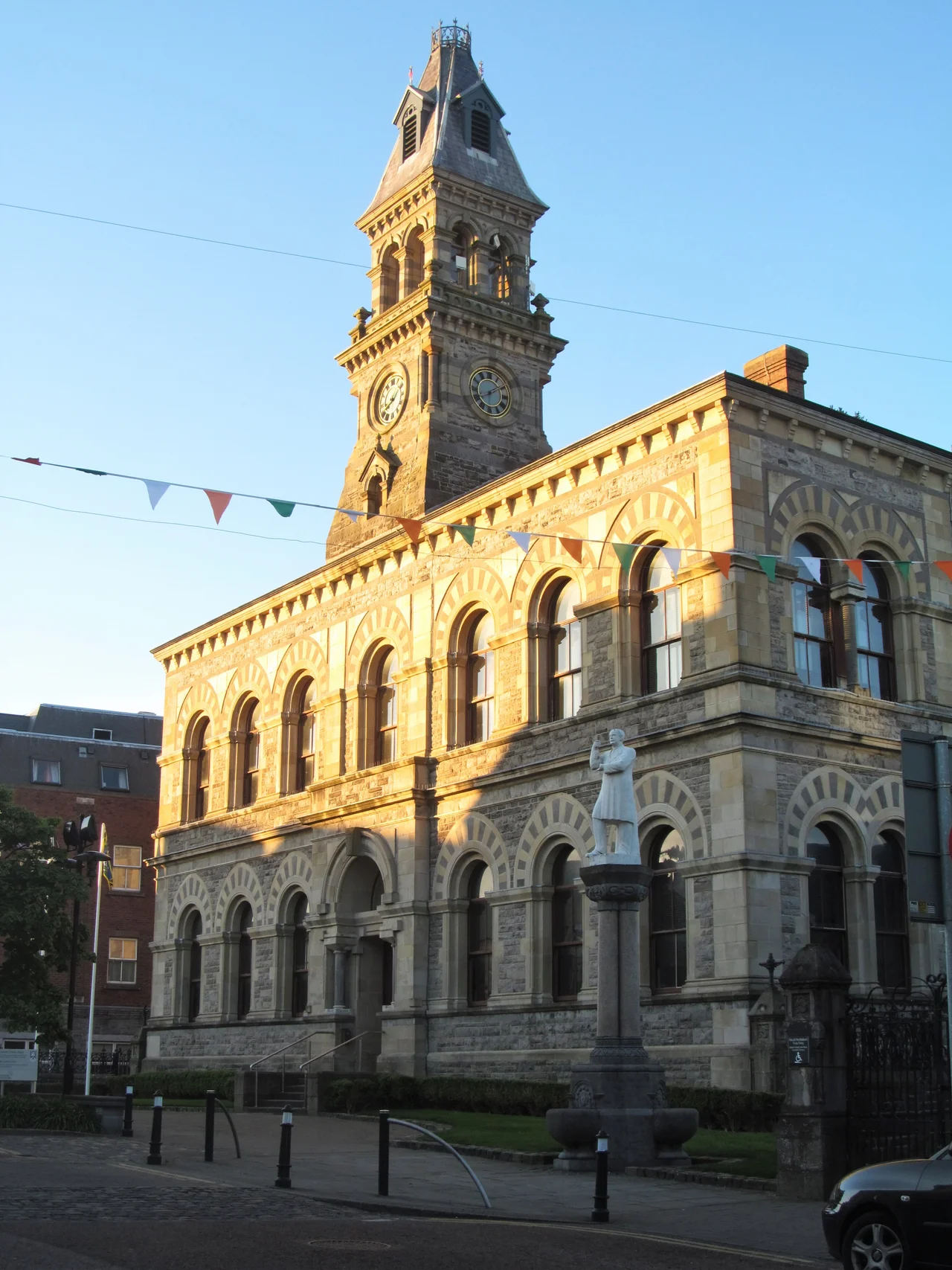

Sligo Town Hall
On a September morning in 1948, an Irish naval corvette named Macha arrived at Galway harbour carrying the body of W. B. Yeats, which had been kept in the south of France since his death nine years before. From Galway, the cortège drove north to Sligo - there was no deep harbour in Sligo for the vessel to dock. A guard of honour was posted on the steps of Sligo Town Hall on Quay Street as the cortège passed. The Lombard Romanesque tower rose behind the soldiers, its clock - paid for by the Harbour Commissioners so they could keep an eye on shipping - already over seventy years old. The poet was on his way north to Drumcliff churchyard, beneath the shadow of Benbulbin, where he had asked to be buried. The town hall has been waiting for occasions like that since 1872.
Built On Older Ground
Sligo Corporation first resolved to build a town hall in 1825, but the money fell through and for thirty-five more years the council rented offices for its meetings. In 1860 the corporation asked the Lord Lieutenant of Ireland, George Howard, 7th Earl of Carlisle, to apply to HM Treasury for funding, with the rest to be raised by public subscription. The site selected on Quay Street held the remains of a 1646 fort and, archaeologists have since suggested, may originally have been the location of Sligo Castle itself, built by Maurice Fitzgerald in 1245. Five centuries of fortifications, all gone, with a Victorian municipal building rising on the bones.
Hague's Lombard Vision
The foundation stone was laid by Mayor William Abbott Woods on 12 October 1865. William Hague designed the building in the Lombard Romanesque style - round-headed arches, alternating sandstone and limestone voussoirs, a modillioned cornice running the length of a seven-bay frontage. The Crowe Brothers built it in rubble masonry with ashlar dressings for £6,863, which sounds modest until you learn the workmanship was so painstaking that the cost ran over and the building wasn't truly finished until 1874. The central three-stage tower rises with a round-headed window in its first stage, the clock faces in its second, and a belfry in its third, capped by a pyramid roof with octagonal iron cresting. Local contractor Patrick Morris built the tower; the Harbour Commissioners paid for the clock and got their view of the port in return. The Nelson brothers manufactured the clock and installed it in 1877.
The Voices in the Hall
The assembly hall upstairs - 75.5 feet long and 33 wide - became the venue for Sligo's political voice. Father Michael O'Flanagan, the Catholic priest and Irish nationalist, taught Irish language classes here and served as founding secretary of the Sligo Feis - the annual cultural festival. At a Feis lecture in the town hall in 1903, Padraig Pearse delivered an address titled "The Saving of a Nation," thirteen years before he would lead the Easter Rising. In August 1917, Constance Markievicz - the Sligo-raised revolutionary who would later become the first woman elected to the UK House of Commons - came to the hall to receive the Freedom of Sligo. The room saw the building of a nation, in plain literal terms.
Yeats Passes By
On 18 September 1948 the body of W. B. Yeats came home. The poet had died at Roquebrune-Cap-Martin in France in January 1939, asked to be buried temporarily there and moved to Drumcliff "when a year or so has passed," and then the war intervened. It took nine years and a state-arranged voyage on the naval corvette Macha to bring him back. Sligo Town Hall posted a guard of honour. A decade later, in 1958, the painter Bernard McDonagh's mural depicting the Wanderings of Oisin was unveiled in the hall as a memorial to Yeats. It later came down and was put into the basement, which is where most municipal art commissions eventually go.
After 2014
An extension to the rear in 2000 added five bays and modernised the building's working spaces. The assembly room continued to serve as council chamber of Sligo Borough Council until 2014, when the council was dissolved and its functions absorbed by Sligo County Council. The Town Hall remains in municipal use but is no longer the centre of a town government - that ended after almost a century and a half. P. A. McHugh, the Irish nationalist politician, stands in bronze outside the entrance, relocated from O'Connell Street in the 1970s, sculpted by Hanrahan of Dublin. He looks toward Quay Street and the river, witness to a building that has outlived the office that built it.
From the Air
Sligo Town Hall sits at 54.273°N, 8.476°W on Quay Street in central Sligo, on the south bank of the Garavogue river near the quays. From the air, the distinctive Lombard Romanesque tower with its pyramid roof and clock faces is a prominent landmark in the town centre, set within the dense urban grid between the river and Lord Edward Street. Sligo Airport (EISG) is 8 km west; Donegal Airport (EIDL) is 50 km northeast. Best viewed at 1,500-2,500 ft AGL over the town centre.
Nearby Stories
- Killala 5.5 km away
- Ballaghaderreen 7.4 km away
- Townlands of Kilcommon 10 km away
- River Shannon 11 km away
- Monastery of Mohill-Manchan 15 km away
- Pettigo 18 km away
- Killybegs 19 km away
- RMS Empress of Britain (1930) 97 km away