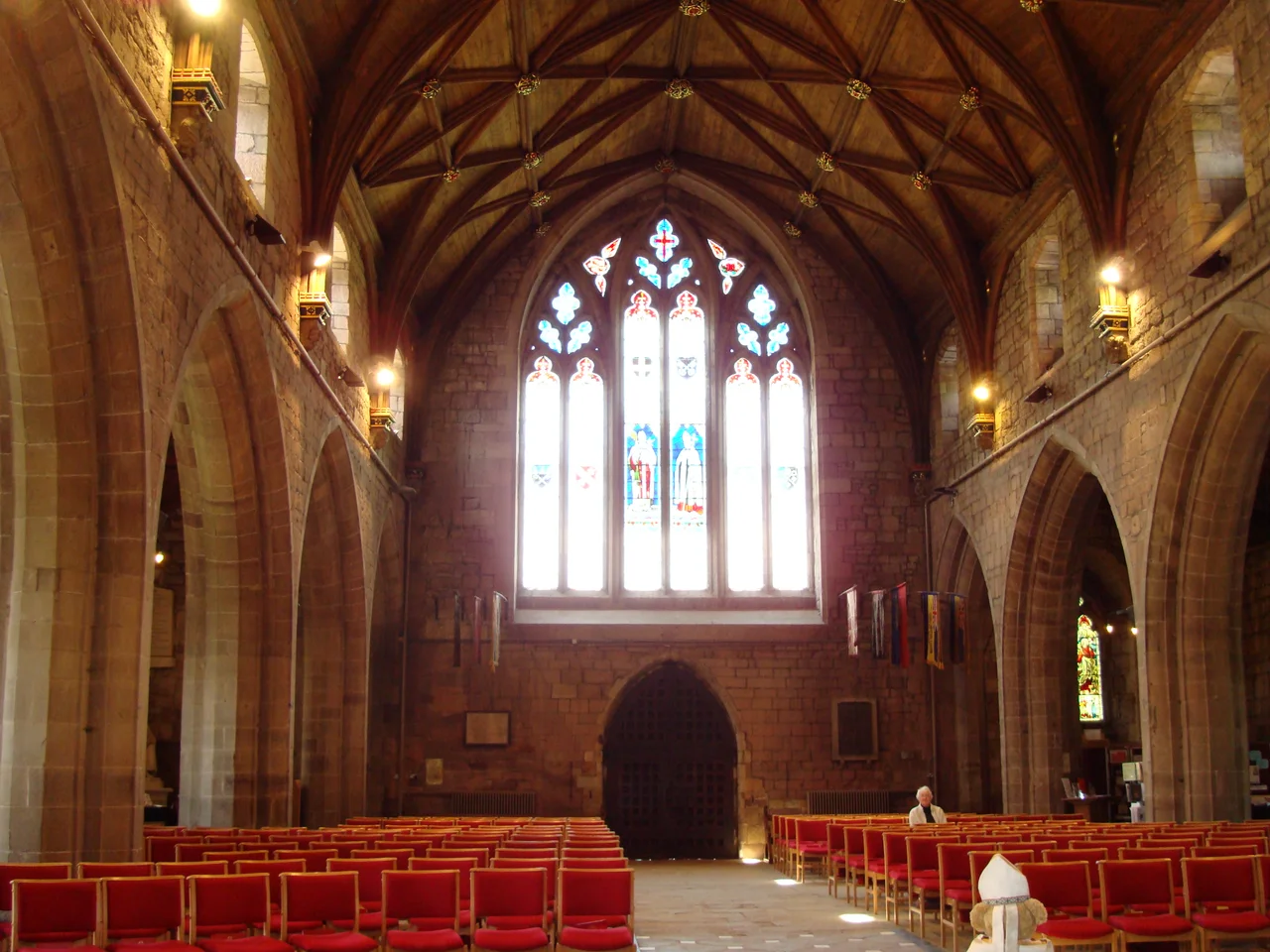

St Asaph Cathedral
Bishop William Morgan finished the work in 1588, the year the Spanish Armada sailed and the year the Welsh language nearly stopped being a literary language at all. He translated the entire Bible from Hebrew and Greek into Welsh - the first complete translation - and in doing so saved his mother tongue from a slow drift into folk-tale and farm vocabulary. Morgan later became Bishop here at St Asaph, and his Bible still sits on public display inside the cathedral he served. The building itself is small enough to walk across in under a minute and old enough to have been burned twice. It is the smallest of Britain's ancient cathedrals, and the most consequential single book in the history of the Welsh language was made by the man buried in its choir.
Asa and Kentigern
The story begins in the sixth century with Saint Kentigern, the Scottish missionary monk who founded a religious community on this site sometime around the year 560. He left it under the care of a young pupil named Asa - also called Asaph - who was the grandson of Pabo Post Prydain, a figure half lost in the mists between history and Welsh saint-genealogy. Asa gave the community its enduring name. For seven centuries the place served as a working diocese, modest in scale and exposed to every shift of border politics. The original stone cathedral burned during the Second Welsh War in 1282, set alight by soldiers of Edward I as the English crown drove its conquest of Gwynedd into the upper Vale of Clwyd. Plans to relocate the see to Rhuddlan came to nothing. Conwy and Caernarfon got the new fortresses; St Asaph rebuilt where it had always been.
Built Twice, Wounded Often
The cathedral you see now is mostly thirteenth century in plan, finished slowly through the disturbances that followed. Owain Glyndŵr's rebellion swept through in the early fifteenth century and left part of the cathedral a roofless ruin for seventy years. The reign of Henry Tudor brought the major rebuilding, and successive bishops added the tower, the choir furnishings, and the long nave the cathedral keeps today. The Victorians restored the interior in the nineteenth century, polishing away centuries of accumulated patch-work and replacing the floor. In 1930 the tower began to subside dramatically. The cathedral architect Charles Marriott Oldrid Scott traced the cause to a subterranean stream undermining the foundations, and his urgent repairs - finished in 1935 - kept the tower standing. The story made the national press twice, once for the crisis and once for the cure.
William Morgan's Bible
Of the bishops who served here, William Morgan looms largest. Born in Penmachno about 1545, educated at Cambridge, Morgan spent decades translating the scriptures into Welsh from the original languages - not as a scholarly exercise but as a parish necessity. Welsh-speaking congregations had no Bible in their own language. By 1588 Morgan had finished. The translation was published in folio at London. Within a generation, Welsh priests were reading from Morgan's Bible at every service in every parish in Wales, and the Welsh language - which had been drifting toward administrative obscurity under the Tudor settlement - acquired a stable, prestigious literary form. Morgan became Bishop of Llandaff, then Bishop of St Asaph in 1601, and died here in 1604. His Bible is on public display in the cathedral. The cathedral grounds carry a Translators' Memorial commemorating him and the other clerics who built the Welsh scriptural canon.
Geoffrey, Mathias, and the Choir
Other bishops have passed through. Geoffrey of Monmouth, the twelfth-century cleric whose Historia Regum Britanniae gave the medieval world its King Arthur, served as Bishop of St Asaph from 1152 to 1155. War and unrest kept him from ever visiting his see. Eight centuries later, the composer William Mathias - born in Whitland in 1934 - is buried in the cathedral churchyard, his choral music still part of the Anglican repertoire. The choir tradition at St Asaph runs deep. In August 2018 the cathedral made its music staff redundant for financial reasons, a decision that drew sharp criticism across Wales. The position of Director of Music was re-established the following year, and the choir continues to sing for three services a week beneath roofs that William Morgan would still recognise.
The Smallest Cathedral
St Asaph the place is sometimes described as the smallest city in Britain - a status granted formally in 2012 to mark the Diamond Jubilee of Queen Elizabeth II - and the cathedral at its centre is among the smallest of Britain's ancient cathedrals. There is no gothic stretch, no fan-vaulted glory. The proportions are domestic, almost parish-church in feel, with a sturdy crossing tower and a nave that does not strain for grandeur. What St Asaph has instead is a quiet weight: a community established before the Saxons reached this corner of Britain, a building that has been burned and restored and underpinned, and a single shelved book that turned Welsh from a vanishing speech into a literature that still sings.
From the Air
St Asaph Cathedral stands at 53.257°N, 3.442°W in the lower Vale of Clwyd, about 4 nm inland from the north Wales coast. The cathedral is the dominant feature of the small city, with the tower visible from several miles. Best viewed at 1,500-3,000 feet AGL. Nearest airports are Hawarden (EGNR) 20 nm east, Liverpool John Lennon (EGGP) 25 nm northeast, and Caernarfon (EGCK) 30 nm west. The Clwyd estuary lies just to the north - look for the river meandering toward Rhyl and Prestatyn, with St Asaph's tower marking the first major settlement upstream.
Nearby Stories
- Carnedd Llewelyn 7 km away
- Tarporley 9.7 km away
- Battle of Winwick 14 km away
- RAF Shawbury 16 km away
- Cymer Abbey 17 km away
- New Brighton Lifeboat Station 19 km away
- Battle of Oswestry 20 km away
- Celtic Array 52 km away