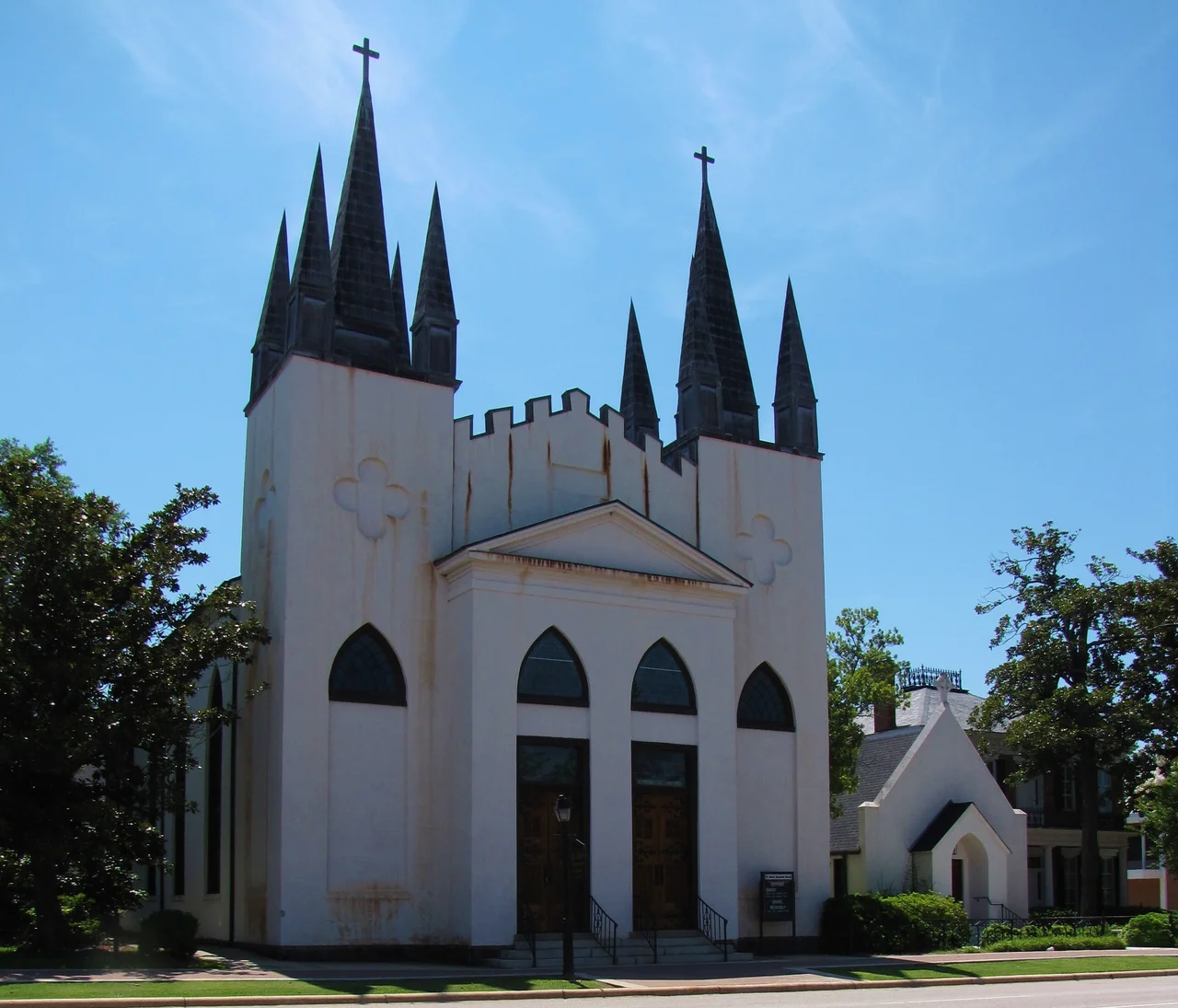

St. John's Episcopal Church (Fayetteville, North Carolina)
In 1816, a Fayetteville man named John Winslow rode to Wilmington to ask a priest a question. Could the Episcopalians in his town, scattered among a population overwhelmingly Scottish Presbyterian, finally have a church of their own? The Reverend Dr. Bethell Judd answered yes. He came back to Fayetteville with Winslow, and on April 7, 1817, the parish formally organized. Judd became its first rector. Two centuries later, his successors are still preaching from the same Green Street ground, in a sanctuary that has now outlived the city's most famous catastrophe.
The First Building
The local Masonic lodge laid the foundation in 1817. The first church rose with a single spire, and into that spire someone installed the town clock, a civic gift that meant the Episcopalians had given Fayetteville its sense of time as well as its newest congregation. The building cost about sixteen thousand dollars, a substantial sum in the early Republic. The first rectors cycled through quickly: Judd for one year, Gregory Bedell for four, William Hooper for two, Henry Mason, Philip Wiley, William Jones in a single year, then Jarvis Buxton from 1831 onward. Buxton would still be there when disaster came.
The Great Fire
The Great Fire of 1831 burned through downtown Fayetteville on May 29, taking hundreds of structures with it. The Masonic-laid church, the clock-bearing spire, the four-figure investment of the small Episcopalian community: all gone. Buxton, freshly arrived as rector, would spend the next two decades shepherding both the rebuild and the reorganization of a congregation that had just lost its home. The current building rose on the same Green Street site in 1832, a remarkably fast turnaround in an era when masonry construction was still hand-laid brick by brick. It would seat over four hundred. It would acquire, eventually, stained glass windows imported from Munich, Germany, depicting Biblical scenes that color the morning light differently across the seasons.
Nineteen Rectors and Counting
Joseph Caldwell Huske held the parish for thirty-seven years, from 1851 to 1888, the longest tenure in the church's history. He carried the congregation through the Civil War, through Reconstruction, through the slow rebuilding of a southern town that had been, briefly, the seat of the state government. Roscoe C. Hauser Jr. served twenty years through the postwar period, 1954 to 1974. Robert M. Alves took the rectorship in 2009 and served until the mid-2020s. Nineteen rectors over two hundred years. The Rite I and Rite II liturgies from the Book of Common Prayer alternate. The Eucharist is always at the center.
The Chapel and the Kyle House
The main sanctuary is for Sunday morning, but the Chapel of the Beloved Disciple gathers smaller weekday congregations under a more intimate ceiling. In 1990, the parish bought the Kyle House next door, a 139-year-old home that had watched Green Street change around it. By 2002, the two buildings were connected, with a gymnasium, a preschool facility, and an expanded fellowship hall stitched between them. The new construction was careful, the historical layers preserved. The preschool serves children from six months through four years of age. The Wednesday evening contemporary service is a recent addition to the rhythm of a church that otherwise leans Broad to High in its worship.
Downtown's Anchor
The National Register of Historic Places lists St. John's among Fayetteville's protected buildings. The designation matters less than what the church does day to day. Public tours run by appointment. The Munich glass still catches the afternoon light. The clock that once hung in the original spire is gone, but the congregation that organized in 1817 to finally have a church of its own is still gathering on the same block. Fayetteville's first Episcopal church remains its longest-running.
From the Air
St. John's Episcopal sits at 35.055 N, 78.877 W on Green Street in downtown Fayetteville, two blocks from the Cape Fear River and walking distance from the Market House. Fayetteville Regional Airport (KFAY) lies 4 nm south-southeast and operates as Class D airspace. Recommended sightseeing altitude 2,500-3,500 feet keeps you clear of approaches to KFAY and Simmons Army Airfield (KFBG) 6 nm northwest. Watch for Class C airspace and high helicopter traffic from KFBG. The downtown is visible as a compact street grid wrapped in the Cape Fear's broad bend. KEYF (Elizabethtown) lies 28 nm south for diversion.
Nearby Stories
- Laurinburg, North Carolina 4.7 km away
- Sampson County, North Carolina 9.1 km away
- Rockingham Speedway 18 km away
- Campbell University 19 km away
- The Robesonian Takeover 20 km away
- Johnston County, North Carolina 21 km away
- North Carolina Aviation Museum 53 km away
- Pender County, North Carolina 57 km away