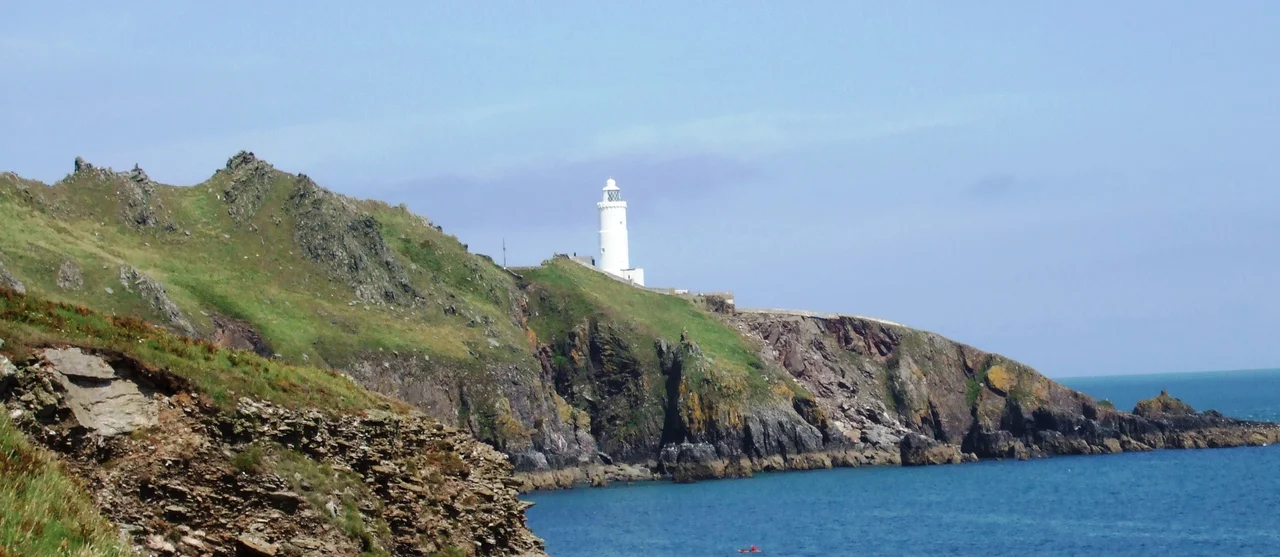

Start Point Lighthouse
Start Point juts almost a mile out into the western English Channel, a finger of dark schist pointing toward France. At the tip stands a white granite tower 92 feet tall, finished in 1836 with a Gothic crenellated parapet and a single revolving light. It was the first lighthouse in Trinity House's care ever fitted with a Fresnel lens - the technology that, ever since, has been the way most lighthouses on Earth throw a beam across the dark. For most of its working life the men who tended it could only get on and off by boat. Today the road runs almost to the gate, and you can walk out to the lantern on a summer afternoon if the weather will let you.
James Walker's Tower
The man who designed Start Point was James Walker, the Scottish engineer who designed around 22 lighthouses still standing around the British coast, from the Smalls off Pembrokeshire to the Wolf Rock off Land's End. Walker liked his towers Gothic - hood mouldings, Tudor arches, crenellated parapets that look as much like a medieval keep as a working signal. The tower at Start Point is built of tarred and white-painted granite ashlar, with a cast-iron lantern roofed in copper and a cantilevered granite spiral staircase wrapped around the interior wall. The masonry steps cantilever out from the curve of the tower itself, each step locking against the next, with no central pillar - a structural trick that lets the stairs feel almost weightless under your hand on the iron balustrade as you climb. Two entrance porches, north and south, both with Trinity House arms set into the parapet. Walker built things to last.
First of the Fresnels
The original optic was the new thing in 1836: an octagonal array of eight first-order Fresnel lenses, each one a stepped glass disc that focused light far more efficiently than the polished reflectors lighthouses had used before. Seven tiers of concave mirrors stacked above the lenses to catch the lost light. The maker was Cookson and Co. of Newcastle-upon-Tyne; the engineering was based on the work of the French physicist Augustin Fresnel as developed by Alan Stevenson - one of the great Scottish lighthouse Stevensons, engineer to the Northern Lighthouse Board and uncle to Robert Louis. Until Start Point, Trinity House had never put a dioptric, lens-based light in any tower in their care. Within a few decades the system was standard everywhere. The original Start Point lens is now on display at the visitor centre below the tower. James Douglass, the engineer who designed Eddystone, built a new lantern on top in 1873 and improved the light again. Oil burned in the lamp until 1959, when the cottage telephone first rang with mains electricity.
The Foghorn on the Cliff
The light was not enough when fog closed in. From 1862 a bell hung in a small building on the cliff face, ringing 48 times a minute, the mechanism driven by a falling weight inside a tube that ran down the sheer rock. In 1877 a siren replaced the bell - a horizontal horn on the roof that could be turned into the prevailing wind. The signal kept getting louder. A two-tone siren came in 1883, then five-inch sirens through copper trumpets at the turn of the century, then a 12-inch siren in 1928 sounded from a pair of conical horns in a cast-iron turret. Behind them a pair of Gardner diesel engines drove the air compressors. The sound carried for miles when the weather closed, the rhythmic blasts marking the headland for ships that could not see anything beyond their own bow. In 1989 a landslip took most of the fog signal building over the cliff. The electric horn that replaced it sounds once every sixty seconds, a flatter modern note, but it does the same job.
Living on the Point
Until 1871 the keepers and their families lived inside the tower itself, on the ground and first floors. New keepers' houses went up that year either side of the porches; a third cottage followed in 1882, set back a little to the east. James Douglass designed them all. The keepers had a well-house and a piggery up on the headland - they had to be self-sufficient for long stretches between supply boats, with no road in. The south cottage was knocked down after the 1989 landslip damaged it badly. The other dwellings, rebuilt in the 1950s, still stand. Automation came in early 1993 - eighty-two thousand pounds and a few months' work by LEC Marine - and the last keepers left. The lighthouse runs itself now, monitored remotely from Trinity House's centre at Harwich, the light still pulsing every ten seconds, the way it has done since 1836.
Walk Out on a Summer Day
The headland is one of the most dramatic stretches of the South West Coast Path. From the car park half a mile inland, the lane drops steeply between gorse and bracken, the Skerries Bank visible offshore where the green of shallow water turns to deeper blue and back. Seabirds nest on the cliffs - gulls, cormorants, occasionally a peregrine. On clear days you can see clean past Prawle Point to the east and Bolt Tail to the west. Trinity House opens the tower to the public during summer afternoons; you climb the spiral granite staircase with a guide, stand in the lantern beside the modern optic, and look out over the bend of coast where the Atlantic meets the Channel. The light still keeps ships off the Devon coast. The tower, listed Grade II by English Heritage, is still painted white every few years against the salt and the weather - the keepers gone, but the keeping continued.
From the Air
Start Point Lighthouse stands at approximately 50.222 degrees N, 3.642 degrees W on a long narrow promontory at the southeastern tip of the South Hams in Devon. The headland is unmistakable from the air: a dark schist ridge pointing southeast into the Channel, with the white tower and remaining keepers' cottages at the very end. The Skerries Bank lies just offshore to the north. Nearest airports are the closed Plymouth City Airport (EGHQ) about 22 miles west and Exeter (EGTE) about 32 miles north; Newquay Cornwall is the western alternative. Cruise altitudes of 1,500-3,000 feet give superb views of the headland and the Slapton Sands shingle bar running north toward Torcross. Channel weather is changeable - the lighthouse exists precisely because of how often this coast is in fog, low cloud or driving rain. Expect quick-changing visibility year-round.
Nearby Stories
- Dartington Hall 0.3 km away
- Eddystone Lighthouse 3.4 km away
- Cotehele 5.2 km away
- HMS Formidable (1898) 7.8 km away
- Lyme Bay Canoeing Disaster 34 km away
- HMS Affray 48 km away
- Casquets Lighthouses 61 km away
- Battle off Lizard Point 72 km away