
State Library of Queensland
The point of land is called Kurilpa, and the name was here long before the library was. In the Yuggera language it means the place of the kuril, the water rat that once worked these riverbanks. On that ground now stands the State Library of Queensland, a low concrete-and-glass building opening wide toward the Brisbane River, and architects who write about it reach, oddly, for the language of home. They have called it one of Australia's most cherished public living rooms. It is a building designed to be walked into freely, by anyone, to hold the written memory of an entire state and give it away for nothing.
A Free Library, Argued For
The institution is old, founded in 1896 as the Brisbane Public Library and opened to the public in 1902. Its modern character owes much to one man's insistence. James Stapleton became Queensland's first State Librarian in 1947 and argued two things relentlessly: that the library needed a real building, and that its services should be free to the public. He held the post until 1970, the longest tenure of any State Librarian, and the principle outlasted him. The library's job, set in law, is to gather and preserve Queensland's documentary heritage and to open it to every Queenslander, a mandate that runs from rare convict records to election leaflets to fifty thousand photographs released free for anyone to use.
The Living Room on the River
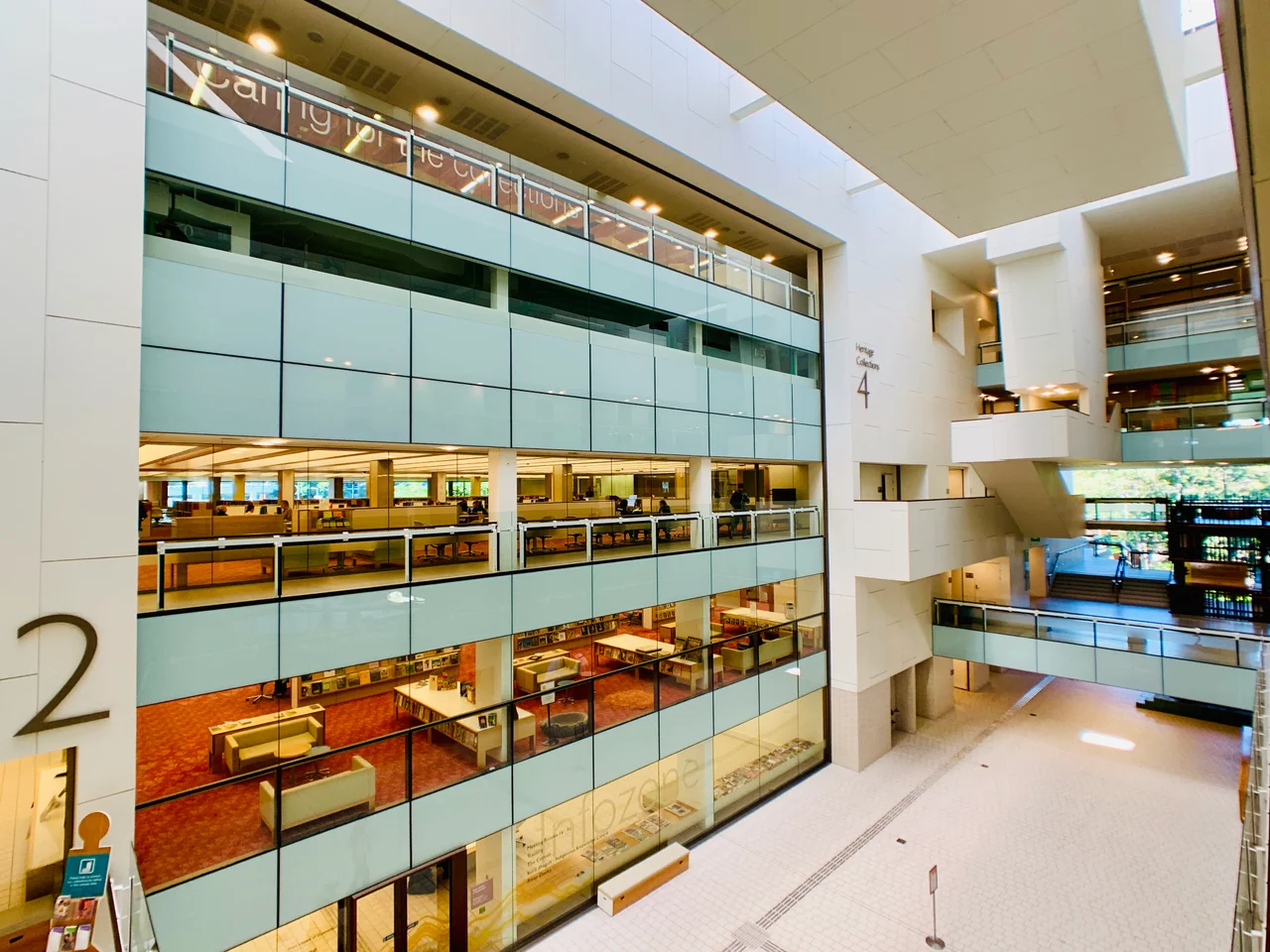
The library moved to South Bank in 1988, into a C-shaped block of straight concrete and glass that completed Robin Gibson's grand Queensland Cultural Centre. It was good, but it was about to become remarkable. Between 2004 and 2006 the Brisbane firms Donovan Hill and Peddle Thorp reworked the building under the Millennium Library Project, adding a level, a sweeping new wing toward the river and a reconfigured entrance, and doubling its floor space. It reopened on 25 November 2006 and swept the year's national architecture awards, including the country's top prize for a public building. The redesign turned a competent civic block into a place of light and openness, more public square than reading room.
kuril dhagun
Inside is a space called kuril dhagun, an Indigenous Knowledge Centre whose name draws again on the Yuggera words for this place: kuril, the water rat of Kurilpa Point, and dhagun, meaning earth, place or country, together kuril's place. It is the public face of a wider mission begun in 2003, when the library started building Indigenous Knowledge Centres in remote communities across Cape York and the Torres Strait, a network that has grown to more than twenty. The work is built on partnership rather than collection alone, on training and employing First Nations people in the library sector and on holding cultural knowledge in the communities it belongs to. The library also runs the black&write! fellowships, supporting Aboriginal and Torres Strait Islander writers across the country.
What the Walls Hold
The collections are the reason all of this exists. The John Oxley Library, named for the explorer who charted the Brisbane River in 1823, anchors the state's research holdings, and seven of the library's collections are inscribed on UNESCO's Australian Memory of the World Register, among them convict records from the Moreton Bay penal settlement, an 1892 Queensland Labour Party manifesto, and the Margaret Lawrie collection of Torres Strait Islander material gathered across three decades. There are sixty thousand photographs of suburban Brisbane houses, an archive documenting the state's built heritage, family histories, maps and music. A library is a city's memory made durable, and this one is unusually generous about letting the public come and remember alongside it.
From the Air
The State Library of Queensland stands at 27.4712°S, 153.0181°E on Kurilpa Point, at the northern end of the Queensland Cultural Centre on the south bank of the Brisbane River in South Brisbane. From the air, look for the cluster of pale Cultural Centre buildings on the riverbank just west of the Victoria Bridge, with the spiky Kurilpa Bridge footbridge crossing the river immediately to the north and South Bank Parklands stretching downstream to the southeast. The Brisbane River's loop around the CBD makes the precinct easy to locate opposite the downtown towers. Brisbane Airport (YBBN / BNE) lies about 13 km to the north-northeast; Archerfield (YBAF) is roughly 11 km to the south-southwest. Subtropical visibility is usually clear, with summer haze and afternoon storms most likely from December to February.
Nearby Stories
- Redcliffe Peninsula 2.7 km away
- Tamborine National Park 12 km away
- Cressbrook Homestead 27 km away
- Main Range National Park 31 km away
- 2010-2011 Queensland Floods 38 km away
- Cape Byron 96 km away
- Cape Byron Light 126 km away
- HMS Porpoise (1799) 588 km away