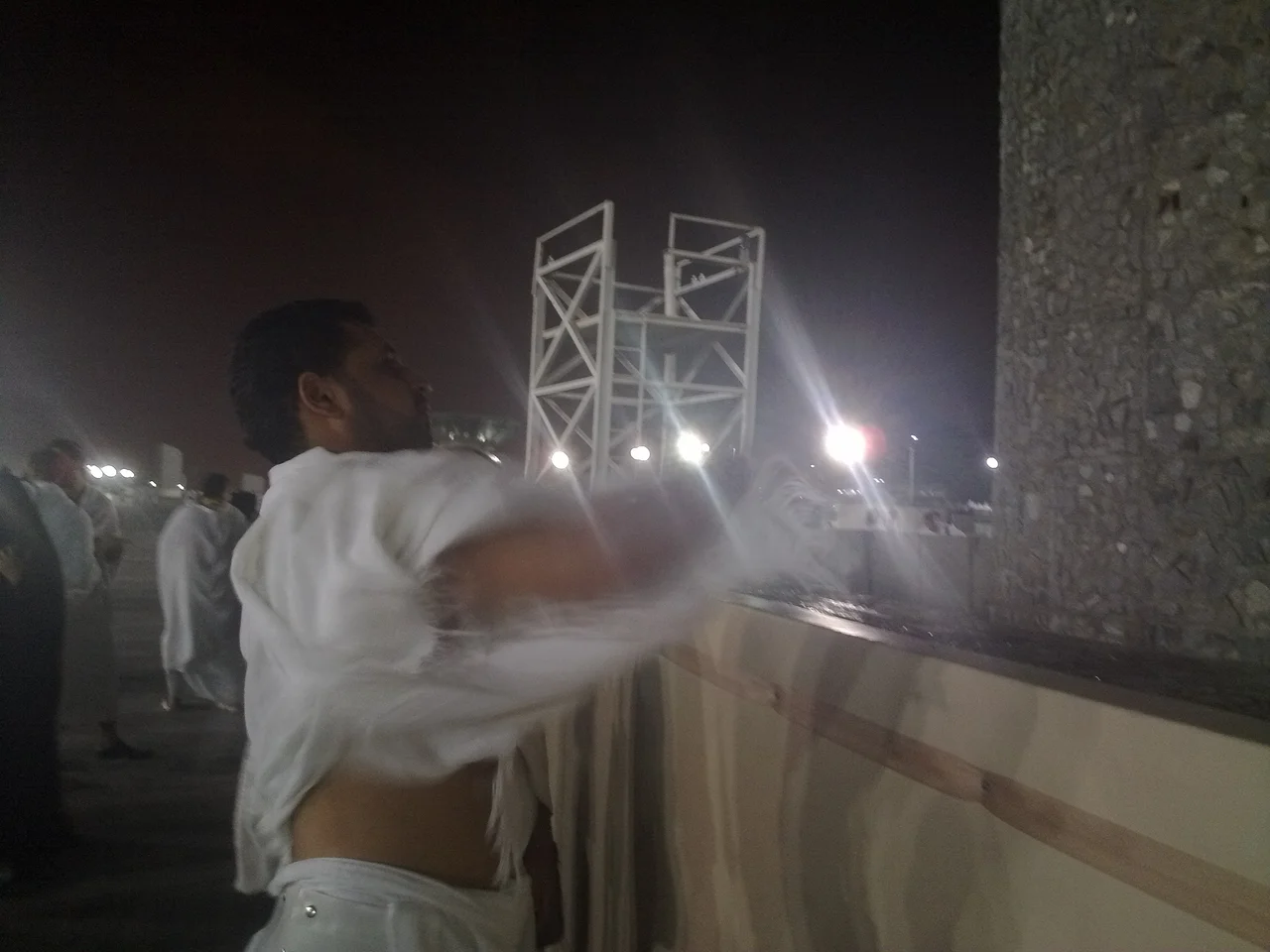

Stoning of the Devil
Seven pebbles, no bigger than chickpeas, pocketed the night before in the plain of Muzdalifah. A crowd numbering in the millions moves as one current through the valley of Mina, each pilgrim holding their gathered stones, each walking toward three walls that used to be three pillars. The Stoning of the Devil is one of the oldest continuous rituals on Earth, and one of the most dangerous. On 24 September 2015, at least 2,411 pilgrims died here when two converging streams of people met on a narrow road. That figure, from an Associated Press count, made it the deadliest day in the history of the annual Hajj.
The Story Behind the Stones
The ritual is a reenactment. According to the account preserved by the Muslim historian al-Azraqi, when Ibrahim (Abraham) left Mina and walked down toward the defile called al-Aqaba, the Devil appeared to him. Gabriel told him to pelt the tempter. Ibrahim threw seven stones. The Devil appeared again at the middle stone-heap, and again at the little one, and each time the angel said the same thing: pelt him. Seven stones at each site. The three jamarat, the three stone-heaps, stand where those temptations are said to have occurred. The first and largest represents the Devil tempting Ibrahim against sacrificing his son Ismail. The second represents the temptation of Hagar, Ibrahim's wife, to stop him. The third represents the attempt to save Ismail himself from the sacrifice. All three are rebuked.
The Sequence of the Rite
On Eid al-Adha, the tenth day of Dhu al-Hijjah, pilgrims strike the largest of the three jamarat, Al-Jamrah Al-Aqaba, with seven pebbles. They then cut or shave their hair. For the following two days they hit all three walls with seven pebbles each, moving east to west. The minimum total is twenty-one stones, though a missed throw means collecting more. Pilgrims who stay an additional day stone each wall seven times more. The pebbles themselves are traditionally gathered at Muzdalifah the night before the first throw, though Mina is also acceptable. Behind the simple count, an Islamic theologian's interpretation runs deeper: the stones are cast against the nafs al-ammara, the internal despot, the self that wants what it should not.
Pillars Become Walls
Until 2004, the three jamarat were tall pillars. They had been pillars for centuries, but century-scale tradition met modern crowd dynamics and did not hold. Pilgrims on one side threw stones that struck pilgrims on the other side. After the 2004 stampede, Saudi authorities replaced the pillars with 26-meter walls, long enough that stones thrown at one face would not fly past. A multi-tier pedestrian bridge, the Jamaraat Bridge, was built around the walls so pilgrims could throw from ground level or from above, distributing the crowd across elevations. The changes were physical, but the ritual was unchanged in form and meaning. Seven pebbles, three times, three walls, as Abraham was said to have done.
What the Numbers Cannot Say
Crowd management is now the single hardest problem at Hajj. The Stoning of the Devil is the most dangerous part of the pilgrimage, because sudden crowd movements near the Jamaraat Bridge can crush people against barriers or against one another. In 2006, a stampede here killed at least 346 pilgrims and injured 289 more. The 2015 Mina crush killed over 2,411, according to the AP count that followed months after the Saudi government's own lower figure. Authorities identified the cause as two waves of pilgrims converging on a narrow road, with luggage and off-route movement adding to the confusion. These were not just casualties. They were mothers on a journey many had saved decades to make. Teachers, laborers, grandparents who had sold land or taken loans for the chance to stand at Mina. The rites they died performing are among the most sacred in their faith.
The Valley That Holds Both
Mina lies just east of Mecca, a valley transformed every year into a tent city that holds roughly three million people for five days. Outside Hajj it is quiet. The infrastructure, the bridge, the walls, the cooled tents, sits waiting. Then Dhu al-Hijjah arrives, and the valley fills. The ritual that starts in the prehistory of Abraham and continues in real time through engineered walkways is one of the clearest examples in the world of a tradition that refuses to be simplified. The pebble in the hand is the same pebble. The crowd around it is the largest gathering our species performs by choice each year. Both are true at once at Mina.
From the Air
The Jamaraat complex sits in the valley of Mina, about 5 km east of the Masjid al-Haram in Mecca, at 21.42 N, 39.87 E. From altitude the site is visible as the large tent city east of Mecca, with the distinctive multi-tiered Jamaraat Bridge as a white linear structure near the center. Nearest airport: King Abdulaziz International (OEJN) at Jeddah. Hajj season closes much of the airspace to commercial traffic.
Nearby Stories
- Al-Balad, Jeddah 23 km away
- Jeddah Tower 33 km away
- Battle of Turubah 123 km away
- Red Sea Rift 143 km away
- Ghadir Khumm 159 km away
- Al-Baha 162 km away
- Thee Ain 206 km away
- Hejaz 214 km away