,_circa_1934.jpg)
Story Bridge
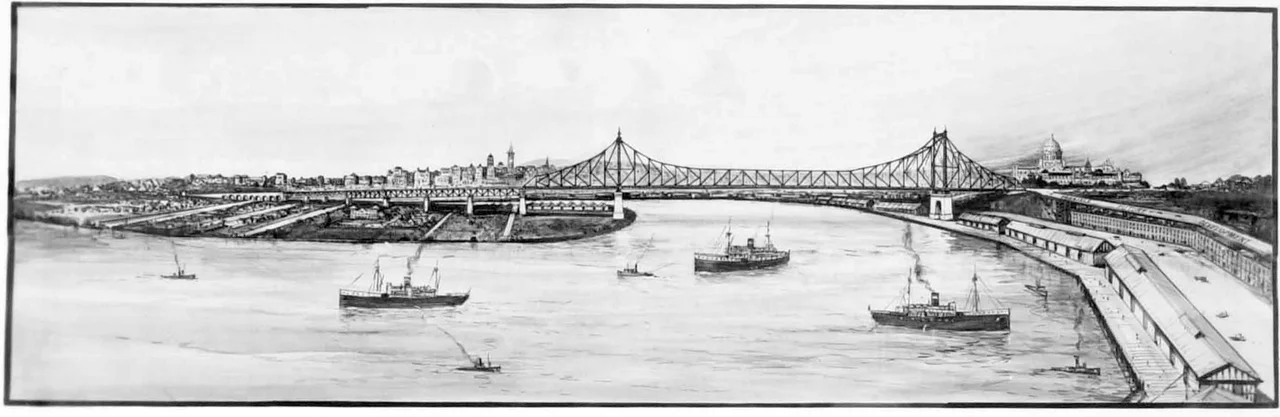
It is the bridge that Brisbane decided to climb. Since 2005, harnessed visitors have inched up the riveted steel of the Story Bridge to stand 80 metres above the brown sweep of the Brisbane River, the city spread out beneath their boots. From the water it is a different creature: a grey cantilever giant, the longest of its kind in Australia, flinging itself across the river in a single dramatic leap between Fortitude Valley and Kangaroo Point. Brisbane has built taller towers since, but none of them is the picture the city paints of itself. That honour belongs to the bridge.
The Man Who Bridged Two Cities
Before the Sydney Harbour Bridge opened in 1932, the Queensland government had already turned to the engineer behind it. John Bradfield - whose name is stamped on the Sydney crossing - was appointed in December 1933 as consulting engineer for a new Brisbane bridge, and in June 1934 his recommendation of a steel cantilever design was approved. He looked abroad for his model, basing the structure heavily on Montreal's Jacques Cartier Bridge, completed in 1930. The result spans 777 metres with a main span of 282 metres, the longest cantilever bridge in the country. The road across it carries the name Bradfield Highway - the same name as the deck of the Sydney Harbour Bridge, a quiet signature from the engineer who gave both cities their river crossings.
A Century of Wanting
The bridge was a long time coming. As early as 1865, while the first Victoria Bridge was still being built, several hundred Brisbane residents were petitioning for a second crossing to reach Kangaroo Point. In 1888 a public meeting at the Town Hall demanded a bridge, with citizens prepared to sacrifice part of the Botanic Gardens to get one. The idea finally took shape in the 1920s as part of University of Queensland professor Roger Hawken's plan for a series of river bridges to relieve the congested city centre. Money was the obstacle. Only when the Great Depression made public works a tool of employment did the project proceed, with a budget capped at 1.6 million pounds. Until it was finished, locals knew it as the Jubilee Bridge, honouring King George V.
The Price in Lives
Construction began on 24 May 1935, and at times the work ran around the clock. It was dangerous labour, and three men did not come home. In November 1937 Hans James Zimmerman slipped and fell. In February 1939 Alfred William Jackson fell into the river; pulled out alive, he died four hours later without regaining consciousness. In December 1939 Arthur McKay Wharton was struck on a nerve by a piece of equipment, fainted, and fell to the water - a cruel turn, given that eighteen months earlier Wharton had saved a fellow worker from falling. When Governor Sir Leslie Orme Wilson opened the bridge on 6 July 1940, naming it for senior public servant John Douglas Story, the celebrations carried the weight of those three lives.
The City's Stage
More than 97,000 vehicles cross the Story Bridge on an average day, but its role in Brisbane runs deeper than traffic. Each year it becomes the centrepiece of Riverfire, the fireworks spectacular that pours light off its span into the river below. It is floodlit by night, has appeared on beer labels, and in 1990 the road was closed so pedestrians could walk it to mark fifty years. The bridge has known sorrow too - like San Francisco's Golden Gate, it has drawn those in despair, prompting the city to install crisis-line telephones. Now eighty-five years old, the steel veteran needs care: the council has flagged a full restoration by 2045 to keep it open, and in October 2025 the first replaced footpath reopened pedestrians and cyclists to the crossing while work continues on the other side.
From the Air
The Story Bridge sits at 27.464 degrees south, 153.036 degrees east, spanning the Brisbane River between Kangaroo Point and Fortitude Valley, immediately east of the CBD. Its grey steel cantilever and dual towers make it one of the most legible landmarks on the river - follow the Brisbane River's S-bends through the city and the bridge marks the downstream edge of the central business district. Best appreciated from a few thousand feet in clear daylight, with the high-rise wall of the CBD on its western flank and the green of the City Botanic Gardens just upstream. Brisbane Airport (YBBN / BNE) lies about 12 km to the north-northeast; Archerfield (YBAF) is roughly 13 km to the southwest for general aviation.
Nearby Stories
- Redcliffe Peninsula 2.7 km away
- Tamborine National Park 12 km away
- Cressbrook Homestead 27 km away
- Main Range National Park 31 km away
- 2010-2011 Queensland Floods 38 km away
- Cape Byron 96 km away
- Cape Byron Light 126 km away
- HMS Porpoise (1799) 588 km away