.jpg)
Strandhill
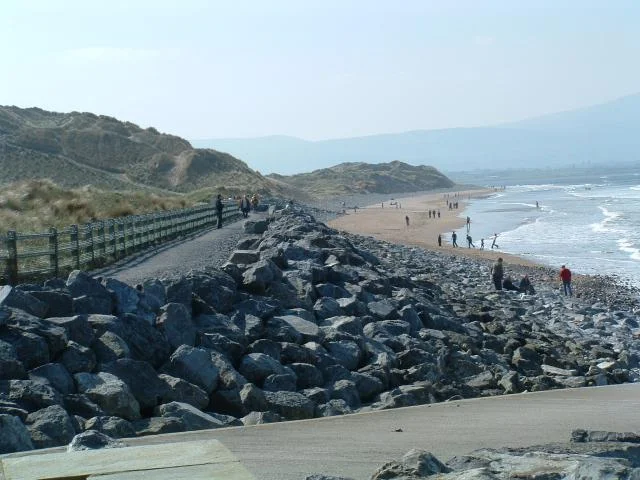
Walk down Shore Road in Strandhill on any morning with surf in it and you'll see them: wetsuits half-zipped, boards under arms, the same expressions surfers wear in Cornwall or California, here at the western base of Knocknarea where the Atlantic comes in hard and unbroken. The signs at the beach tell you not to swim. They don't quite say why - the tourist boards prefer not to mention the sewage outfall - so they emphasise the currents instead, which are also real. Strandhill is a village whose name is exactly true: a great expanse of strand in front, a steep hill behind, and a population of about 2,000 perched between them. There used to be another village here. The sand swallowed it.
The Deserted Village
Before Strandhill was a place, an older settlement stood near where Sligo Airport now sits. The shifting sands of the peninsula gradually buried it - dune over wall, marram grass over hearth - and its residents fled up the slopes of Knocknarea. The famine of the 1840s killed most of those who had moved. The village's name became, with grim Irish humour, the Deserted Village. You can visit the surviving ruins today, picked clean by weather and time, set incongruously beside the tarmac of an airport runway. Underneath the sand, a community is still waiting to be properly excavated.
Buenos Ayres Drive
The modern village owes its existence to a Victorian developer named Benjamin Murrow. In 1895 he bought the undeveloped land from the upper road for £1,760, spent another £1,000 cutting a road down to the sea, and offered plots either side. He called his new street Buenos Ayres Drive - the imperial gesture of a man who believed seaside resorts could be willed into existence. In 1912 he built a bathhouse to draw visitors. It worked, slowly. The street was conveyed into public ownership in 1928, the shore strip in 1936. By the 1960s the village was a recognisable seaside resort. By the 2010s it had reinvented itself again as a surf town, the bathhouse logic now bent toward wax and neoprene rather than Victorian convalescents in striped costumes.
Knocknarea Above
Knocknarea rises straight up behind the village - 327 metres of flat-topped limestone, capped by the cairn locals call Miosgán Médhbh: Queen Maeve's grave. The cairn is believed to date from around 3000 BC, twice the diameter of Listoghil at nearby Carrowmore, and folklore insists it contains an unopened Neolithic passage tomb in which the warrior queen stands upright in full armour, facing her enemies. Archaeologists have never excavated it. The direct path from Strandhill is fifteen kilometres there and back, steep and muddy and a brute. The path from Primrose Grange to the southeast is gentler. Either way, from the summit you look down on Strandhill, Sligo Bay, the Atlantic, and on a clear day to Donegal.
The Crossing to Coney Island
At low tide, a road appears across Cummeen Strand from the mainland to Coney Island. The sand is firm enough to drive a car across, though you'll pick up enough salt to regret it later. Fourteen sturdy guide markers line the route, each aligned with the Black Rock lighthouse to keep travellers on the safe firm sand and not sinking in the soft channels between. The crossing must be timed: set off two to three hours before low tide and be back an hour after it turns. Locals tell the story of a man called Dorrin who didn't heed the tide times and didn't make it back, and whose name still hangs - somewhat inaccurately - on the street that holds Dolly's Cottage. The island itself is small, mostly populated by rabbits (its name probably comes from the Old Dutch for them, the same root that named the New York Coney Island), and has a single pub run by Michael J Ward. Opening hours, sensibly, depend on the tide.
Surfing, Seaweed, and the Warriors' Run
The west-facing beach gets the swell that has crossed three thousand kilometres of open Atlantic, and on the right days it produces serious waves. Two surf schools operate from the strand. The 18-hole golf course backs the dunes with what local writers call "undulating fairways and unforgiving short cuts." Seaweed baths - a coastal tradition all along this stretch of Ireland - are available in the village; you sink into a tub of hot seawater and bladder-wrack and emerge feeling, depending on your temperament, either renewed or extremely confused. Every August the Warriors' Run sends competitors fifteen kilometres up Knocknarea to the cairn and back down, a race held annually since 1985, the entire village turning out for the music and the festivities. Westlife's Kian Egan lives here. So does the actress Jodi Albert. The famous and the unfamous all stand on the same sand.
From the Air
Strandhill sits at 54.272°N, 8.593°W on the south shore of Sligo Bay at the western base of Knocknarea, 9 km west of Sligo town. From the air, the long west-facing beach, the dunes, Coney Island offshore, and Knocknarea's flat-topped summit (with Queen Maeve's cairn) are all unmistakable landmarks. Sligo Airport (EISG) sits within the village itself on the peninsula. Donegal Airport (EIDL) is 60 km north. Best viewed at 1,500-3,000 ft AGL; Atlantic conditions can change quickly, and Knocknarea generates significant turbulence in westerly winds.
Nearby Stories
- Killala 5.5 km away
- Ballaghaderreen 7.4 km away
- Townlands of Kilcommon 10 km away
- River Shannon 11 km away
- Monastery of Mohill-Manchan 15 km away
- Pettigo 18 km away
- Killybegs 19 km away
- RMS Empress of Britain (1930) 97 km away