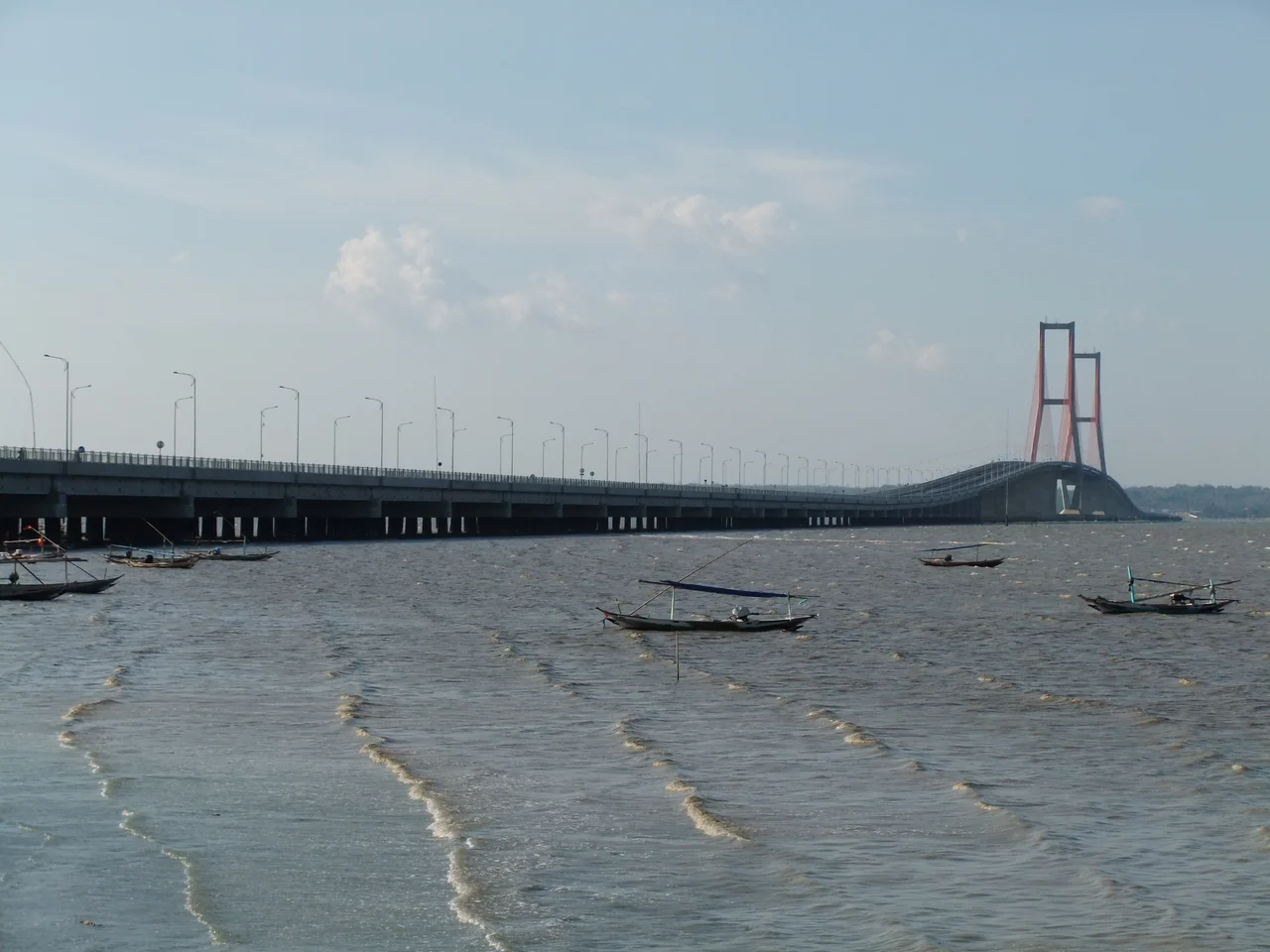

The Bridge That Took Half a Century
For decades, the Madura Strait was a boundary as much as a waterway. Surabaya, Java's second-largest city, sat on one side with its factories, universities, and port. Madura Island sat on the other, close enough to see but far enough to feel remote -- an island of salt farms, bull races, and an economy that lagged behind the Javanese mainland. Engineers first proposed bridging the gap in the early 1960s. It took until 2009 to finish the job. The Suramadu Bridge -- its name fusing Surabaya and Madura into a single word -- now stretches 5.4 kilometers across the strait, a cable-stayed span that is both Indonesia's longest bridge and the physical answer to a question the country debated for nearly fifty years: how much does it cost to connect an island?
A Professor's Idea, a President's Decree
The bridge began as an idea in the mind of Professor Sedyatmo, a prominent engineer from the Bandung Institute of Technology, who proposed the crossing in the early 1960s. The concept lay dormant for two decades before staff from Indonesia's National Development Planning Bureau raised it with Japanese aid donors in the mid-1980s. A pre-feasibility study followed in 1990, and by December of that year President Suharto had appointed a team of ministers and advisers to evaluate the plan. A consortium took shape -- Indonesian state firms partnered with Mitsubishi, Itochu, Shimizu, and the Long-Term Credit Bank of Japan. The project appeared to be gathering momentum. Then the Asian financial crisis struck in 1997, and Indonesia's economy collapsed. The consortium dissolved. The bridge was shelved.
From Rubble to Ribbon-Cutting
The bridge's revival came from the provincial level. By 2000, the East Java government had taken ownership of the effort, and President Megawati Sukarnoputri issued a decree directing ministers to support construction. A new consortium formed -- this time the Indonesian firms PT Adhi Karya and PT Waskita Karya, working with China Road and Bridge Corporation and China Harbor Engineering. The price tag reached 4.5 trillion rupiah, roughly 445 million US dollars. Construction began in August 2003, but the project hit trouble almost immediately. In July 2004, a girder collapsed, killing one worker and injuring nine others. Funding ran out by the end of 2004, halting work entirely. Construction resumed in November 2005, and the main span was finally connected on March 31, 2009. The bridge opened to the public on June 10, 2009, six years after breaking ground and nearly five decades after the idea was first floated.
Bolts Missing Before the Paint Dried
Within a week of the grand opening, inspectors discovered that nuts, bolts, and maintenance lamps had been stolen from the bridge. There was also evidence of vandalism on the cables supporting the main span. The theft was brazen -- the bridge was barely a week old, its paint still fresh, and already scavengers were stripping it for scrap. The incident was embarrassing but not uncommon for large Indonesian infrastructure projects, where the gap between a ribbon-cutting ceremony and effective long-term maintenance can be wide. The bridge's cable-stayed design features a main span of 434 meters flanked by two 192-meter side spans, with dedicated motorcycle lanes in each direction -- a nod to the reality that two-wheelers dominate Indonesian traffic. Despite the early vandalism, the structure was engineered to last a century.
The Price of Crossing
The economics of the Suramadu Bridge tell a story of shifting priorities. Tolls were initially set at 30,000 rupiah (about three US dollars in 2009) for cars and 3,000 rupiah for motorcycles. But the bridge was supposed to stimulate Madura's economy, and toll costs undercut that mission by discouraging crossings. In 2016, President Jokowi pushed for a 50 percent reduction to promote competitiveness on the Madura side. The state-owned operator PT Jasa Marga absorbed the cut because the government paid it directly to manage the bridge -- an arrangement that insulated the company from revenue shortfalls but raised questions about long-term sustainability. Then, on October 27, 2018, Jokowi went further: tolls were abolished entirely. The bridge became free. It was a populist gesture with real economic logic -- removing the last friction between Java's industrial powerhouse and an island that had always been just out of reach.
From the Air
Located at approximately 7.18°S, 112.78°E, the Suramadu Bridge stretches 5.4 km across the Madura Strait between Surabaya (Java) and Bangkalan (Madura Island). The cable-stayed structure with its distinctive towers is clearly visible from altitude, especially the main 434-meter span. Best viewed at 3,000-5,000 ft when flying along the strait. Juanda International Airport (WARR) is approximately 12 nm south of the bridge. The Surabaya harbor complex and Port of Tanjung Perak sit to the west.
Nearby Stories
- The Gate That Outlasted Its Kingdom 6.7 km away
- Bengawan Solo: Java's River of Deep Time 11 km away
- Madura: Salt, Bulls, and the Island That Emptied Itself 14 km away
- Where Teak Meets Oil 30 km away
- HNLMS Kortenaer: A Destroyer's Last Two Minutes 42 km away
- The Kedopok War: When Probolinggo Rose Against Its Buyer 45 km away
- The Train Builders of Madiun 74 km away
- Forty Hours in the Masalembo Sea 209 km away