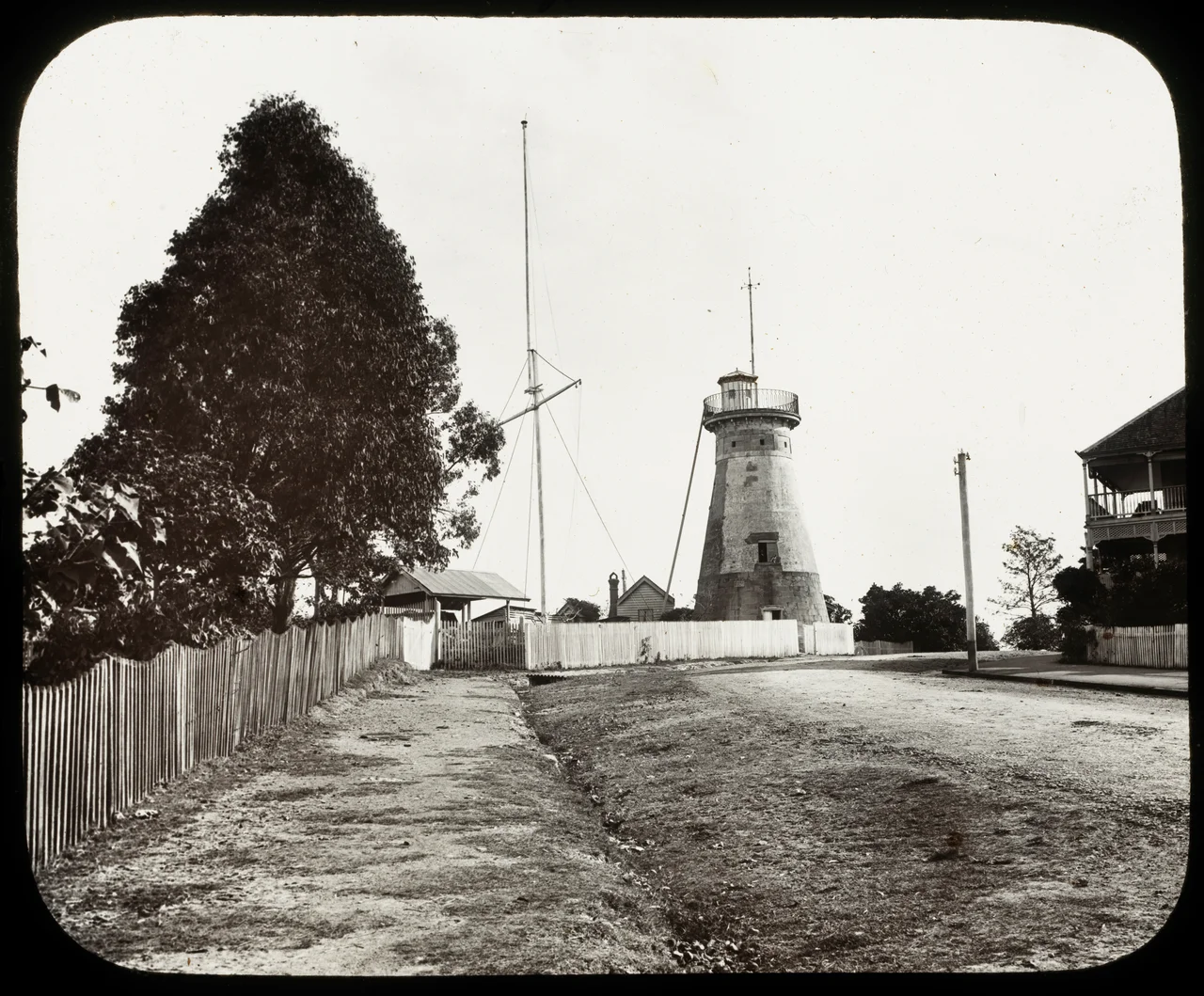

The Old Windmill, Brisbane
It looks almost gentle now: a stubby stone tower with a timber cabin on top, ringed by lawn, dwarfed by the glass office blocks of Spring Hill that crowd up to its boundary. But the Old Windmill on Wickham Terrace is the oldest surviving building in Queensland, raised in 1828 by convict hands, and very little about its early life was gentle. Wind rarely turned its sails reliably, so the mill carried a treadmill - a grinding wheel turned by the legs of prisoners, designed to process grain and to break men at the same time. Before it was a quaint heritage curio, this tower was an instrument of colonial punishment.
The Tower of Toil
The windmill was built to grind the wheat and corn of the Moreton Bay penal settlement, but its winds were fickle. As early as 1827, with a large crop to process, the settlement's storekeeper recommended a treadmill, and the notoriously harsh commandant Patrick Logan saw a double use in it: a machine that would grind flour and punish convicts in the same turning. Prisoners trudged the wheel for hours, their labour milling grain that fed the settlement that imprisoned them. The mill ground its last grain in 1845, and the treadmill was gone before 1849. The structure that survives is largely rendered stone and brick, about 8.4 metres across at the base and tapering to roughly 4.5 metres at the top, standing some 16 metres high beneath its observation cabin and time ball.
Mullan and Ningavil
On 3 July 1841 the disused tower became a gallows. The settlement's Foreman of Public Works, Andrew Petrie, ran a heavy beam out of an upper window and hung the nooses from it. The two condemned were Aboriginal men: Mullan, also recorded as Merridio, and Ningavil, also written Neugavil or Nungavil. They had been convicted in Sydney as accessories to the killing of Assistant Surveyor Granville Stapylton and a convict of his party, William Tuck, near Mount Lindesay in May 1840 - the surveyors were mapping the district to open it for settlement, work that pressed onto Aboriginal land. Returned north to Moreton Bay, the two men were hanged before a crowd that included about a hundred Aboriginal people, most of whom stayed to bury them afterward. These were Brisbane's first legal executions, and the men who died were not abstractions. They had names, kin, and a community that came to mourn them at the foot of the tower.
From Gallows to Lookout
After the milling stopped, the tower's fate hung in the balance. In December 1849 it was auctioned to a government official who promptly advertised for someone to demolish it and cart away its machinery, the sale terms demanding it be cleared within three months. The wreckers never came. Instead, from 1855 the tower found a second life as a signal station, relaying shipping news between the mouth of the Brisbane River and the town. Renovations in 1861 added a time ball - a sphere dropped at a set hour so the townsfolk below could set their clocks and watches. A signalman's cottage and detached kitchen were later built nearby, used, and eventually demolished, leaving the tower once more alone on its hill.
The Tower That Watched the Future Arrive
The Old Windmill kept finding new work. From the 1920s it served as a base for experiments in early radio, telephony and even television - among the first such transmissions in Australia broadcast from this convict-built shell, the oldest structure in the state pressed into service for its newest technology. By 1945 the Brisbane City Council recognised the tower as a beloved visitor attraction and began preserving it; restoration in 1950 stripped and re-rendered the whole structure, and further conservation followed in the 1980s and in 2009. Today it presides over Observatory Park, flanked by Wickham Park and King Edward Park, with the cylindrical Tower Mill Hotel opposite deliberately echoing its rounded form. A lookout now, it gazes over a city that has forgotten almost everything the tower once witnessed.
From the Air
The Old Windmill stands at 27.465 degrees south, 153.023 degrees east, on Wickham Terrace in Spring Hill, on a low rise immediately north of the Brisbane CBD. From the air it is a small circular tower set in the green of Observatory Park, easily lost against the surrounding high-rises - look for the patch of parkland on the ridgeline at the northern edge of the city centre, with the three gabled roofs of the Spring Hill Reservoirs nestled behind it. Best appreciated at low altitude in clear conditions given its modest 16-metre height. Brisbane Airport (YBBN / BNE) lies about 11 km to the northeast; Archerfield (YBAF) is roughly 12 km to the southwest.
Nearby Stories
- Redcliffe Peninsula 2.7 km away
- Tamborine National Park 12 km away
- Cressbrook Homestead 27 km away
- Main Range National Park 31 km away
- 2010-2011 Queensland Floods 38 km away
- Cape Byron 96 km away
- Cape Byron Light 126 km away
- HMS Porpoise (1799) 588 km away