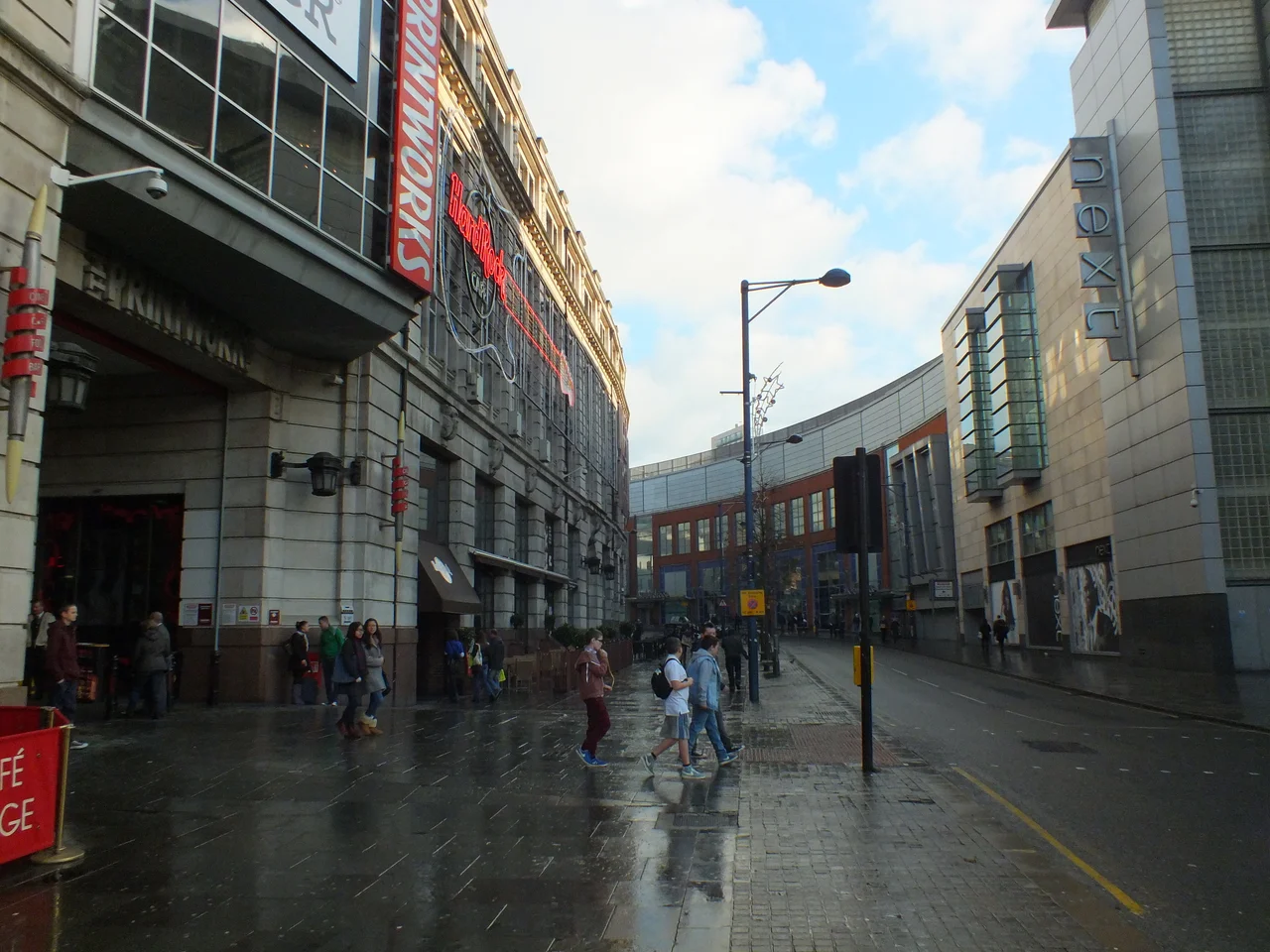

The Printworks (Manchester)
Until 1988, this building on Withy Grove printed newspapers. For most of the twentieth century, what was then called Kemsley House was the largest newspaper printing house in Europe - presses thundering all night, ink and paper moving in industrial quantities, a generation of Manchester journalists tracking through its doors. Then the presses stopped, the building emptied, and the site sat derelict through the 1990s. The thing that finally brought it back to life was not nostalgia. It was a bomb.
The Hulton Newspapers
The story begins in 1873 with Edward Hulton senior, a 19th-century newspaper proprietor who established his business premises on this Withy Grove site. His son Sir Edward Hulton expanded the operation into one of Britain's biggest newspaper empires before selling out in 1923 to Lord Beaverbrook and Lord Rothermere when he retired. The papers were sold again the next year to the Allied Newspapers consortium, renamed Kemsley Newspapers in 1943, and bought finally by Roy Thomson in 1959. Through every owner, the printing happened here. The building grew from the modest Withy Grove Printing House into the Chronicle Buildings, then Allied House, then Kemsley House, then Thomson House, and finally Maxwell House - a series of names tracking ownership across the consolidation of the British press.
Kemsley House
The building that did the heavy lifting was Kemsley House, on the corner of Withy Grove and Corporation Street, developed gradually from 1929. At its peak it housed the largest newspaper printing operation in Europe - rotary presses running tabloid and broadsheet titles around the clock, paper trucks circling the block. The presses kept rolling until 1988. By then the British newspaper industry had moved away from city-centre printing - Murdoch's Wapping move in 1986 was the most famous example - and the Manchester operation went the same way. The building was left empty. For more than a decade it stood derelict, an enormous shell on prime city-centre land, waiting.
1996 and After
On 15 June 1996, the Provisional IRA detonated a 1,500-kilogram truck bomb on Corporation Street, roughly a hundred metres from the derelict Kemsley House. It was the largest bomb in mainland Britain since the Second World War. Nobody was killed - the police had cleared the area after a warning - but more than two hundred people were injured and the heart of Manchester's retail district was wrecked. What followed was one of the largest urban regeneration projects in modern British history. The bomb had created the awful opportunity, and the city took it. The Arndale was rebuilt. Exchange Square was created. And the derelict Kemsley House was redeveloped into an urban entertainment complex - cinemas, bars, restaurants, nightclubs - which opened around 2000 and was named, simply, the Printworks.
The Complex Today
Walk through the doors today and the interior is dominated by enormous digital screens running over a vaulted central thoroughfare flanked by venues. The Vue Cinema includes one of the few IMAX screens in the UK certified to show 70mm prints - among the small number of cinemas worldwide chosen to screen Christopher Nolan's Oppenheimer in that format in 2023. There is a Tenpin bowling alley, Treetop Golf, a Nuffield Health club, and a long list of restaurants and chains - Hard Rock Cafe, Nando's, Wagamama, the Bierkeller and others. A £27 million upgrade in 2024 reset the public spaces. The building still has the ghost of its industrial scale - the long central run, the high ceilings, the sense of having been built for something heavier than entertainment. Which it was.
From the Air
The Printworks sits at 53.4853 degrees north, 2.2414 degrees west, on the corner of Withy Grove and Corporation Street in central Manchester, two minutes' walk from Manchester Victoria station. Manchester Airport (EGCC) lies about 13 km south. Manchester Barton (EGCB) is about 8 km west. From altitude look for the bend in the Manchester rail viaducts feeding into Victoria, with the Arndale shopping centre and Exchange Square cluster immediately south.
Nearby Stories
- National Science and Media Museum 0.2 km away
- Jodrell Bank Observatory 3.2 km away
- Siege of Lathom House 5.6 km away
- Chester Zoo 6.2 km away
- Whalley Abbey 8.9 km away
- Haddon Hall 10 km away
- Wentworth Castle 16 km away
- Blackpool 16 km away