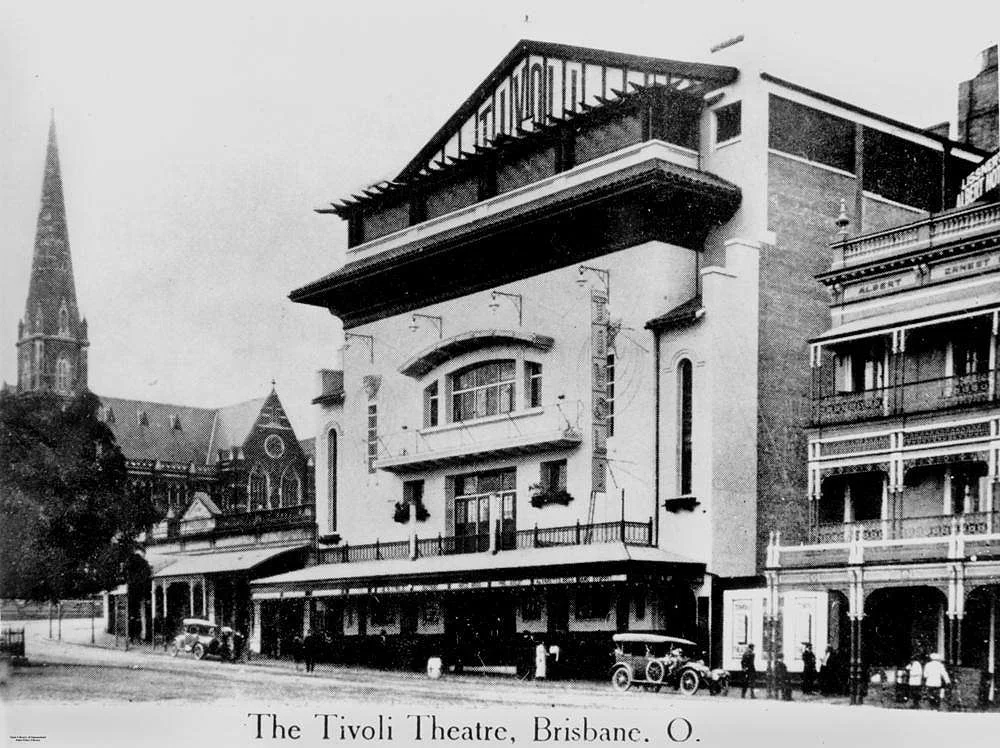

Tivoli Theatre, Brisbane
Stand in King George Square today, in the open paving opposite Brisbane City Hall, and you are standing where a theatre used to dream. For half a century the Tivoli rose here on Albert Street - a 1,800-seat vaudeville palace with ruby-red carpets, machine-chilled air, and the unlikeliest feature of all: a second theatre open to the sky on its roof, where 1,200 people could watch a show under the warm Brisbane night. It is all gone now, swept away in 1969 so the square could be built. But the Tivoli's name refused to die with the building, and that is part of its story too.
A Theatre on the Roof
Construction began in 1914 on the site of former Turkish baths, and the Tivoli opened its doors in May 1915. The architect was Henry E. White, one of Australasia's most prolific theatre designers, who gave it an Art Nouveau interior across three levels with a facade of Oriental influence overlooking Albert Square. Inside, an air plant pumped ice-cold air through the auditorium - a genuine luxury in subtropical Brisbane. But the masterstroke was overhead. A rooftop garden theatre, open-sided for ventilation with steel shutters to hold off the rain, gave summer audiences somewhere cooler to sit, and smoking was permitted up there among the night air. With two entrances and two stages, the building could run two productions at once for two separate crowds.
The Showman's Circuit
The opening bill set the tone: the Tivoli Follies in the main auditorium and a vaudeville production on the roof. Both were staged by Hugh D. McIntosh, a showman and promoter influential in the Rickard Tivoli circuit that carried variety entertainment across Australia. Vaudeville was Brisbane's mass entertainment in that era - comedy, song, acrobatics and satire stitched into a single night - and the Tivoli was its premier Brisbane house. It was not without rivals. The nearby Empire Theatre, also on Albert Street, regularly drew bigger crowds, and the two houses competed for the city's appetite for spectacle. Then the ground shifted beneath live theatre altogether. As the Great Depression bit in the 1930s and variety audiences thinned, survival meant filling those 1,800 seats with cinema patrons to recover costs, and renovations to the foyer and auditorium followed in 1935. The roof garden, conceived for the breeze of a vaudeville summer, now sheltered moviegoers.
Cleared for a Square
The end came not from fire or failure but from town planning. The Brisbane City Council bought the Tivoli in 1963 and closed it in 1965, as part of a sweeping plan to create King George Square on the ground opposite City Hall. The development demanded the demolition of a whole block of buildings - Centennial Hall and the Hibernian Building among them - and after four years standing dark, the Tivoli came down in 1969. A theatre that had chilled its air and opened its roof to the stars was levelled into open paving. The grandest variety palace Brisbane had built simply ceased to exist. Today the only trace of its programs survives in the Fryer Library at the University of Queensland - paper memories of shows whose stage is now a place where people merely cross the square.
A Name That Survived
Yet the Tivoli endured in spirit. Across the river of decades, the name resurfaced on a different building entirely - a former bakery and factory in Costin Street, Fortitude Valley, reborn in 1989 as a theatre and restaurant and now one of Brisbane's most beloved live-music venues, where local and international acts fill a room of well over a thousand. It is not the Albert Street Tivoli, and never was the same place. But the persistence of the name is its own kind of monument: proof that a city which paved over its grandest variety palace could not quite let the word 'Tivoli' fall silent.
From the Air
The original Tivoli Theatre stood at roughly 27.468 degrees south, 153.024 degrees east, on Albert Street in the Brisbane CBD - the site now occupied by King George Square, the open civic plaza in front of the landmark Brisbane City Hall with its tall clock tower. From the air there is nothing of the theatre left to see; the square reads as a paved opening in the dense city grid, with City Hall's clock tower the obvious navigation cue immediately beside it. The Costin Street venue that now bears the Tivoli name lies about 2 km to the northeast in Fortitude Valley. Brisbane Airport (YBBN / BNE) is roughly 11 km to the northeast; Archerfield (YBAF) about 12 km to the southwest.
Nearby Stories
- Redcliffe Peninsula 2.7 km away
- Tamborine National Park 12 km away
- Cressbrook Homestead 27 km away
- Main Range National Park 31 km away
- 2010-2011 Queensland Floods 38 km away
- Cape Byron 96 km away
- Cape Byron Light 126 km away
- HMS Porpoise (1799) 588 km away