
Tombos (Nubia)
At Tombos, a young Nubian woman was buried in an Egyptian-style chamber tomb with three amulets of the Egyptian household god Bes around her neck. Her body lay in the Nubian flexed position - on her right side, head toward the east. The pottery in her tomb was mostly Egyptian. Her ornaments mixed Egyptian amulets with Nubian ivory bracelets and earrings. Three thousand five hundred years after her death, archaeologists found her in the middle of an ongoing argument about what Egyptian rule did to Nubia during the New Kingdom. Her body, in its awkward, mixed-tradition burial, answers that argument the most honestly: it was complicated.
A Node of Empire
Tombos sits at the Third Cataract of the Nile, on the northern edge of the Dongola Reach, not far from Kerma. It includes Tombos island and the riverbank area around it. Archaeological work has shown occupation beginning in the mid-18th Dynasty of Egypt and continuing through the 25th Dynasty - the Kushite conquest of Egypt, which began at the other end of the political pendulum's swing. In the New Kingdom period, Tombos functioned as an important node of Egyptian colonial control over Nubia. Royal inscriptions and elite tombs in Egyptian style indicate serious Egyptian administrative presence here. A large fortification covering the southern end of the modern village, identified and defined from 2015 to 2020, extended south into a palm grove - a substantial defensive work that confirms Tombos was more than a trading post.
The Viceroy's Inscription
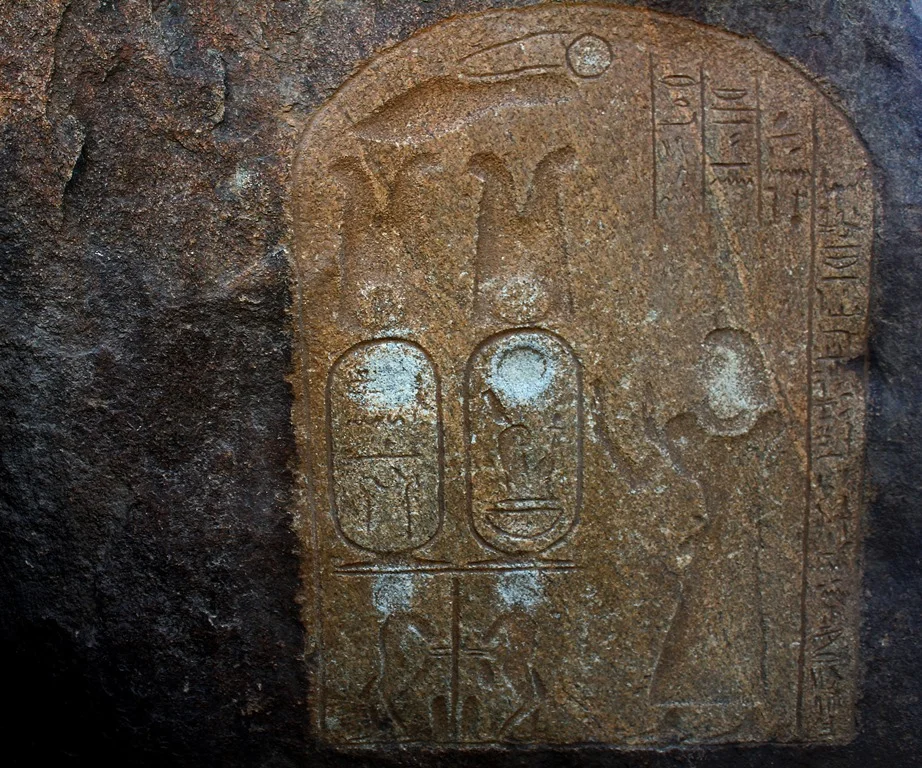
One of the earliest inscriptions at Tombos was left by an Egyptian viceroy named either Inebny or Amenemnekhu, carved on the northern side of a low granite boulder near the river bank during the 20th year of Thutmose III's reign. The text records the viceroy's achievements in delivering southern goods and tribute to the pharaoh, and his favorable reception in return. The viceroy bore the title "the king's son, overseer of southern foreign lands" - language that tells you exactly how Egypt thought about Nubia at the time. The damage to both attestations of the name is the reason scholars debate whether it was Inebny or Amenemnekhu or possibly the same man using alternative names. What the inscription confirms is a government in place by 1459 BCE, a hierarchy of officials, and a flow of Nubian goods moving north to the Egyptian treasury.
Who Was Buried Under the Pyramids
The New Kingdom cemetery at Tombos had two kinds of tombs. Elite pyramid monuments clustered in the southwestern area; underground chamber tombs for the less wealthy clustered to the north. Three elite tombs from the mid-18th Dynasty can be linked to named individuals through funerary cones - clay cones stamped with the names and titles of the deceased, which are otherwise found almost exclusively at Thebes. The first is a pyramid belonging to a man named Siamun and his wife Weren, who carried the title Scribe Reckoner of the Gold of Kush - a high-ranking position second only to the viceroy. But the bioarchaeology has complicated the elite-pyramid picture. Studies of individuals buried in Tombos mud-brick pyramids have determined that many of them were low-level workers - challenging the long-held assumption that monumental tombs at colonial sites were reserved only for the very wealthy. Ordinary Egyptian and Nubian laborers, the people who did the hard work of keeping a colonial outpost running, sometimes rested under pyramids too.
Diplomacy, and the Bodies It Still Marked
The skeletal evidence from Tombos tells a specific story about Egyptian colonial policy. During the New Kingdom, injury rates at Tombos were lower than at nearby Kerma, where direct military conflict had been the Egyptian approach during the earlier Middle Kingdom. Egypt had shifted strategies: rather than crush Nubia militarily, the New Kingdom empire incorporated Nubian elites into local governance and trade administration. It was a more diplomatic kind of domination, and it produced less cranial trauma and fewer defensive parry fractures. But health indicators were not uniformly kind. Male femur lengths at Tombos were shorter than at Kerma, suggesting childhood stress - not enough food, not enough care, not the best conditions for growing bodies. Being integrated into Egypt's colonial system did not protect the Nubian population from ongoing biological hardship. Diplomacy was cheaper than warfare, both for the empire and for the bodies it managed. It did not mean the people of Tombos lived easy lives. The mixed burials - Nubian women holding Egyptian amulets, Egyptian pottery beside ivory bracelets, bodies laid out in whichever posture somebody decided was right - record all of this: a colonial society where domination was real but cultures were intertwined, and where ordinary people made peace with an imperfect arrangement the only way anyone ever does, one day and one gesture at a time.
From the Air
Located at 19.70N, 30.38E at the Third Cataract of the Nile in Sudan's Northern State, north of modern Kerma and the modern village of Tombos. Recommended viewing altitude: 2,000-4,000 feet AGL to see both Tombos island and the associated riverbank archaeological zone. The Third Cataract itself is a distinctive series of rapids and rocky shallows visible from altitude as the river breaks white over exposed basement rock. Nearest major airport is Dongola (HSSW) about 60 km to the south. The landscape mixes cultivated Nile-bank greenery with the harsh bare granite of the Batn-El-Hajar region immediately to the north - a striking geographic boundary between two distinct Nubian environments.
Nearby Stories
- Dongola Reach 31 km away
- Soleb 45 km away
- Nubia 94 km away
- Selima Oasis 159 km away
- Semna (Nubia) 163 km away
- Napata 166 km away
- Northern State (Sudan) 216 km away
- Lake Ptolemy 408 km away