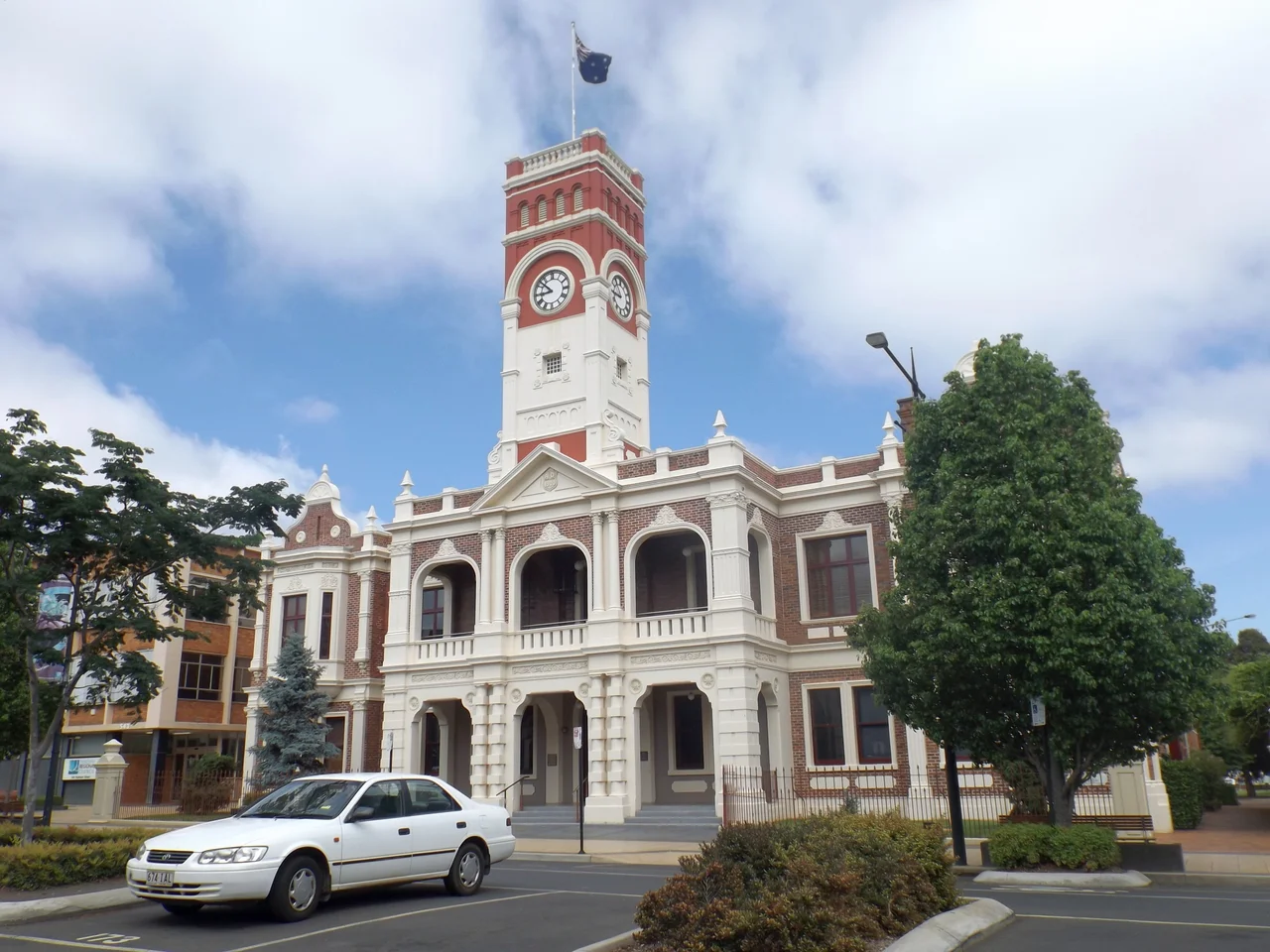

Toowoomba City Hall
It took a fire to build it. For years the Toowoomba council had wanted a town hall closer to the commercial heart of the city, and for years the obstacle was the building already standing on the perfect site, the School of Arts on Ruthven Street. Then, on a winter night in June 1898, the School of Arts burned. Within months the council had voted to clear the ruins and put its grand new hall on the cleared ground. Out of that accident rose the first purpose-built city hall ever constructed in Queensland, its clock tower still presiding over Ruthven Street more than a century later.
The Design Called 'Sincerity'
The council ran a competition, and the first time around it went badly: the sub-committee's recommended winner was rejected outright. A second contest was called, five entries came in, and first prize went to Willoughby Powell for a design he submitted under the motto "Sincerity." Powell was a Cheltenham-born architect who had emigrated in 1872 and once claimed to have erected the majority of the principal buildings in Toowoomba and its district. There is an irony in his triumph. To take a permanent post with the Queensland Public Works Department in 1899, he had to surrender on-site supervision of his own winning building to the local firm of James Marks and Son. He designed the city's proudest landmark, then handed someone else the job of watching it rise.
The Clock That Wasn't Planned
The most recognisable thing about City Hall was never in the original drawings. Powell had planned a far lower tower topped by a spire, with no public clock at all. Only during construction did the council decide, at a meeting in June 1900, that a clock should be imported from England. The turret clock that arrived cost around 278 pounds and came from Gillett and Johnston of Croydon, still reckoned among Britain's great clockmakers. It is believed to have crossed the world aboard the S.S. Devonshire, and the ship's name can still be read, faintly, on one of the two bells that chime the quarter hour. The installation was overseen by a local watchmaker, Henry Walker, whose shop stood almost opposite on Ruthven Street, his small contribution to a structure that would outlast everyone who built it.
Three Buildings in One
When it opened on 12 December 1900, the hall was really three institutions under one roof. The ground floor held the municipal offices and the council chamber, its stamped-metal ceiling picked out in soft colour. The upper floor housed a School of Arts and Technical College, classrooms and reading rooms for a generation with few other routes to higher learning. And at the western end sat a theatre seating hundreds, the venue for concerts, public meetings, drama, and even boxing and wrestling matches. The foundation stone had been laid that February by Sir Samuel Griffith, the colony's chief justice and former premier, a measure of how seriously the town took its new civic heart. For more than sixty years the city's administration ran from these rooms, and Toowoomba's main lending library lived upstairs for over half a century.
A Building That Kept Changing
Few parts of the hall have survived untouched, and the theatre least of all. It was remade in the 1930s, again in the 1940s, and overhauled once more in the early 1970s, each round of work reshaping the floor and seating to chase better sightlines. An art gallery moved in during the 1930s and out again in 1994. Council staff spread through the building as the technical college and library moved out, until a separate administration block finally relieved the pressure in 1963. Then, in a long restoration completed in 1997, the exterior was returned to its original face and the councillors moved back into the chamber where the city was first proclaimed. The Heritage Register had listed it in 1992 as the focus of local government for more than ninety years, generous proof, in its size and confidence, of how important Toowoomba believed itself to be at the turn of the century.
From the Air
Toowoomba City Hall stands at 27.56°S, 151.95°E on Ruthven Street in the city centre, atop the Great Dividing Range near 690 metres elevation. From the air, its square clock tower is the most useful landmark in the central business district, rising above the surrounding low-rise streetscape. Brisbane West Wellcamp Airport (YBWW) lies about 16 km west; Toowoomba City Aerodrome (YTWB) is just north of town. Brisbane (YBBN) is roughly 110 km east over the range. The plateau's cool, often clear air makes the tightly gridded CBD easy to pick out; the green block of Queens Park sits a short distance east.
Nearby Stories
- North Ipswich Railway Workshops 20 km away
- Main Range National Park 22 km away
- Cressbrook Homestead 41 km away
- Woodford Folk Festival 41 km away
- Jimbour Homestead 43 km away
- Tamborine National Park 60 km away
- Warialda 217 km away
- Inverell 254 km away