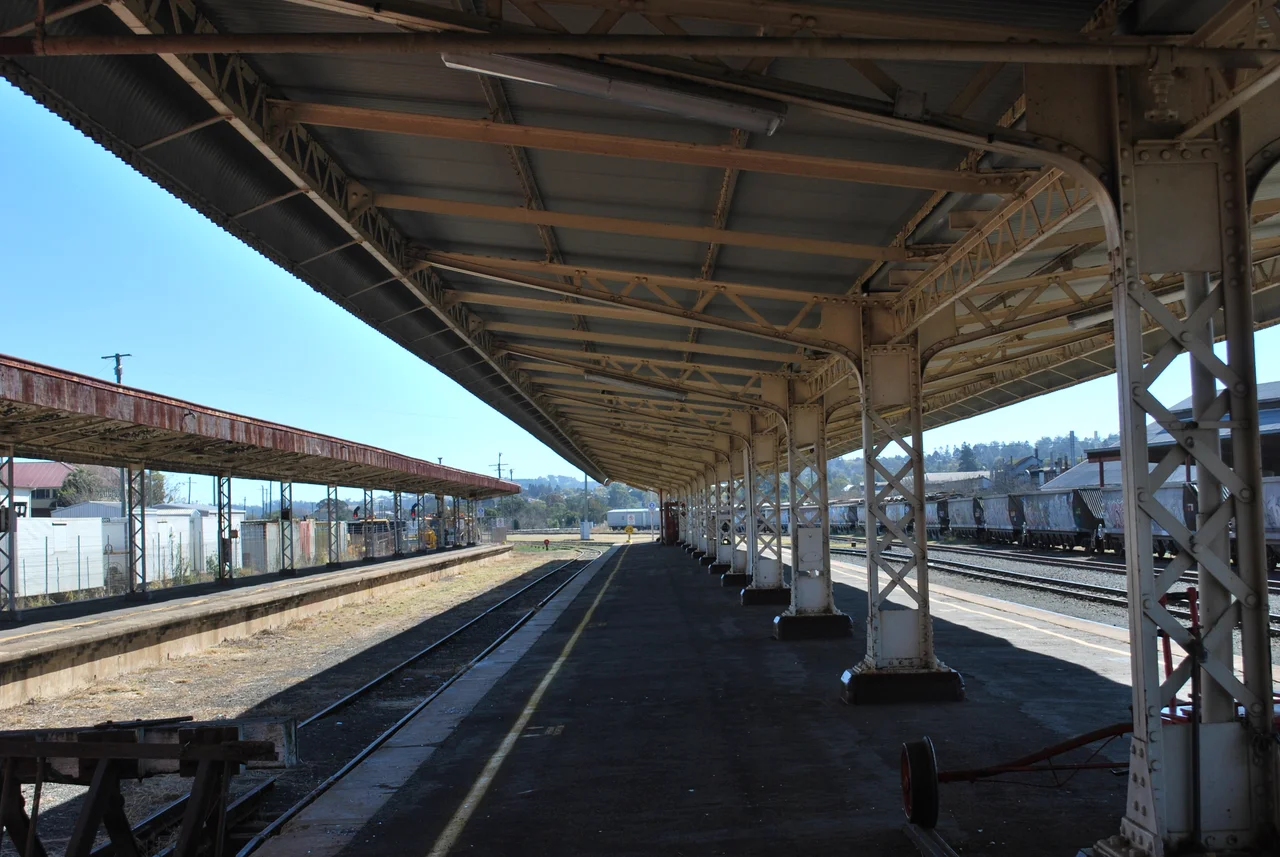

Toowoomba Railway Station
For a generation of travellers, this platform meant relief. The line up the Toowoomba Range was one of the hardest climbs on the Queensland network, a slow grind of curves and grades hauling carriages from the Lockyer Valley to the top of the Great Dividing Range. At the summit waited Toowoomba station, and inside it, a refreshment room with hot tea, monogrammed crockery, and the chance to stretch your legs before the next leg west. Erected in 1867, the station building is the oldest surviving masonry railway station in Queensland, and remarkably, its refreshment rooms have been feeding passengers for more than a century since.
A Station Conceived an Ocean Away
The station that stands today was not the one first imagined. The original concept, drawn up by the eminent engineer Sir Charles Fox in England in 1866, was for an imposing two-storeyed structure, prefabricated in Britain, shipped to Queensland, and reassembled as the administrative centre of the colony's western railways. That grand plan gave way to something built closer to home. The masonry building that opened on the line in 1867 and was handed over in 1874 was designed by the colonial architect FDG Stanley and constructed by R. Godsall. It was the first masonry station building raised in country Queensland, finely detailed with quoined corners, arched openings, and scrolled brackets, the architecture of a colony announcing that its frontier railways had come of age.
The Last Refreshment Room
Long-distance rail once ran on a rhythm of stops, and the refreshment room was the heartbeat. Toowoomba's, built in 1902 and extended over the following decades, survives as the last commercially operating railway refreshment rooms in Queensland. Step inside and the past is still set on the tables. Round timber tables and chairs fill a generously proportioned room beneath a pressed-metal ceiling with elaborate ceiling roses; cast-iron columns rise to floriated capitals; the walls carry large black-and-white photographs of local beauty spots. Where harried staff once raced to feed a platform full of passengers in the few minutes a train paused, the room now operates as a brasserie, one of the very few places in Australia where you can still eat in a working railway refreshment room from the age of steam.
Five Hundred and Fifty-Nine Names
At the northern end of the platform, under an open-sided pavilion, hangs a memorial that the railway built for its own. The Roll of Honour was crafted in the railway workshops themselves, a rare thing, its central panel crowned with a broken pediment carrying the Australian coat of arms and the words "Roll of Honour, 1914-1919, Queensland Railways Toowoomba Employees." Pilasters frame timber plaques where names are picked out in gold. The list runs to 559 people, railwaymen who left this yard for the First World War, and the geography of those names reaches far beyond Toowoomba itself. To stand before it is to read a community's grief carved by the hands of the men's own colleagues.
A Working Museum of the Rails
Beyond the elegant facade, the yard preserves the unglamorous machinery that made a railway run. A long corrugated-iron goods shed from 1896 stands on timber platforms supported by rough-cut logs. Signal Cabin A, taken out of service in 1993, still holds its full frame of colour-coded mechanical levers and brass track indicators, frozen mid-operation. There is a cast-iron water crane that once filled the boilers of steam locomotives, a wagon weighbridge, a Westinghouse brake examination pit, and two World War II air-raid shelters, one for railway staff, one for the public, built when even an inland city braced for bombs. Today the busy timetable is gone, replaced by Queensland Rail's twice-weekly Westlander threading through on its long run between Brisbane and Charleville. The station no longer commands the traffic it once did, but it has kept, more completely than almost anywhere else in the state, the look and feel of the railway that built Queensland.
From the Air
Toowoomba Railway Station sits at 27.56°S, 151.95°E near the city centre, atop the Great Dividing Range close to 690 metres elevation. From the air, look for the long station building, platform canopies, and the cluster of railway-yard structures, including the large goods shed, just west of the central business district, with the rail corridor running roughly north-south through the city. Brisbane West Wellcamp Airport (YBWW) is about 16 km west and Toowoomba City Aerodrome (YTWB) lies just north; Brisbane (YBBN) is roughly 110 km east. The dramatic descent of the line down the Toowoomba Range to the Lockyer Valley is visible to the east; the cool plateau air usually keeps the city centre clear and sharply defined.
Nearby Stories
- North Ipswich Railway Workshops 20 km away
- Main Range National Park 22 km away
- Cressbrook Homestead 41 km away
- Woodford Folk Festival 41 km away
- Jimbour Homestead 43 km away
- Tamborine National Park 60 km away
- Warialda 217 km away
- Inverell 254 km away