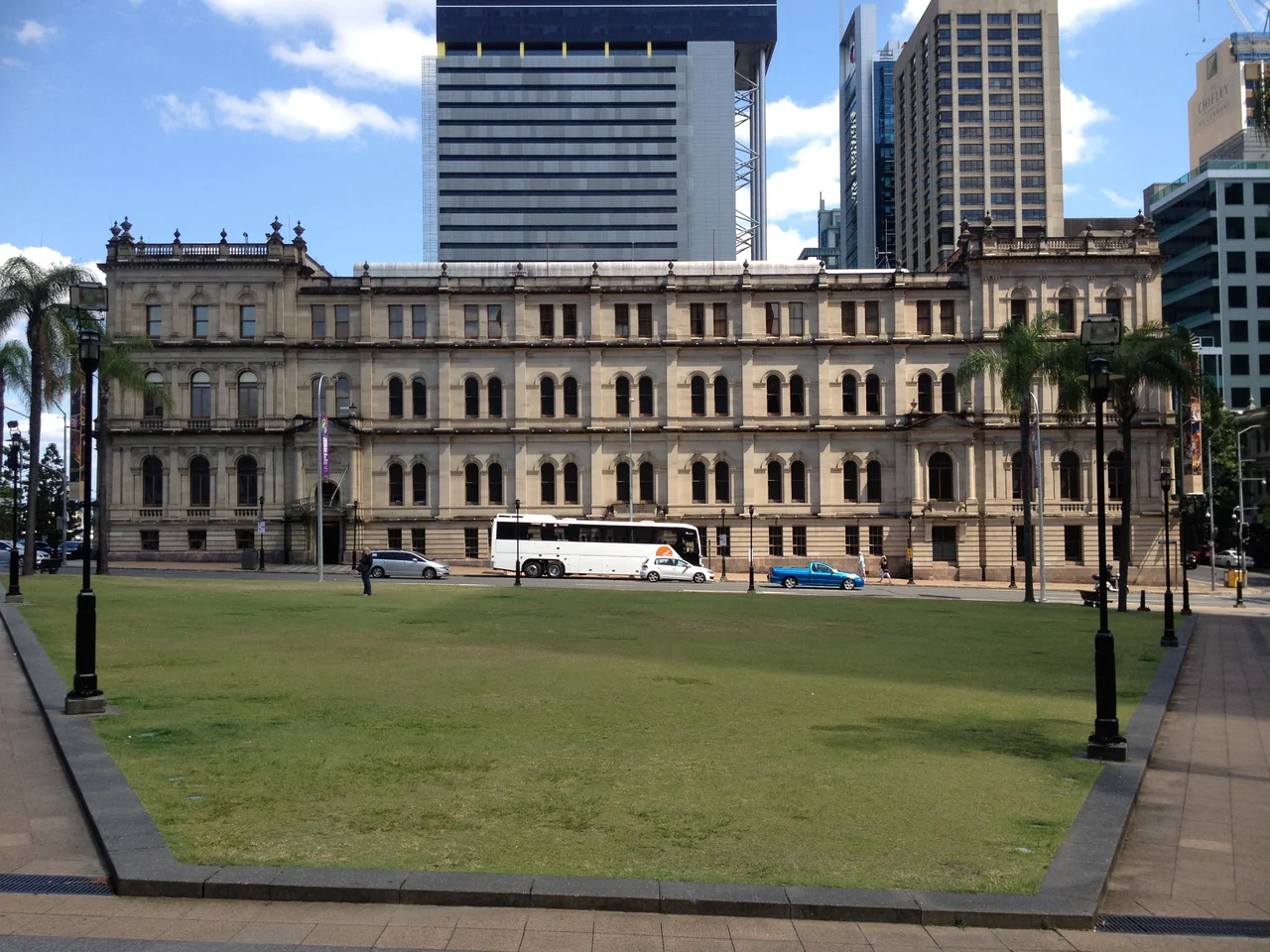

Treasury Building, Brisbane
Look closely at the sandstone and you can read the building's whole life in its colour. The earliest walls, raised in the 1880s, carry one shade; the later sections, finished in the 1920s, carry another. The Treasury Building took forty-two years to complete - longer than some of the careers spent inside it - and across three separate stages it changed quarries, changed governments, and changed the very meaning of the place it occupied. The result is the largest nineteenth-century government building in Australia by floor area, an entire city block of Italian Renaissance grandeur standing guard over the Brisbane River at North Quay.
A Young Man's Masterpiece
The design was the work of John James Clark, an architect of remarkable talent and even more remarkable precocity - he had entered the Victorian public works office as a teenager and was shaping major public buildings before most architects finish training. For the New Public Offices, as the Treasury was first called, he reached back to sixteenth-century Italy, wrapping the block in symmetrical arcades, raising central towers crowned with pediments, and stepping the corners forward into pavilions. Construction began in 1886 and crept forward in stages, halted and resumed as the colony's fortunes rose and dipped. The third and final phase did not begin until 1922, and the building was not officially complete until 1928. Clark's original vision survived all of it, carried faithfully across four decades and three teams of builders.
The Stone Tells the Story
Each phase drew on a different sandstone, and the seams between them are visible to anyone who knows where to look. The first stage used stone from Highfields; the later stages drew on Helidon quarries west of the city. When the government resumed work in the 1920s, it did so deliberately by day labour rather than by contract, and it bought the Helidon quarry outright - a calculated piece of state enterprise meant to keep Queenslanders in work and the profits in public hands. Inside, the ambition shows in the detail: a coffered foyer ceiling, a grand staircase framed by Ionic columns, cedar joinery, marble fireplaces, and a Cabinet room finished with carved cedar panels above its doors. Ministers had their own private corridors, so the powerful could move through the building without ever meeting the public.
Symbol of a Confident Colony
The Treasury was never just an office. In the 1890s and early 1900s its imposing facade became a stage for celebration and patriotic display, the backdrop against which Queensland announced itself. The building rose during the boom years that followed self-government, and its sheer scale was the point - physical proof of a young colony's wealth, confidence and faith in its own future. That confidence had a harder edge, too. The land it sits on had been a military and administrative site since the 1820s, the deep colonial machinery laid over Turrbal and Jagera country along a river the First Peoples have known for thousands of years. The grand stone announced who now held authority here, and it held that role - as the best-known government building in the state - for more than a century.
From Power to Roulette to Lecture Hall
In the 1990s the building's purpose flipped entirely. The central courtyard was roofed over, and from 1995 the old seat of government reopened as the Conrad Treasury Casino - two bars, five restaurants, eight function rooms, the corridors of state administration now humming with the noise of the gaming floor. That chapter closed in 2024 when the casino moved to the new Queen's Wharf precinct downriver. The building did not stay empty for long. In September 2024 Griffith University announced it had bought the Treasury, planning to open an inner-city campus there for students of business, law and information technology. The new campus is scheduled to open in 2027 - in good time, the university noted, for the 2032 Brisbane Olympic Games. After serving power and then pleasure, the sandstone block turns to teaching.
From the Air
The Treasury Building occupies an entire block at the northern end of the Brisbane CBD, near North Quay at approximately 27.472°S, 153.024°E, on a slight rise above the Brisbane River by the northern approach to Victoria Bridge. From the air its rectangular footprint, central courtyard and pale sandstone arcades stand out against the surrounding office towers; the sweeping bend of the river and the green of the adjacent Queens Gardens are the clearest navigational markers, with the Victoria Bridge crossing to South Brisbane just downstream. Brisbane Airport (YBBN) lies about 13 km to the north-east, and Archerfield (YBAF) roughly 9 km to the south-west. Best seen at lower altitudes over the city centre in clear conditions.
Nearby Stories
- Redcliffe Peninsula 2.7 km away
- Tamborine National Park 12 km away
- Cressbrook Homestead 27 km away
- Main Range National Park 31 km away
- 2010-2011 Queensland Floods 38 km away
- Cape Byron 96 km away
- Cape Byron Light 126 km away
- HMS Porpoise (1799) 588 km away