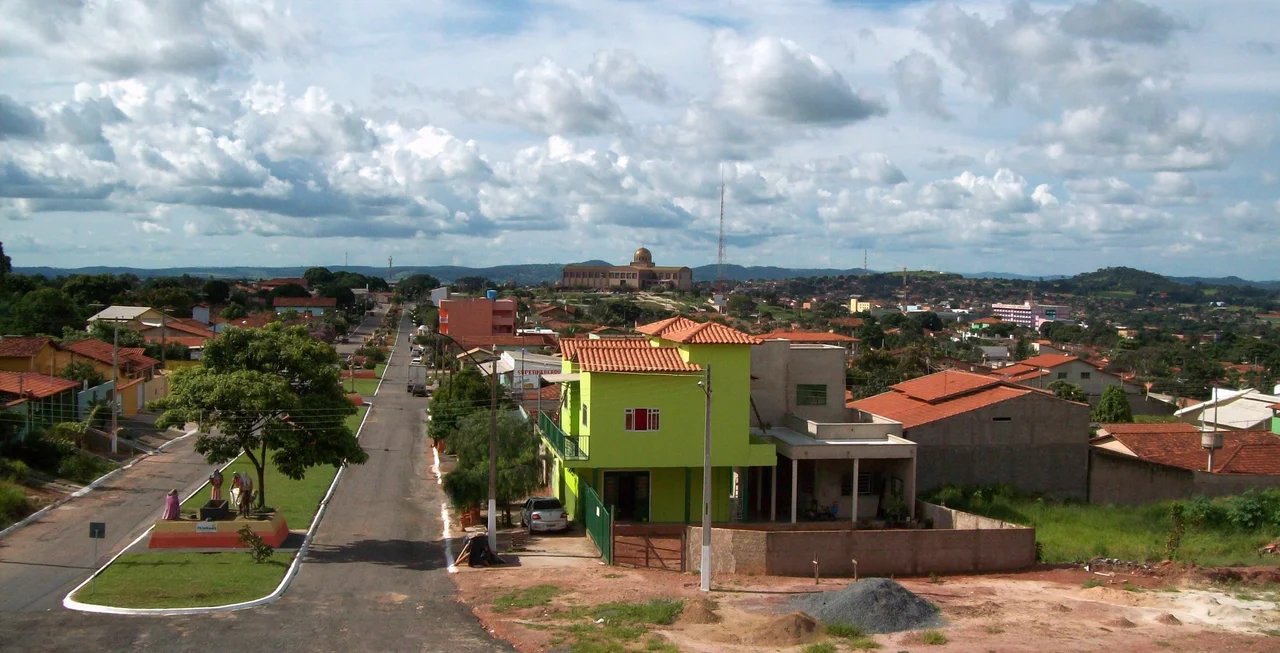

Trindade, Goiás
In 1840 a farmer and his wife named Constantino Xavier and Ana Rosa found something in their fields near a village called Barro Preto, in central Goias. It was a small clay medallion, carved with an image of the Holy Trinity crowning the Virgin Mary. Where it came from nobody could say. What to do with it was more pressing. They built a chapel of palm fronds, which became a chapel of mortar and roof tiles, which became a shrine, which became a pilgrimage. One hundred and eighty-five years later, on the first Sunday of every July, close to a million people converge on the town that grew around the chapel, and 230 ox carts roll down a four-lane highway called the Rodovia dos Romeiros - the Highway of the Pilgrims.
From Barro Preto to Basilica
Trindade did not become a municipality until 1943, but the pilgrimage was already a century old by then. The original clay medallion was eventually sent to Pirenopolis, where the greatest artist of that region carved a wooden version to replace it. The wooden image is what pilgrims see today, mounted in the Basilica of the Eternal Father - the only basilica in the world dedicated to God the Father, the first person of the Catholic trinity. Most Catholic devotional sites focus on Christ, on Mary, on the saints. Trindade focuses on the Father. The theological distinction is subtle; the popular devotion is enormous. The festival of the Divino Pai Eterno - the Divine Holy Father - runs for fifteen days each July and is one of the three largest pilgrimages in Brazil.
The Highway of the Pilgrims
Between Goiania and Trindade there are 18 kilometers of four-lane highway. For most of the year it is ordinary roadway. During the festival it becomes something else. The shoulders are lined with illuminated outdoor panels showing the Stations of the Cross - the Via Sacra - painted by a local artist named Omar Souto. Omar incorporated contemporary events into his traditional subjects. One of the Stations features Leide das Neves Ferreira, the six-year-old girl who died of radiation exposure in the 1987 Cesio 137 accident in Goiania - one of the worst radioactive contamination events in world history, when scavengers found a discarded radiotherapy machine and cracked it open. Her image, in Omar's painting, is folded into the Passion of Christ. The highway, illuminated at night, pulls pilgrims toward the basilica as the road pulled the afflicted toward the suffering of Jesus.
230 Ox Carts
The highlight of the festival is a procession of carros de boi - ox carts. Wooden carts, iron wheels, teams of oxen, their axles singing that distinctive creak that has accompanied Brazilian rural life since the colonial era. They come from all over Goias. In 2003, 230 ox carts rolled through the streets of Trindade, accompanied by almost two thousand riders on horseback. Close to a hundred thousand people watched - perhaps the largest parade of ox carts in the world. The oxen walk at their own pace, which is slow. The carts creak. The riders follow. Young children sit on the rails. The whole thing is a time machine dressed as a parade, a recreation of how the first pilgrims got to Trindade in the nineteenth century, before asphalt and buses and the Rodovia dos Romeiros.
Coca-Cola and Ceramics
Between festivals, Trindade is an industrial center. Around 150 industries now operate in the municipality, producing ceramic, aluminum products, paint, soft drinks, clothing, and leather. The biggest employers are Refrescos Bandeirantes - the local Coca-Cola bottler - and Industria e Comercio de Bebidas Taguatinga, which produces Antarctica beers under the Grupo Imperial umbrella. But the cattle economy that supported the old farms has not gone away either: 78,000 head in 2006, with 25,000 milking cows, plus 11,000 pigs, 64,000 poultry, and a diverse fruit industry heavy on citrus, bananas, and tomatoes. And out on the west side of town there is a purpose-built motocross raceway, which in 2014 hosted a round of the MotoCross World Championship. Trindade can be a destination for pilgrims, industrial workers, motocross riders, and dairy farmers, sometimes on the same weekend.
From the Air
Located at 16.65°S, 49.49°W in Goias state, Brazil, 30 km west of Goiania, connected by the four-lane GO-060 highway. At cruising altitude the town reads as a compact urban grid amid surrounding pasture and soybean country, with the basilica forming a distinctive landmark at its center. During the July festival the nearby highway network shows visibly heavier traffic. Nearest airport: Goiania/Santa Genoveva (SBGO, 30 km east).
Nearby Stories
- Anicuns 17 km away
- Silvânia 28 km away
- Mossâmedes 40 km away
- Anápolis 47 km away
- Corumbá de Goiás 48 km away
- Orizona 63 km away
- Morrinhos, Goiás 100 km away
- Rio Verde, Goiás 148 km away