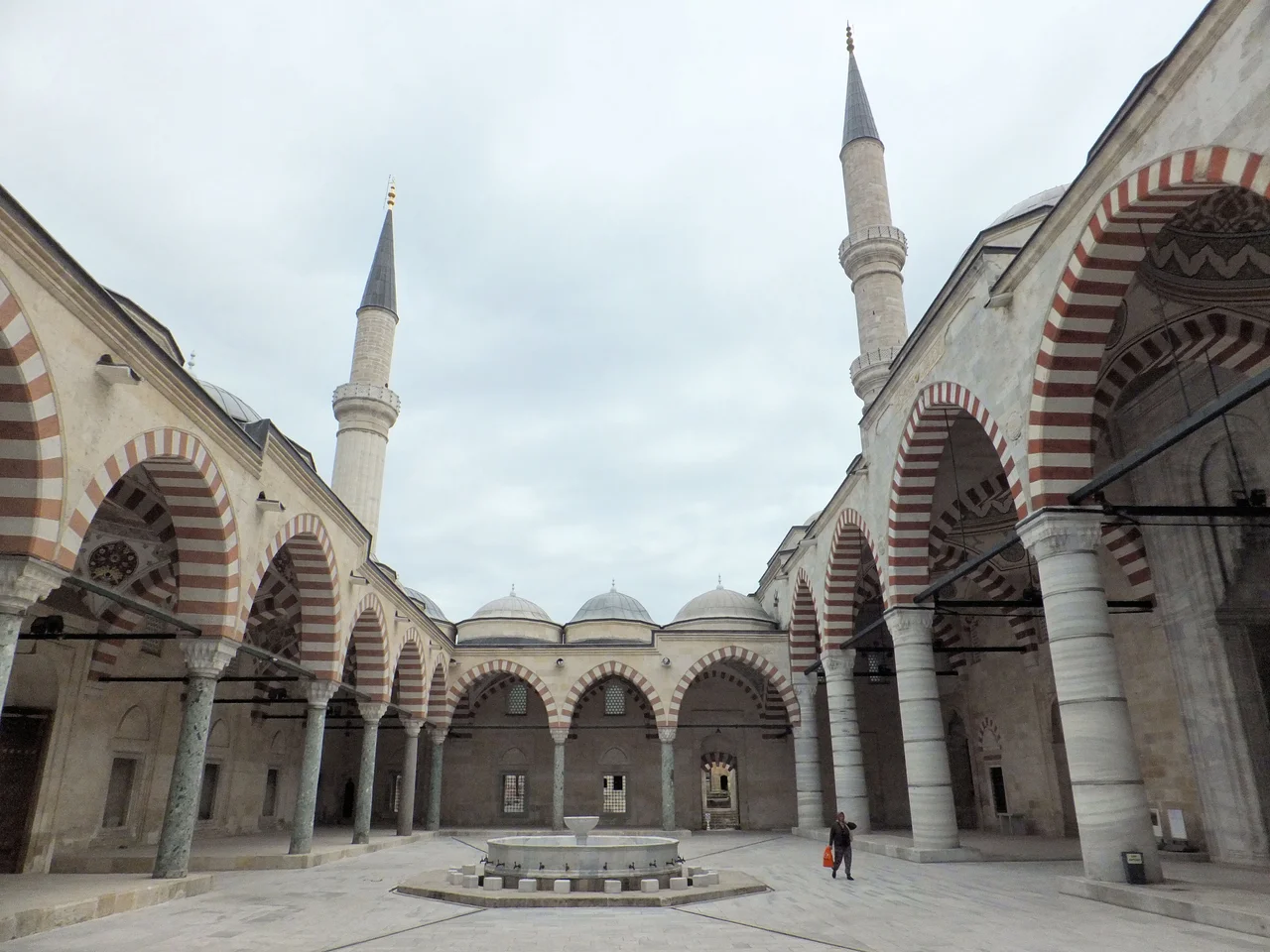

Üç Şerefeli Mosque
The name means three balconies, and once you see the southwestern minaret you understand why. At more than 67 meters, it was the tallest minaret the Ottomans had ever built, and it carries three projecting walkways stacked one above the other where the muezzin could climb out and call the city to prayer. The other three minarets at the corners of the courtyard are different from each other and from this one, each carved with a distinct pattern of flutes and zigzags as if the architect, whose name nobody recorded, was trying out ideas. The Üç Şerefeli was finished in 1447, and a half century later Sinan would build the great imperial mosques of Istanbul. Almost everything those mosques know, they learned here first.
A Dome Larger Than Any Before
Sultan Murad II commissioned the building, and construction ran from around 1438 to 1447 in Edirne, then the Ottoman capital. The prayer hall is centered on a single great dome about 24 meters across, larger than any Ottoman dome that had come before. Pairs of smaller domes cover the flanks. To anyone standing in the courtyard, the effect is a cascade of curves stepping down from the central peak, an arrangement that would become the signature of Ottoman religious architecture and reach its full grandeur a century later in Istanbul. The mosque is built of cut stone, particularly the white Burgaz limestone of the region, and uses bands of contrasting color stone for decoration in places. It marks the moment when Ottoman builders moved away from the alternating brick and stone of their earlier work and committed to ashlar.
Crossroads of an Architecture
Scholars have called the mosque the crossroads of Ottoman architecture, the place where everything converged. Before it, mosques in Anatolia had experimented with many shapes — multi-domed halls, single domes, arcaded courtyards, prayer rooms set behind monumental portals. The Üç Şerefeli pulled these elements together and arranged them in the configuration that future imperial builders would refine and never really abandon: an arcaded courtyard with a central fountain, a rectangular prayer hall behind a tall portal, four corner minarets, a great central dome carrying the eye upward. The art historian Doğan Kuban described it as the last stage of early Ottoman architecture. Looked at from another angle, it was the first stage of everything that followed.
Tiles from Tabriz
Above two of the courtyard windows, blue and turquoise tiles painted under transparent glaze form patterns of leaves and tendrils. They were almost certainly made by the same group of ceramic masters who had decorated the Yeşil Mosque in Bursa a few years earlier, where the tiles are signed in Persian as the work of the masters of Tabriz. These were craftsmen who had traveled west from Iran to work for the Ottoman court, and who plied their trade across at least three buildings in Bursa and Edirne over a generation. The running floral border in the Üç Şerefeli tile panels echoes the tilework of the smaller Muradiye Mosque just up the road, finished about a decade earlier. A small ceramic diaspora, leaving traces.
Damage and Survival
The mosque has not had an easy time of it. A fire in 1732 swept through the building. Twenty years later, in 1752, an earthquake shook Edirne hard enough to do further structural damage. Sultan Mahmud I ordered repairs and partial reconstruction, and what stands today is the result. The chronicler Taşköprüzade also preserved a strange, gruesome anecdote from the early years: a group of dissidents were executed by burning in front of the mosque, and the official ordering the executions, Mahmud Pasha, accidentally set fire to his own beard in the process. It is one of those small grotesque footnotes the medieval chronicles preserve, a reminder that the elegant courtyard you walk through today has watched five centuries of human business, much of it not at all elegant.
From the Air
Üç Şerefeli Mosque: 41.6781 N, 26.5535 E, in central Edirne in northwestern Turkey, very close to the Greek and Bulgarian borders. Best viewed below 3000 feet. Identifiable by four corner minarets surrounding the courtyard, with the southwestern minaret noticeably taller than the other three and bearing three balconies. The much larger Selimiye Mosque, with its four pencil-thin minarets, dominates the skyline only about 400 meters southeast. Çorlu (LTBU) is the nearest commercial field, about 95 nm east. Plovdiv (LBPD) lies about 70 nm west. Class G airspace covers most of Edirne; check NOTAMs for the nearby Greek and Bulgarian borders.
Nearby Stories
- Didymoteicho Fortress 16 km away
- 1928 Chirpan-Plovdiv Earthquakes 64 km away
- Ganos 85 km away
- Istanbul's Rural Outskirts 113 km away
- Great Basilica of Plovdiv 113 km away
- Samothrace temple complex 117 km away
- Buzludzha Monument 124 km away
- Varna Necropolis 149 km away