
Vale of Rheidol Railway
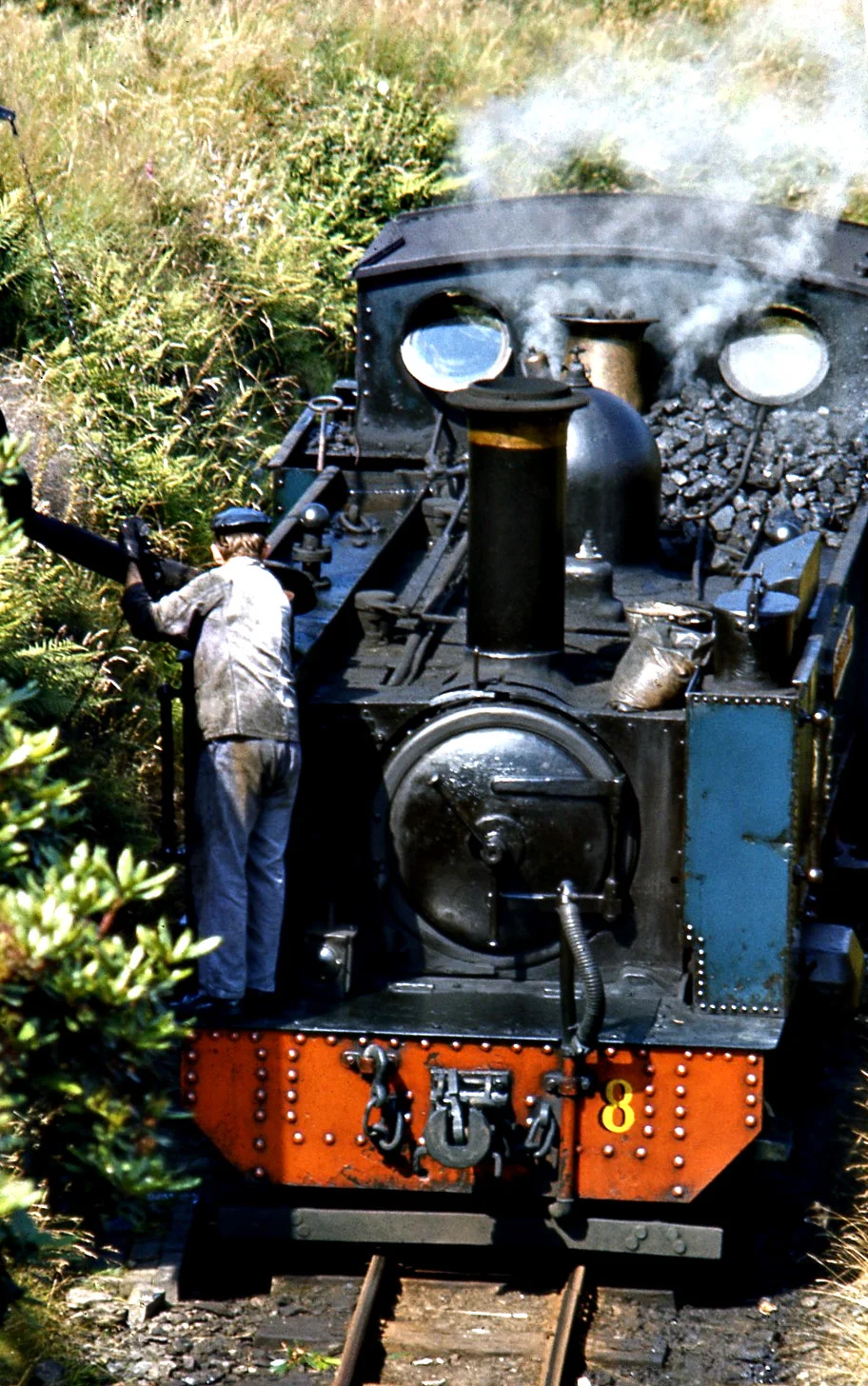
On 11 August 1968, the last main-line steam locomotive on British Rail blew its whistle and steamed into history. Except for one place. In a quiet corner of Ceredigion, two small Victorian-era tank engines kept making the climb from Aberystwyth to Devil's Bridge as if nothing had changed. Owain Glyndwr, Llywelyn, and Prince of Wales: three steam locomotives bearing the names of Welsh kings, hauling tourists up a narrow gauge line through woods and gorges and a thousand feet of altitude. For twenty-one years, from 1968 until privatisation in 1989, the Vale of Rheidol Railway was the entire reason the British Railways logo still appeared on the side of a working steam engine.
Built for Lead, Saved by Tourists
The original purpose was industrial. By 1900, the lead mines in the Rheidol valley were producing ore at a steady clip but had no way to transport it. A standard gauge railway had been planned in the 1860s and never built. Eventually a narrow gauge line of 1 ft 11¾ inches was settled on, partly because it was cheap and partly to match the nearby Plynlimon and Hafan Tramway. Construction began in 1901 with rock hewn by hand to save the cost of blasting. The first mineral trains ran in August 1902, the first passenger services on 22 December, and the final bill came to £60,000. By the time the line opened, however, lead mining was already declining. The tourists had begun to arrive instead, and what was built to carry rock would spend most of its life carrying day-trippers.
The Climb to Devil's Bridge
Twelve miles, end to end, with the second half climbing at one in fifty through wooded gorges where the rails sit on a ledge known as Pant Mawr with no road access for miles. The line follows the contours of the terrain because the engineers could not afford to cut through it; the result is a journey that feels like a Victorian tour-guide had laid it out personally. Capel Bangor, Nantyronen, Aberffrwd, and then the steep climb to Devil's Bridge, the famous gorge where three stone bridges, one stacked atop another, span a waterfall said to have been built by the devil himself in a deal he subsequently lost. The whole journey takes about an hour. Steam locomotives stop at Aberffrwd to take on water from a tall column, as they have done since 1902.
The Last Steam on British Rail
The railway joined British Railways in 1948 as part of nationalisation, and from then on it became an oddity within the larger network: a narrow gauge tourist line operated by a nationalised mainline operator. When Transport Minister Barbara Castle was asked in the 1960s whether to close it, she let it stand. Then in 1968, when steam was withdrawn from main-line working everywhere else, the Vale of Rheidol locomotives were repainted in BR's corporate blue with the double-arrow logo and continued steaming. Visiting locomotives from the Ffestiniog Railway joined the roster on occasion. Simulated Wild West Indian attacks were staged for tourists in the 1970s. A derailment near Aberffrwd in 1986 finally exposed how much maintenance had been deferred. Three years later the line was sold off, the first piece of British Rail to be privatised.
The Phyllis Rampton Trust
Peter Rampton and Tony Hills bought the line in 1989. In 1996 they split the partnership, Hills keeping the Brecon Mountain Railway and Rampton placing the Vale of Rheidol into a charitable trust named for his late wife Phyllis. Unusually for a preserved railway, the line ran without volunteers for its first twenty years of private operation; the staff were paid, the engineering was professional, and the workshop at Aberystwyth grew into one of the best narrow gauge restoration facilities in the country, taking on contract work for other heritage lines. Volunteers eventually arrived, but the railway retained the feel of a serious operating concern rather than an enthusiast's hobby. The locomotive shed sits where British Rail's standard gauge Carmarthen line trains once stabled.
What You Hear When You Stand Still
The locomotives are old enough now that their names mean something. Number 7, Owain Glyndwr, carries the name of the rebel prince who fought King Henry IV from these hills six centuries ago. Number 8 is Llywelyn, for the last sovereign Welsh prince, killed near Builth in 1282. Number 9 is Prince of Wales. The choice of names was not accidental; they were given in 1956 by a railway looking for a Welsh identity to attach to engines that had until then borne only numbers. Stand at Devil's Bridge in late October, when the leaves have turned and the wind comes down off Plynlimon, and listen. The whistle of a steam locomotive climbing the Rheidol Valley still sounds the way it did in 1902. The lead mines are gone. The line is one of the Great Little Trains of Wales, and it still goes there.
From the Air
Located at 52.41N, 4.08W with the line running approximately 12 miles inland from Aberystwyth on the coast to Devil's Bridge in the foothills. From the air, look for the line of cleared track snaking up the Rheidol Valley between forested hills, with the deep gorge at Devil's Bridge visible at the eastern terminus. The Cambrian Mountains rise to the east and Plynlimon (the source of the Severn and Wye) is to the north-east. Nearest airports: Aberporth (EGFA) approximately 32nm south-west; Welshpool (EGCW) approximately 38nm east. Recommended viewing altitude: 2,500-4,000 ft for the full valley sweep. Watch for orographic cloud over the Cambrians in westerly weather.
Nearby Stories
- Cambrian Mountains 6.1 km away
- Battle of Orewin Bridge 7.1 km away
- Church of the Holy Cross, Mwnt 9.1 km away
- Cymer Abbey 10 km away
- Plas yn Rhiw 10 km away
- Talgarreg 19 km away
- HMS Whirlwind (R87) 23 km away
- Battle of Oswestry 34 km away