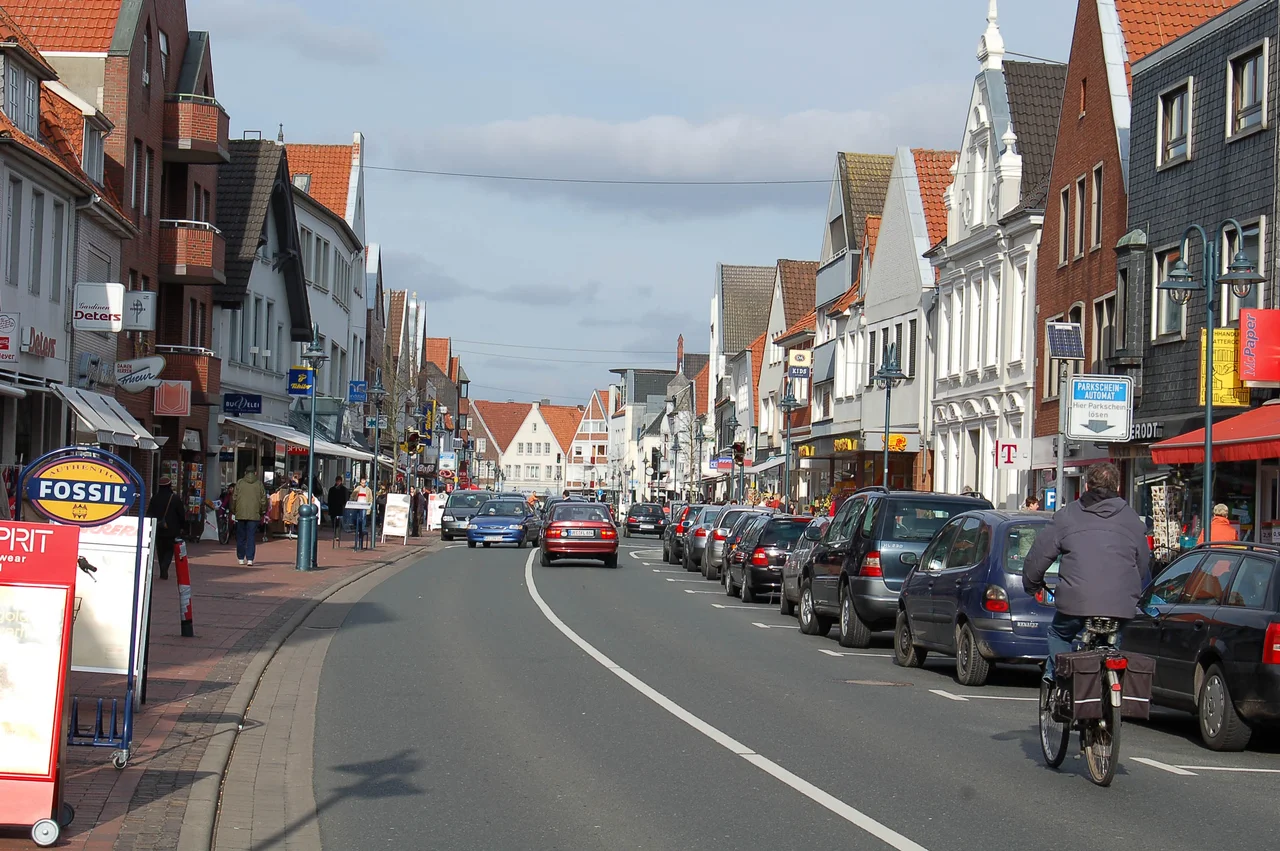

Vechta
When the plague came to Vechta in 1577, the merchants moved the market out of the city — past the fortress walls, into a stubble field where the harvest had just been brought in. The fair had been running since 1298, and they had no intention of letting an epidemic stop it. They simply rerouted around death. The stubble gave the market its new name — Stoppelmarkt, the Stubble Market — and it has been held in an open field outside the old walls ever since. Today, 800,000 people show up every August. That is twenty-four times the population of the town itself.
The Catholic Island
Vechta has the unusual distinction of being one of the very few German towns where the population is still growing. Together with neighboring Cloppenburg, the city posts the highest fertility rates and lowest median age in Germany — a demographic profile that has almost nothing in common with the rest of the country and almost everything to do with the dense Catholic culture that has shaped this region since the Counter-Reformation. The city sits in what Germans call the Oldenburg Münsterland, a wedge of devoutly Catholic country stuck inside an otherwise Protestant Lower Saxony. The young families fill the schools, the parishes, the basketball arenas. Vechta is the rare German city that does not need immigration to keep its lights on, though it has that too.
Conrad Who Made a Pope Resign
Around 1370, a boy named Conrad was born here. He grew up to become Bishop of Verden, then Bishop of Olomouc, then Archbishop of Prague and Chancellor of the Kingdom of Bohemia — a remarkable ecclesiastical career for a son of a small Lower Saxon town. As Archbishop of Prague, Conrad of Vechta found himself entangled in the early Hussite movement and the politics of the Western Schism, the great medieval crisis in which two and then three rival popes simultaneously claimed the Catholic throne. Conrad notably abstained from the Council of Constance, declining to defend Jan Hus against condemnation there — a choice that reflected his own deepening sympathy with the Hussite movement. Within a few years he had formally endorsed the Hussite program, the most dramatic conversion of a sitting archbishop in the crisis. The boy from the Stoppelmarkt town played his own part in a knot that took the Church almost forty years to resolve.
The Composer Who Played for Beethoven
Andreas Romberg, born in Vechta in 1767, was a violinist and composer who spent his career on the Hamburg-Hanover circuit and ended his life working in Gotha. He played alongside his cousin Bernhard, performed with Joseph Haydn in London, and counted Beethoven among his musical contemporaries — though the comparison rarely flatters him. Romberg wrote symphonies, operas, and choral works of careful, idiomatic skill that fell out of fashion within a generation of his death in 1821. His name now belongs mostly to musicologists and to Vechta, where it sits on the list of notable people the town's historical sketches always include.
Basketball and Speedway
Modern Vechta carries two unlikely sports identities. The Rasta Vechta basketball club plays in the German Bundesliga — the top flight — making this town of fewer than 33,000 people one of the smallest cities in Europe to host top-tier professional basketball. And tucked away in the south of town, off the Kiefernweg, the Reiterwaldstadion is a long-track motorcycle speedway oval where in September 2025 Britain won the FIM Long Track of Nations team world championship. The two sports could not be more different — indoor precision versus outdoor noise and dirt — but the town carries both with the slight bemusement of a community that knows it punches above its weight.
The Growth Curve
In 1890, Vechta had 2,188 inhabitants. By 1950, after refugees from the lost eastern territories had been settled, the population was 13,097. By 2000 it had crossed 27,000, and in 2021 it reached 32,900. The University of Vechta — a small institution focused on teacher training and the social sciences — adds students who often stay. The Hansalinie (the A1 freeway) runs past three interchanges, putting Bremen and Osnabrück within easy commuting distance. The Stoppelmarkt fills the local hotels every August. None of these are dramatic engines of growth. They simply work, year after year, in the patient German way of building wealth and population without anyone ever quite noticing the curve bending upward.
From the Air
Coordinates 52.73 N, 8.29 E, in the Oldenburg Münsterland of Lower Saxony, with three A1 (Hansalinie) interchanges connecting Vechta to Bremen (about 60 km north) and Osnabrück (about 55 km southwest). View from 3,000 to 5,000 feet — the historic town core sits on the Vechta water mill stream, with the Stoppelmarkt field visible as an open area southeast of downtown. Look for the cluster of university buildings west of the old town. Nearest airports: Bremen (EDDW) to the north, Münster/Osnabrück (EDDG) to the southwest. Terrain is gently rolling north German plain, mostly 30–50 meters elevation; maritime climate with 700 mm of rainfall and 8.5–9.0 C average temperature.
Nearby Stories
- Wildeshausen Geest 8.1 km away
- Osnabrück (district) 8.6 km away
- Ibbenbüren 12 km away
- Esterwegen concentration camp 13 km away
- Minden 13 km away
- Schnoor 18 km away
- Emsland Railway 29 km away
- Minden Aqueduct 39 km away