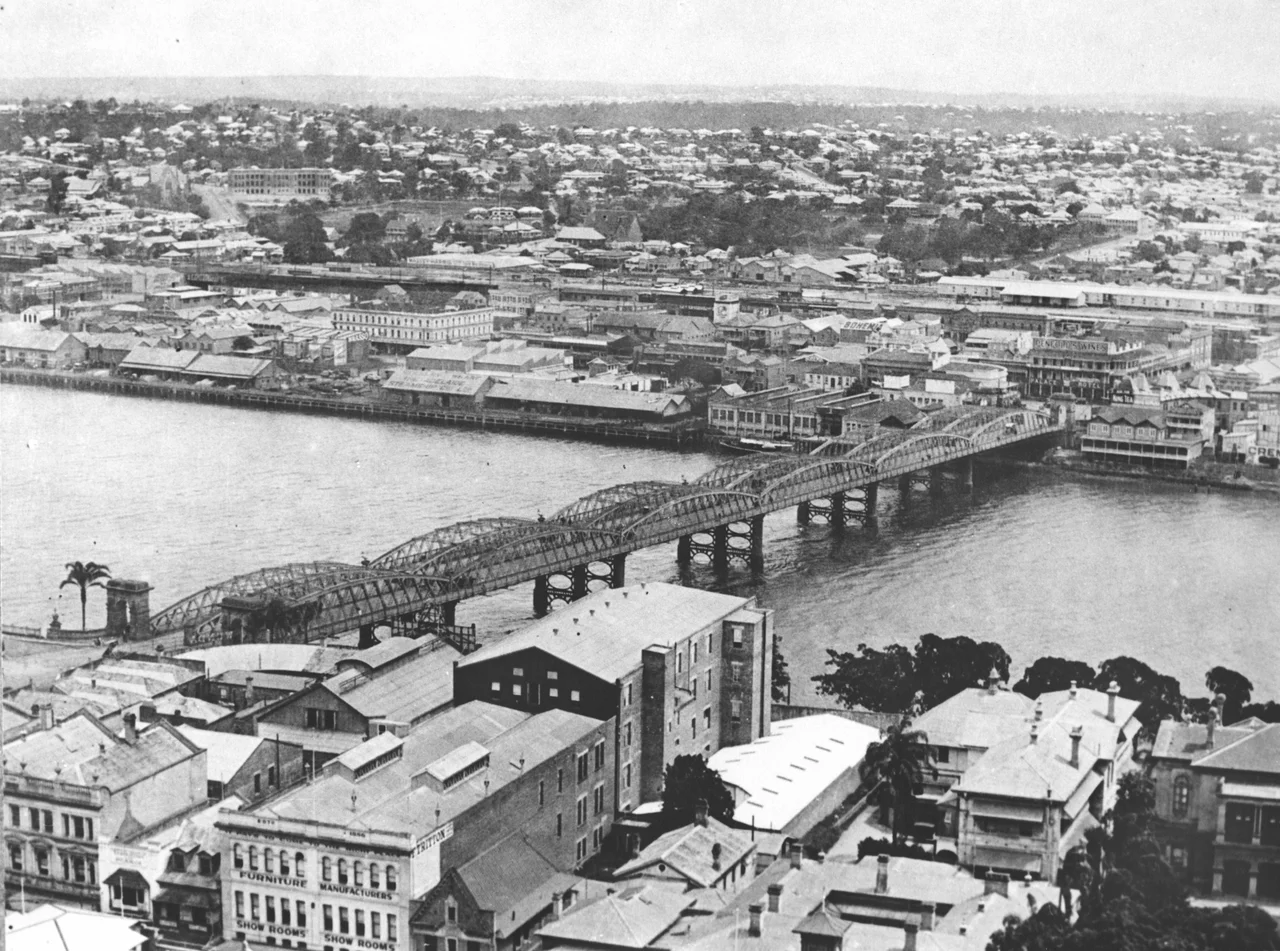

Victoria Bridge, Brisbane
The bridge you see today is the fourth to span the Brisbane River at this exact point, and the third built to last. Crossings here have a habit of not lasting. The first was a temporary timber affair; the second was torn apart by the great flood of 1893, and its loss set in motion one of the worst disasters in the city's history. To stand at the northern approach near North Quay is to stand on a thin strip of ground that has carried trams, troops, mourners and a century of Brisbane's daily traffic - and that has, more than once, been the difference between life and death.
The First Crossings
Brisbane agreed to bridge its river in 1861, and work on the foundations began in 1864. The contractor, John Bourne, offered a clever shortcut: he would turn his construction scaffolding into a temporary toll bridge, and this timber structure opened in June 1865. A more permanent bridge followed, named the Victoria Bridge by the Governor of Queensland and paid for by heavy borrowing the council hoped to recover through tolls. The tolls were unpopular and the revenue thin, so the bridge passed to the colonial government. Tram lines were laid across it, and pipes beneath it carried the first mains water to South Brisbane. For a time the crossing did exactly what a bridge should - it quietly knitted the two halves of a growing city together.
When the River Took the Bridge
In February 1893 a colossal flood swept down the Brisbane River and tore the northern half of the Victoria Bridge away. With the main crossing broken, people fell back on ferries - and that improvised arrangement led to catastrophe. On 13 February 1896 the ferry Pearl, dangerously overloaded, was struck and pushed against the anchor chain of a government steam yacht. Its hull breached and it capsized within moments, trapping those below deck and flinging the rest into the river. Fifty-seven people drowned, in what remains Australia's worst river transport disaster. A temporary wooden structure patched the gap until a new permanent bridge could open in 1897 - a reminder that a missing bridge is never a small thing.
A Boy, a Memorial, and a Riot
The southern approach holds a quieter story. A surviving abutment of the old bridge carries a memorial to Hector Vasyli, a Greek-Australian boy of eleven who spent his pocket money on flowers, sweets and gifts for soldiers returning wounded from the First World War. On 9 June 1918, as he waited to greet a convoy of returning troops, a car in the procession swerved and struck him; he died at the spot the memorial now marks. The riverbank nearby would see violence of a different kind in November 1942, when tensions between American and Australian servicemen erupted into two nights of brawling known as the Battle of Brisbane. One Australian soldier was killed and hundreds were injured - allies turning on one another in the streets beside the bridge.
From Cars to Buses
The 1897 bridge served until 1969, when the present concrete crossing replaced it - a sleek, elegant span built to carry the growing crush of post-war traffic, briefly running alongside its predecessor as the old and new bridges each took one direction. For decades it funnelled cars between the central business district and South Brisbane, where the South Bank Parklands and the Queensland Cultural Centre now draw crowds of their own. Then, in January 2021, the bridge changed character once more. As part of the Brisbane Metro project, it closed to private cars; after reconstruction completed in 2025, it now carries buses, cyclists and pedestrians only. The crossing that began as a toll-collector's scaffold has, in its latest life, given the river back to people on foot.
From the Air
Victoria Bridge crosses the Brisbane River between North Quay in the CBD and South Brisbane, at approximately 27.472°S, 153.021°E. From the air it is the crossing linking the western edge of the city centre to the green expanse of South Bank Parklands and the white roofs of the Queensland Cultural Centre on the south bank; the sweeping bend of the river, the adjacent Treasury Building and the Kurilpa and William Jolly bridges nearby are the clearest navigational markers. Brisbane Airport (YBBN) lies about 13 km to the north-east, and Archerfield (YBAF) roughly 9 km to the south-west. Best seen at lower altitudes over the inner city in clear conditions.
Nearby Stories
- Redcliffe Peninsula 2.7 km away
- Tamborine National Park 12 km away
- Cressbrook Homestead 27 km away
- Main Range National Park 31 km away
- 2010-2011 Queensland Floods 38 km away
- Cape Byron 96 km away
- Cape Byron Light 126 km away
- HMS Porpoise (1799) 588 km away