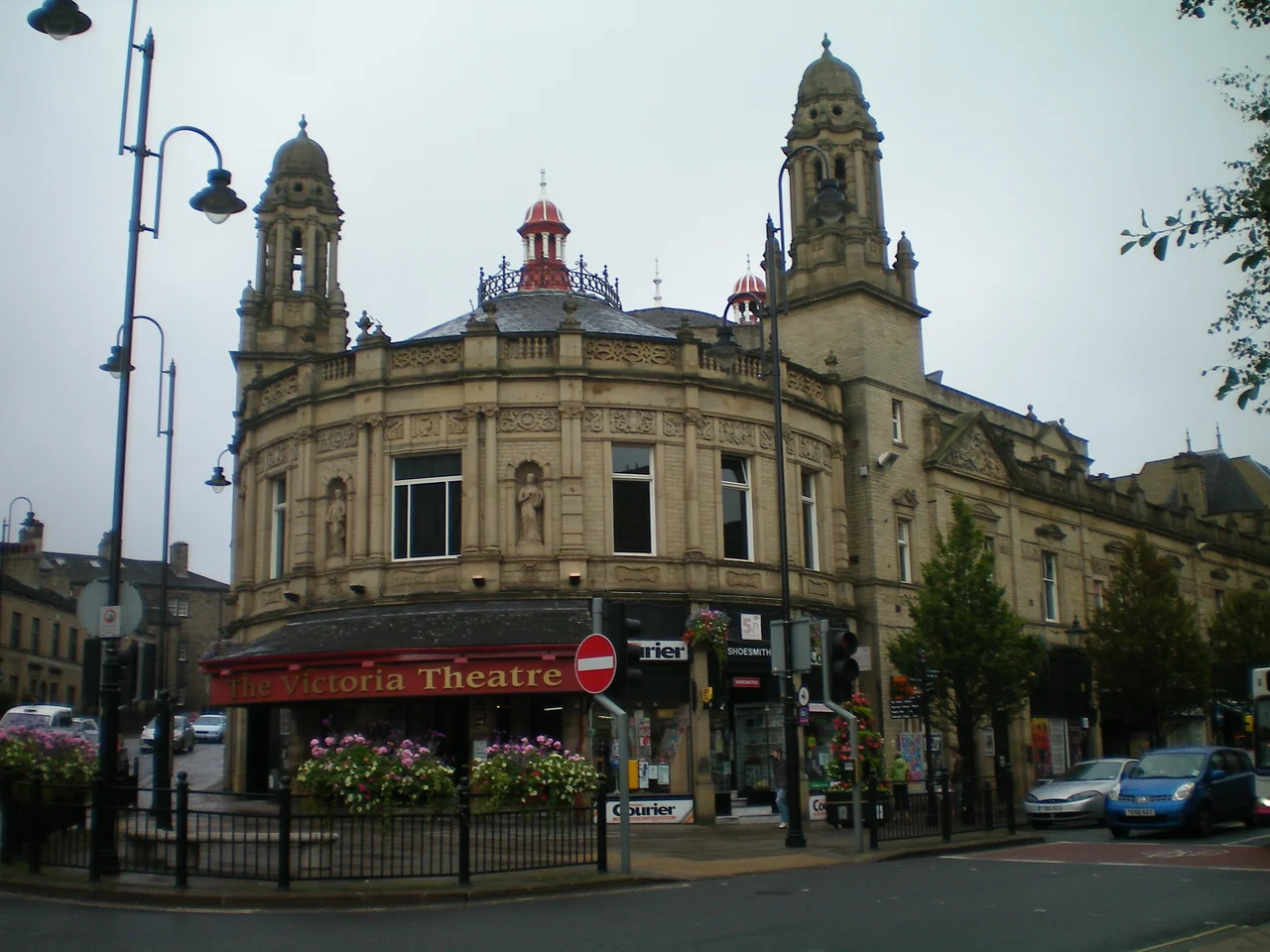

Victoria Theatre, Halifax
On 14 April 2012, the cast of the Halifax Amateur Operatic Society stood on the stage of the Victoria Theatre and began their final performance of Titanic at 11.40 p.m. exactly. One hundred years to the minute earlier, the ship they were singing about had struck an iceberg in the North Atlantic. The audience that night in Halifax included relatives of crew members who had sailed from West Yorkshire to their deaths. The theatre had hosted The Beatles, The Jackson 5 and Morrissey on its stage, but this was a different kind of moment. The Victoria has always been good at moments.
Built for Edwardian Halifax
The building opened on 8 February 1901 as the Victoria Hall, designed for a town then at the height of its industrial prosperity. Halifax had grown rich on wool, machine tools and Crossley carpets, and it wanted a concert hall to match. The civic pipe organ was given the same year by Elizabeth Porter in memory of her brother Samuel, a Halifax philanthropist who had died in 1899. For sixty years the hall played host to choral societies, civic events and the slow rhythms of provincial musical life. In 1960, Halifax Borough Council bought the building and reinvented it as a dual-purpose theatre and concert venue. It became The New Victoria. The name changed again in 1973, to The Civic Theatre, and once more in 1993 to The Victoria Theatre, where the cycle finally settled.
The Bands That Came Through
Halifax sits on a railway line, and railway lines bring touring bands. The Beatles played the Victoria. So did The Jackson 5. Kasabian, The Human League and Steve Harley have all stood under the proscenium arch. In 2005 Steve Harley opened his Quality of Mercy tour here, the first album in 29 years credited to Steve Harley and Cockney Rebel. In 2006 Embrace sold out the venue in four hours after the success of their World Cup anthem, and Morrissey sold his show even faster. Ian Brown brought a Stone Roses crowd to the Victoria in 2007. In 2017 Westlife's lead vocalist Shane Filan played the venue as a solo act. The bookings reflect a venue confident enough to chase rock acts that other regional theatres would not consider, and small enough that audiences feel close to whoever is on stage.
The Pantomime
Every Christmas the Victoria stages a pantomime, produced since the 2000s by Coventry-based Imagine Theatre and written by the creative team behind The Tweenies. Snow White, Peter Pan, Cinderella, Sleeping Beauty, Aladdin, Beauty and the Beast. From 2009 to 2019 the Halifax actor Neil Hurst headlined for ten consecutive years, almost a thousand performances, before stepping aside. In November 2019 the theatre announced it would ban plastic toys from its pantomimes, citing both single-use waste and distractions to the performers caused by light-up gadgets in the dark. The pantomime is the kind of thing that does not make national news but matters intensely locally: children growing up in Calderdale measure their childhoods by which pantomime they remember best.
Renovations and a Civic Argument
Calderdale Council has invested steadily in the building over the past two decades. New toilets, cloakrooms, rewiring, a VIP suite. The stalls were refitted at a cost of £335,000. In 2007 the theatre manager Tim Fagan was talking about restoring the venue to host the Royal Shakespeare Company and the National Theatre. The building has been Grade II listed by English Heritage since the 1990s. Then in 2022 a professional consultant's report found that the civic pipe organ, given by Elizabeth Porter in 1901, needed renovation. The theatre management floated a proposal to remove the organ altogether, on the grounds that the venue had moved away from classical concerts. A campaign began to save it, arguing that an instrument given to the people of Halifax could not simply be sold off. The controversy continues. The organ remains.
From the Air
Located at 53.721 N, 1.862 W in central Halifax, West Yorkshire. The building is a stone-fronted Grade II listed Edwardian structure at the heart of the town centre, visible from the air alongside Halifax Town Hall and Piece Hall. Best viewed from 2,000-3,500 ft AGL. Nearest airports are Leeds Bradford (EGNM) about 13 nm northeast and Manchester (EGCC) 25 nm southwest. The Calder Valley runs north-south through the area and can hold low cloud in winter. Shibden Hall lies 1 nm east.
Nearby Stories
- Ribston Hall 1.5 km away
- Bolton Priory 3.5 km away
- Clifton Park and Museum 4 km away
- Blackburn 5 km away
- Nostell Priory 5.5 km away
- Mellor Mill 9.4 km away
- Warrington bombings 10 km away
- Ashton Memorial 23 km away